
“Businesses across Italy are increasingly exploring digital solutions to improve operational efficiency, strengthen customer relationships, and create more connected business processes. From manufacturing companies and fashion brands to retail businesses, healthcare providers, and professional service organisations, technology is becoming an important part of everyday operations. A well-designed web application can help businesses manage information, automate repetitive activities, and provide employees and customers with convenient access to essential services. Custom web application development for Italian companies offers an opportunity to build software around specific business requirements rather than adapting every process to a generic application. These solutions can include customer relationship management systems, employee portals, inventory management platforms, booking applications, reporting dashboards, and enterprise workflow tools. By combining appropriate technologies with a clear understanding of business objectives, companies can create digital systems that support their current needs while remaining flexible enough to accommodate future growth. As Italy continues to advance its digital transformation, businesses are looking for practical ways to connect their operations and improve their use of technology. The European Commission's Digital Decade reporting highlights ongoing progress in business digitalisation alongside opportunities to strengthen the adoption of advanced technologies. For Italian organisations, this creates a relevant reason to assess how custom web applications can support productivity, service delivery, and long-term competitiveness.”
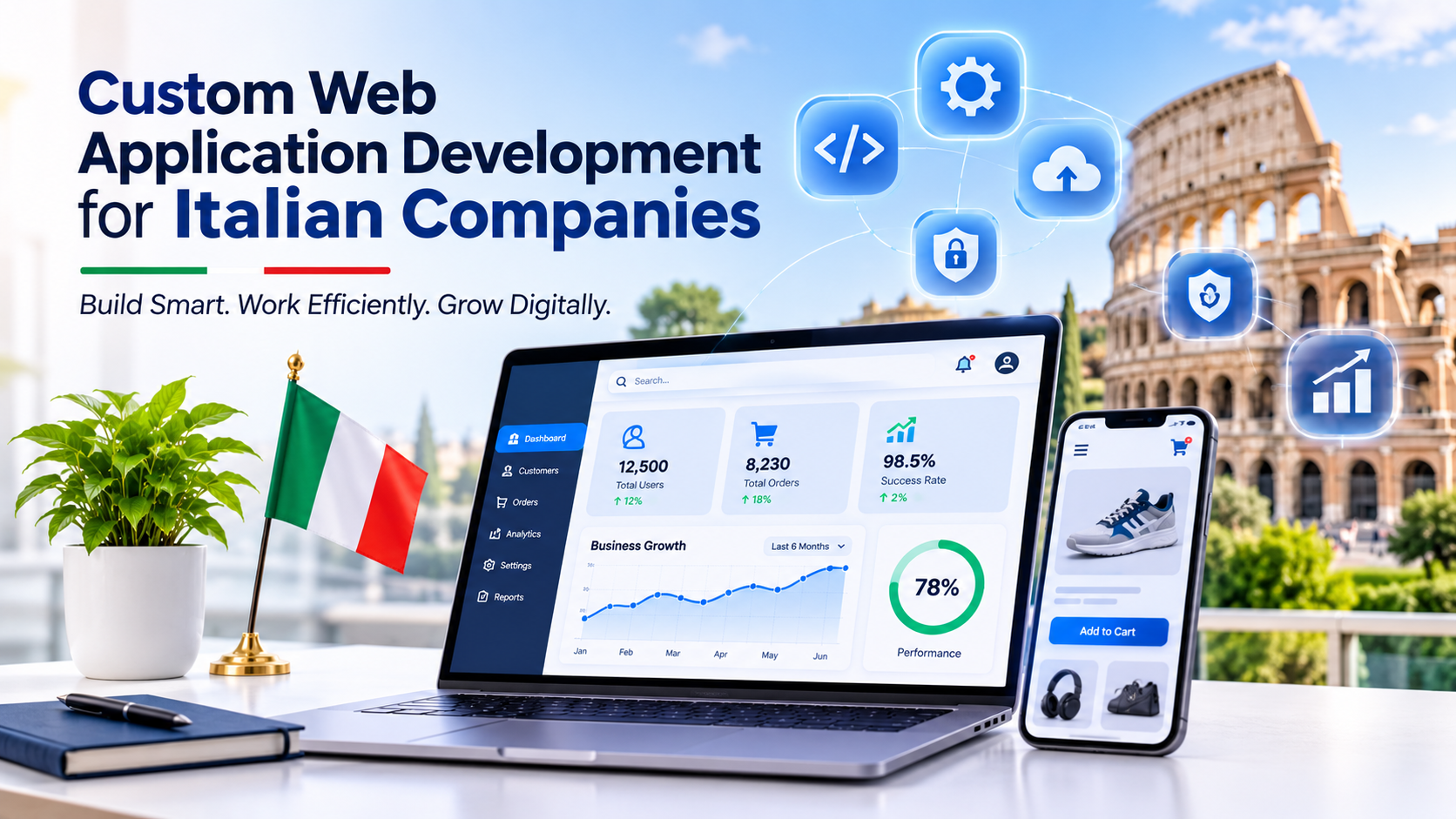
Businesses across Italy are increasingly exploring digital solutions to improve operational efficiency, strengthen customer relationships, and create more connected business processes. From manufacturing companies and fashion brands to retail businesses, healthcare providers, and professional service organisations, technology is becoming an important part of everyday operations. A well-designed web application can help businesses manage information, automate repetitive activities, and provide employees and customers with convenient access to essential services. Custom web application development for Italian companies offers an opportunity to build software around specific business requirements rather than adapting every process to a generic application. These solutions can include customer relationship management systems, employee portals, inventory management platforms, booking applications, reporting dashboards, and enterprise workflow tools. By combining appropriate technologies with a clear understanding of business objectives, companies can create digital systems that support their current needs while remaining flexible enough to accommodate future growth. As Italy continues to advance its digital transformation, businesses are looking for practical ways to connect their operations and improve their use of technology. The European Commission's Digital Decade reporting highlights ongoing progress in business digitalisation alongside opportunities to strengthen the adoption of advanced technologies. For Italian organisations, this creates a relevant reason to assess how custom web applications can support productivity, service delivery, and long-term competitiveness.
What Is Custom Web Application Development?
Custom web application development is the process of designing, building, testing, and maintaining browser-based software tailored to an organisation's requirements. Unlike a conventional informational website, a web application allows users to perform specific tasks, interact with business data, manage accounts, submit requests, and complete workflows through a functional interface. For example, a manufacturing business in Italy might require an application to monitor production activities, manage stock, and coordinate orders. A retail company might need a central dashboard for products, customers, and sales, while a professional services firm could benefit from a client portal that simplifies document sharing, appointments, and project updates. The main advantage of custom development is flexibility. Features, permissions, integrations, and workflows can be designed around the way the business operates. When the application is planned carefully, the result can be a more consistent digital experience for employees, customers, and business partners.
Why Italian Companies Need Custom Web Applications in 2027
Italian businesses operate across a diverse range of industries, each with its own operational requirements and customer expectations. Standard software may provide useful starting functionality, but it does not always accommodate specialised workflows, legacy systems, or unique business models. A custom web application can bring disconnected processes into a more organised digital environment. Employees may be able to access shared information, managers can review operational performance, and customers can interact with services through a central platform. This can reduce unnecessary manual work and improve the consistency of business information. Digital transformation should also be considered in practical terms. Rather than introducing technology simply because it is new, businesses should identify recurring operational challenges and determine which processes would benefit most from automation, integration, or improved access to information. For companies planning their digital strategy for 2027, custom web application development can provide a structured approach to addressing these challenges while preparing for changing customer expectations and future business requirements.
Key Benefits of Custom Web Application Development
Improved Business Process Automation
Many organisations still depend on spreadsheets, email conversations, and repetitive administrative tasks to manage everyday operations. These methods may work initially, but they can become difficult to maintain as transaction volumes, employee numbers, and operational complexity increase. Custom web applications can automate selected workflows, including enquiry management, approval requests, appointment scheduling, invoice tracking, stock updates, and reporting. When these processes are implemented correctly, employees can spend less time on repetitive administration and more time on activities that require professional judgement. Automation should be designed around clearly defined processes, with appropriate checks and human approval where necessary. This helps businesses improve consistency without introducing unnecessary complexity.
Centralised Business Information
When information is distributed across multiple files, systems, and departments, employees may struggle to find accurate and current records. A custom business web application can provide a central interface for accessing relevant information, depending on each user's permissions. A shared dashboard might display customer enquiries, pending tasks, project updates, stock availability, and recent transactions. Centralisation can improve coordination between departments and help managers make decisions using more consistent information. The application should also include suitable validation, access controls, backup procedures, and data-retention practices to maintain information quality and protect business records.
Better Customer Experience
Customer-facing web applications can simplify interactions by allowing users to access services whenever they need them. Depending on the business model, customers may be able to request quotations, book appointments, check order progress, download documents, submit support requests, or manage their accounts. A well-designed interface should make these activities straightforward, with clear navigation, useful instructions, accessible forms, and informative confirmation messages. For Italian companies serving international customers, multilingual support may also be important. A carefully localised interface can help businesses present their services more clearly to customers in different markets.
Flexible and Scalable Business Operations
Business requirements rarely remain unchanged. A growing company may need additional users, new departments, more complex reporting, or integrations with external services. Custom web application development allows the architecture to be planned around anticipated requirements. Modular features, well-defined APIs, and suitable database structures can make it easier to introduce new capabilities without redesigning the entire platform. Scalability does not happen automatically. It depends on sound architecture, performance testing, infrastructure planning, and ongoing maintenance. Development teams should consider both current requirements and realistic future needs before selecting an approach.
Types of Custom Web Applications for Italian Businesses
Customer Relationship Management Applications
A custom CRM application can help businesses organise customer profiles, enquiries, sales opportunities, communications, and follow-up activities. Instead of maintaining separate records across departments, employees can work from a shared system with permissions appropriate to their roles. For B2B companies, consultancies, and service providers, CRM functionality can support more organised lead management, improve follow-up consistency, and make sales activity easier to monitor.
Enterprise Resource Planning and Management Systems
Businesses that manage several operational functions may benefit from a tailored management platform that connects selected processes. Depending on requirements, the application might include purchasing, inventory, sales orders, staff administration, reporting, or financial workflow integrations. A custom ERP-style application can be particularly useful when existing tools do not support the company's operational model. The project should begin with process mapping to identify which functions genuinely need to be integrated.
Inventory and Supply Chain Applications
Manufacturers, wholesalers, distributors, and retailers often need accurate visibility into stock movements, purchase orders, warehouse activity, and fulfilment status. A custom inventory application can help staff monitor available stock, record transactions, manage suppliers, and identify discrepancies. Integrations with accounting systems, barcode scanners, or logistics services may further improve operational coordination when those integrations are technically and commercially appropriate.
Booking and Appointment Management Applications
Businesses that depend on scheduled services can use web applications to manage appointments, availability, customer details, confirmations, and rescheduling. Examples include healthcare practices, consulting firms, training providers, hospitality businesses, and maintenance services. Automated notifications and clear booking interfaces can reduce administrative effort while helping customers manage their appointments more conveniently.
Customer and Employee Portals
A customer portal can provide secure access to orders, documents, support requests, and account information. An employee portal can centralise internal announcements, requests, policies, task assignments, and selected human resource workflows. Both types of applications should be designed with appropriate role-based permissions, intuitive navigation, and clear information structures. Their functionality should reflect the actual needs of the people using them.
Conclusion
Custom web application development for Italian companies offers a practical way to improve business workflows, connect operational systems, and create more effective digital services. From customer portals and inventory platforms to enterprise dashboards and intelligent automation, the right application can address specific challenges while supporting future business requirements. The most effective projects combine a clear business strategy with thoughtful design, suitable technology, reliable integrations, security, accessibility, and ongoing maintenance. Rather than adding complexity for its own sake, businesses should prioritise functionality that improves daily operations and delivers measurable value. As Italian organisations continue to develop their digital capabilities, custom web applications can provide a flexible foundation for more connected and efficient business processes. Seyfert Infotech can help businesses explore web development solutions aligned with their operational needs and long-term digital goals.
Build a smarter digital foundation for your business with custom web application development.
What is custom web application development?
Custom web application development involves building browser-based software around a business's specific requirements. It can include dashboards, customer portals, management systems, booking platforms, workflow tools, and integrations with existing business software.
Why should Italian companies invest in custom web application development?
Custom applications can help Italian companies organise business information, automate repetitive tasks, connect separate systems, and create more convenient digital experiences for employees and customers. The value depends on the business problem, implementation quality, and ongoing adoption.
What types of businesses can benefit from custom web applications?
Manufacturing companies, retailers, fashion brands, logistics providers, healthcare organisations, professional service firms, and many other businesses can benefit when a web application addresses a clearly identified operational need.