
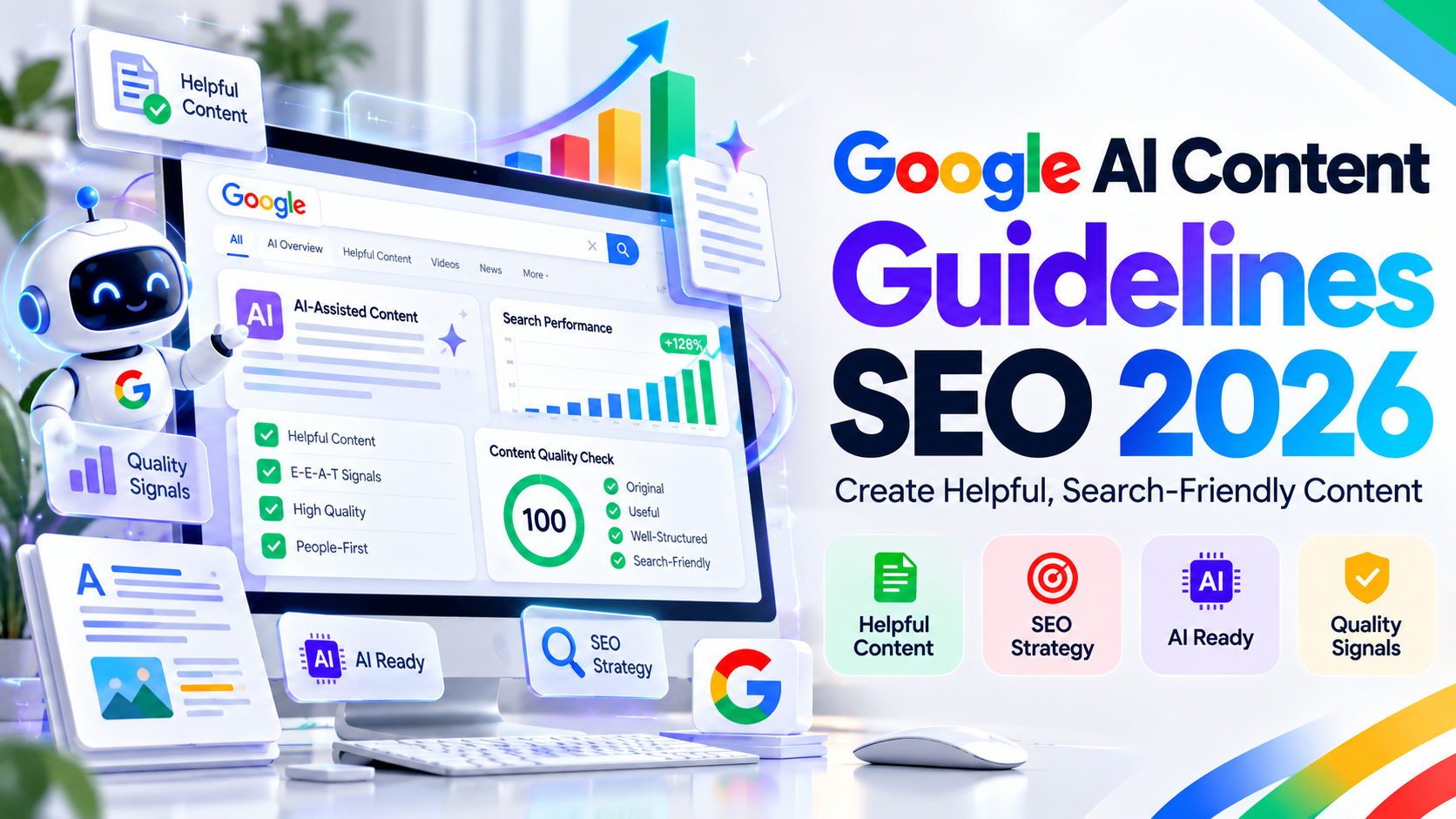
“Artificial intelligence has become an important part of modern content creation, but using AI does not automatically make content valuable or search-friendly. Google focuses on whether content provides useful, accurate, relevant, and original information that satisfies the needs of people visiting a website.”
Understanding Google's AI Content Guidelines for SEO
Artificial intelligence has become an important part of modern content creation, but using AI does not automatically make content valuable or search-friendly. Google focuses on whether content provides useful, accurate, relevant, and original information that satisfies the needs of people visiting a website.
Can AI-Generated Content Rank on Google in 2026?
AI-generated content can appear in Google Search when it meets Google's quality requirements. The important factor is not simply whether AI was used, but whether the resulting content is accurate, useful, original, relevant, and created to provide value to users rather than manipulate search rankings.
Businesses can use AI for research, outlining, brainstorming, editing, and content organization, but the final content should be reviewed carefully. Google specifically recommends focusing on accuracy, quality, and relevance when generative AI is used to create website content.
Create People-First Content Instead of Search-First Content
People-first content is created primarily to help a specific audience solve a problem, understand a topic, compare options, or make a decision. The content should have a clear purpose and provide enough useful information for visitors to achieve what they came to the website to accomplish.
Search-first content takes the opposite approach by creating pages mainly to attract search engine traffic. Google's guidance recommends evaluating whether content provides original information, useful analysis, substantial coverage, and a satisfying experience instead of producing pages simply because a keyword appears popular.
Add Original Information and Real Business Expertise
One of the biggest differences between valuable content and generic AI content is originality. Businesses should add information based on their own experience, projects, customer questions, processes, research, observations, case studies, and industry knowledge.
Simply rewriting information already available across other websites does not provide a strong reason for users to choose your page. Google encourages content that provides original information, research, analysis, or meaningful additional value rather than copying or lightly rewriting existing sources.
Fact-Check Every AI-Generated Content Before Publishing
Generative AI can produce incorrect information even when the writing appears confident and professional. Businesses should therefore verify statistics, dates, technical information, product details, company information, claims, names, and other important facts before publishing AI-assisted content.
Google specifically recommends manually reviewing AI-generated content for accuracy and trustworthiness before publication. This review should also cover metadata, structured data, page titles, meta descriptions, and image alternative text when AI has been used to create them.
Avoid Publishing Large Volumes of Low-Value AI Content
AI makes it possible to produce large amounts of content quickly, but publishing more pages does not automatically create better SEO performance. Hundreds of pages with similar information, weak originality, or little usefulness can make a website less valuable to visitors.
Businesses should prioritize quality over publishing volume. Each page should have a clear purpose, target a genuine user need, contain meaningful information, and provide enough value to justify its existence on the website.
Use AI as a Content Assistant Instead of a Replacement
AI can be useful throughout the content workflow. It can help with topic research, content outlines, keyword grouping, question discovery, editing, summarization, idea generation, and identifying areas that require further research.
Human expertise should remain responsible for the final quality of the content. A strong workflow combines AI assistance with human research, fact-checking, editing, industry experience, and original insights so the final page provides genuine value.
Optimize AI-Assisted Content Around Search Intent
Search intent explains what a person is trying to accomplish when entering a query. A user searching for “website development cost in India” may want pricing information, while someone searching for “website development company India” may be comparing service providers.
AI-assisted content should be written around the actual intent behind the search rather than repeating the target keyword throughout the page. Understanding the audience and providing the information they genuinely need creates a stronger foundation for SEO.
Create Detailed Content With Useful Topic Coverage
A strong article should cover the important aspects of its topic without adding unnecessary information simply to increase word count. Helpful sections can include explanations, examples, processes, comparisons, common mistakes, practical advice, and frequently asked questions.
Google's helpful-content guidance asks whether content provides a substantial and complete description of the topic, offers insightful information beyond the obvious, and provides meaningful value compared with other pages in search results.
Use Clear Headings and Structured Content
Clear content structure helps visitors quickly understand what a page covers. Relevant H2 and H3 headings can separate major topics and supporting questions while making long-form content easier to read and navigate.
Businesses should organize information logically rather than creating headings only to insert keywords. A well-structured page can contain a clear introduction, topic sections, supporting explanations, FAQs, internal links, and a relevant call-to-action.
Optimize AI Content for AEO and Answer Search
Answer Engine Optimization focuses on making useful information easy to understand for question-based searches and answer-oriented experiences. AI-assisted content can support AEO by identifying common questions and creating clear explanations that directly address them.
Question-based headings, concise answers, detailed explanations, FAQs, definitions, and practical examples can improve the usefulness of a page. However, businesses should avoid creating repetitive FAQ sections simply for search optimization and should only answer questions that are genuinely relevant.
Question-based headings, concise answers, detailed explanations, FAQs, definitions, and practical examples can improve the usefulness of a page. However, businesses should avoid creating repetitive FAQ sections simply for search optimization and should only answer questions that are genuinely relevant.
Prepare AI Content for GEO and Generative Search
Generative Engine Optimization is commonly used to describe strategies for improving visibility within AI-generated search experiences. Businesses can prepare their websites by publishing authoritative information, maintaining consistent business details, demonstrating expertise, and creating comprehensive resources around important topics.
GEO should complement traditional SEO rather than replace it. Google's current guidance emphasizes that established SEO practices continue to matter for generative AI features in Search, so businesses should focus on crawlability, indexing, useful content, internal linking, and strong page experience.
Maintain Strong Technical SEO for AI Content
Even high-quality content needs a technically accessible website. Search engines need to discover, crawl, process, and index website pages before those pages can become candidates for search visibility.
Businesses should maintain clean URL structures, appropriate internal linking, XML sitemaps, mobile responsiveness, HTTPS, crawlable content, proper redirects, and reliable website performance. AI content strategies should therefore be built on top of a technically healthy website.
Use Structured Data Accurately on AI-Assisted Pages
Structured data can help search engines understand specific information about a webpage. Depending on the website, relevant structured data can describe supported content such as articles, products, organizations, breadcrumbs, and other eligible search features.
AI-assisted websites should carefully validate structured data because automatically generated markup can contain incorrect information. Google recommends ensuring that structured data follows its general and feature-specific guidelines and that the markup accurately represents the page content.
Add Author and Business Expertise Information
Trust becomes more important when publishing informational content. Businesses can provide context through accurate author information, professional experience, company details, credentials where relevant, and explanations of how information was created or reviewed.
Google's people-first guidance encourages clear authorship where appropriate and warns against fabricated author profiles, false credentials, or deceptive identities created to make content appear more trustworthy.
Disclose AI Use When It Provides Useful Context
Not every page requires a prominent AI disclosure simply because an AI tool was used somewhere in the workflow. However, explaining how automation or AI contributed to creating substantial content can provide useful context when readers would reasonably want to understand how the content was produced.
Google recommends considering information about how content was created when it would help users understand the role of automation. The goal is to provide meaningful context rather than adding an unnecessary label to every page.
Keep AI Content Updated and Factually Accurate
AI-assisted content can become outdated as technologies, products, regulations, search features, prices, and business information change. Publishing an article once and leaving it untouched for years can reduce its usefulness even if the original content was accurate.
Businesses should periodically review important pages and update outdated information, examples, statistics, links, screenshots, service details, and recommendations. Content maintenance is particularly important for topics involving rapidly changing technology and search engine developments.
Avoid Keyword Stuffing in AI-Generated Content
AI tools can easily be instructed to repeat keywords throughout an article, but excessive repetition makes content unnatural and difficult to read. Search optimization should focus on covering the topic comprehensively rather than inserting the same phrase into every paragraph.
Relevant keywords and related terminology should appear naturally where they help explain the subject. A well-written article can cover SEO, AEO, GEO, AI search, technical SEO, content optimization, and related concepts without forcing identical keyword variations into every section.
Build Content Around Real Customer Questions
Customer questions are valuable sources of content ideas because they represent genuine information needs. Businesses can identify questions from sales conversations, support requests, enquiries, search queries, reviews, forums, and frequently discussed problems within their industry.
Turning these questions into useful articles, service-page sections, guides, and FAQs creates content with a clear purpose. AI can help organize these questions, but the business should add its own knowledge and practical answers.
Create Helpful Content Instead of Chasing AI Search Rankings
Trying to engineer every sentence specifically for an AI search system can distract businesses from the fundamentals of good content. The stronger approach is to create information that is genuinely useful, accurate, original, clearly structured, and easy for people to understand.
Google's current guidance emphasizes that there is no special shortcut that guarantees visibility in AI-powered Search. Strong SEO fundamentals and valuable content remain important, while AI-specific optimization should support rather than replace those foundations.
Monitor AI Content Quality After Publication
Publishing content should be followed by measurement and review. Businesses can monitor organic impressions, clicks, search queries, landing-page performance, conversions, indexing, and engagement to understand whether their content is attracting the right audience.
Performance data should guide improvements rather than encouraging businesses to publish content simply because a page receives impressions. The objective is to attract relevant visitors and provide a satisfying experience that supports the website's broader business purpose.
Follow Google's People-First SEO Approach in 2026
The safest long-term approach to AI content is straightforward: use AI where it genuinely improves the workflow, but keep human judgment responsible for accuracy, originality, relevance, and usefulness. AI should help businesses produce better information rather than simply more information.
Google's current documentation continues to emphasize people-first content and warns against content created primarily to manipulate rankings. Businesses that combine AI assistance with real expertise, careful review, technical SEO, and genuine customer value can build a stronger foundation for search visibility in 2026.
Use AI to Improve Your Content Workflow — Not to Replace Original Value
AI can make content research and production faster, but sustainable SEO depends on what the final content provides to users. Accuracy, originality, expertise, search intent, technical quality, and genuine usefulness should remain the foundation of every AI-assisted website content strategy.
Frequently Asked Questions About AI Content and SEO
Can AI-generated content rank on Google?
Yes. Google does not automatically reject content simply because generative AI was used. The important considerations are whether the content is useful, accurate, relevant, original, and created in accordance with Google's Search Essentials and spam policies.
Does Google penalize websites for using AI content?
Using AI itself is not the core issue. Google warns against using generative AI or other automation to produce many pages without adding value, particularly when the purpose is to manipulate search rankings.
How can AI content be made SEO-friendly?
AI-assisted content should be fact-checked, edited by humans, aligned with search intent, enriched with original information, structured clearly, supported by relevant internal links, and optimized for users rather than created primarily to manipulate rankings.
Should AI-generated content be disclosed?
Disclosure can be useful when readers would reasonably want to understand how substantial content was produced. Google recommends considering information about the content creation process when it provides useful context for the audience.
Is AEO or GEO required for Google AI Search?
There is no separate technical requirement that guarantees appearance in Google's AI search features. Businesses should continue following established SEO fundamentals while creating useful, clear, original, and well-structured content.