
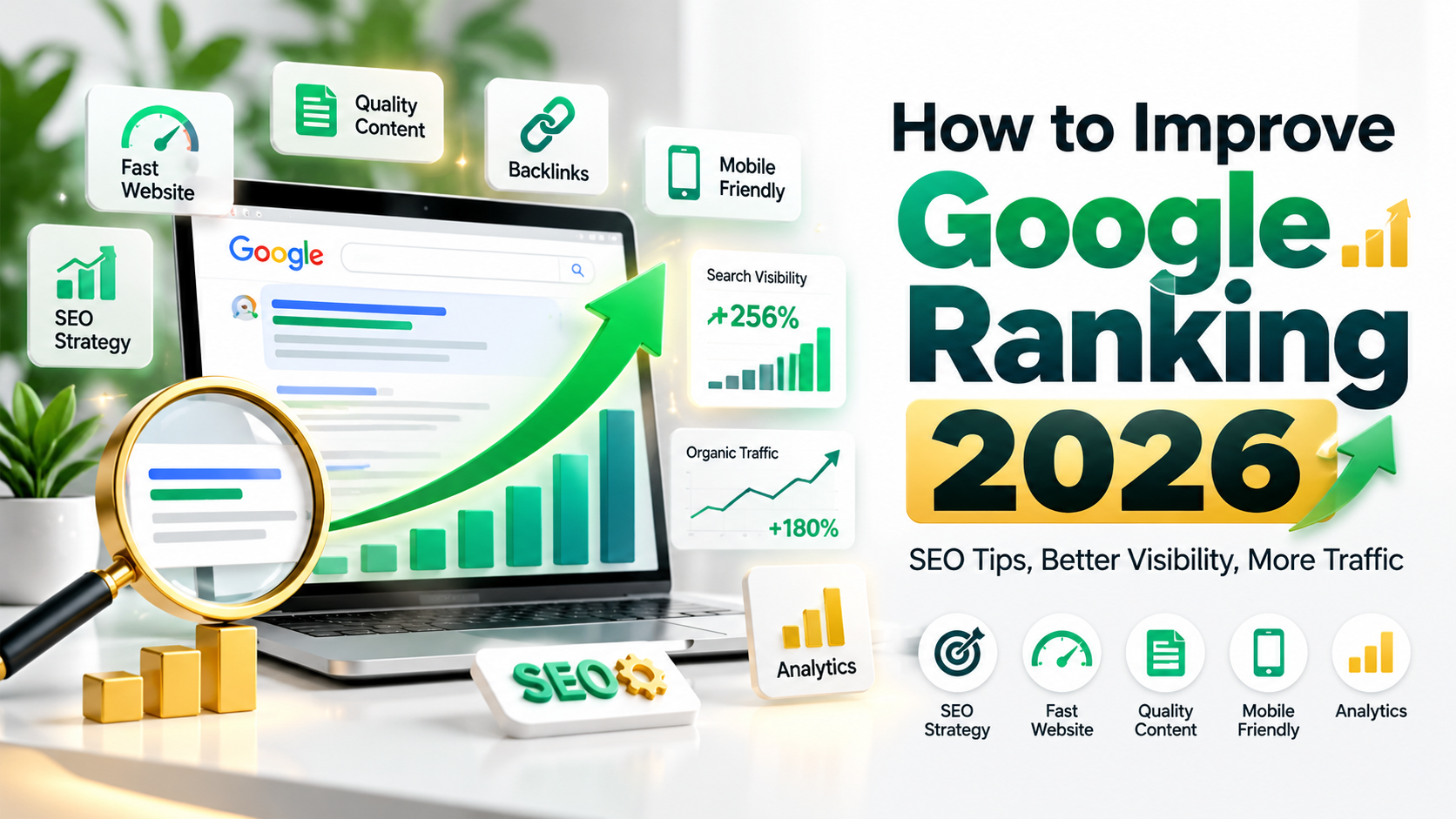
“Improving Google rankings in 2026 requires more than adding keywords to website pages. Search systems increasingly evaluate whether content is useful, relevant, technically accessible, trustworthy, and aligned with what users are actually trying to accomplish.”
How Google Ranking Works in 2026
Improving Google rankings in 2026 requires more than adding keywords to website pages. Search systems increasingly evaluate whether content is useful, relevant, technically accessible, trustworthy, and aligned with what users are actually trying to accomplish.
Google's current guidance for AI-powered search continues to emphasize established SEO fundamentals such as crawlability, indexing, helpful content, internal linking, and good page experience. AI search expands how information is presented, but it does not remove the need for a technically strong website.
Start With Search Intent Instead of Keywords
Keyword research remains useful, but businesses should first understand why someone is searching for a particular phrase. A person searching for website development services may be comparing companies, checking prices, researching technologies, or looking for a local provider.
Creating content around the actual search intent produces more useful pages than repeatedly inserting the same keyword. Each important page should answer the main question clearly while providing enough supporting information to help visitors make their next decision.
Create Helpful and Original Content
High-quality content should provide information that customers cannot easily get from dozens of generic websites. Businesses can strengthen their content by including original explanations, practical experience, examples, case studies, processes, comparisons, and answers to genuine customer questions.
Google's guidance for generative AI search also emphasizes unique and valuable content rather than commodity information. Using AI tools to assist with content does not remove the need for originality, accuracy, relevance, and genuine value for readers.
Improve Your Website Technical SEO
Technical SEO creates the foundation that allows search engines to discover, crawl, understand, and index website pages. Important areas include crawlability, indexation, XML sitemaps, canonical URLs, redirects, HTTPS, clean URL structures, mobile compatibility, and proper website architecture.
Technical problems can prevent even strong content from performing well. Regular technical audits can identify broken links, indexing problems, duplicate pages, incorrect redirects, slow resources, and other issues that may affect the website's search visibility.
Improve Website Speed and Core Web Vitals
Website performance affects how visitors experience a website. Large images, unnecessary JavaScript, excessive third-party scripts, poor hosting, and inefficient code can increase loading times and make pages difficult to use.
Businesses should optimize images, reduce unnecessary resources, use effective caching, improve server response times, and monitor important performance metrics. A faster website provides a better experience and supports the broader page-experience foundation of modern SEO.
Make Your Website Mobile Friendly
A large share of online searches takes place on smartphones, so websites need to work properly across different mobile screen sizes. Navigation, buttons, forms, images, headings, and important information should remain easy to use without excessive scrolling or zooming.
Responsive design should be tested across smartphones, tablets, laptops, and desktop screens. Mobile optimization should be treated as part of the core website development process rather than as a final adjustment after the website is launched.
Build Strong Internal Linking Structure
Internal links connect related pages within a website and help users discover additional information. They also provide search engines with useful context about the relationship between different pages and topics.
Businesses can create topic hubs by linking detailed service pages, supporting blogs, FAQs, guides, and related resources. Relevant descriptive anchor text helps users understand what they can expect when they follow a link.
Build Topical Authority With Content Clusters
One article rarely demonstrates complete expertise about a broad subject. Businesses can build topical depth by creating a central page supported by related content covering questions, problems, comparisons, processes, and specific subtopics.
For example, a website development company could create connected content around website development, website cost, SEO-friendly development, mobile development, website maintenance, AI-ready websites, AEO, GEO, and website security. Internal links can connect these resources into a clear topic ecosystem.
Optimize Content for AEO and AI Search
Search is increasingly providing direct answers through AI-powered experiences. Answer Engine Optimization focuses on creating content that clearly addresses questions and provides useful explanations that can be understood quickly.
Businesses can improve AEO readiness by using clear question-based headings, concise answers, detailed explanations, FAQs, structured content, and accurate business information. These practices support users while making important information easier for search systems to interpret.
Use GEO to Prepare for Generative Search
Generative Engine Optimization is commonly used to describe strategies for improving visibility within AI-generated search experiences. The practical foundation remains strong SEO combined with useful content, clear entities, topical depth, and trustworthy information.
Businesses should not rely on shortcuts or special AI tricks. Google's guidance indicates that existing SEO fundamentals remain important for AI Overviews and AI Mode, so GEO should complement rather than replace traditional optimization.
Create Clear and Structured Website Content
Well-structured content is easier for visitors to scan and understand. Important pages should use descriptive headings, focused paragraphs, relevant subheadings, useful examples, FAQs, and supporting information instead of presenting large blocks of unorganized text.
Each section should communicate one clear idea and provide enough context to stand on its own. This structure improves readability while making important information easier for search systems to identify and interpret.
Optimize Title Tags and Meta Descriptions
Every important page should have a descriptive title that accurately communicates its topic. Titles should reflect search intent naturally rather than being overloaded with repeated keywords.
Meta descriptions should summarize the page clearly and encourage relevant users to visit. They should accurately represent the content instead of making exaggerated claims or using unrelated keywords simply to attract clicks.
Improve Local SEO for Better Google Visibility
Businesses serving specific cities or regions should strengthen their local search presence. Location-focused service pages, accurate contact information, consistent business details, customer reviews, and a properly maintained Google Business Profile can support local discovery.
Local SEO should focus on genuine service areas rather than creating large numbers of nearly identical location pages. Each location page should provide useful information that is genuinely relevant to customers in that area.
Build Trust and Website Authority
Search visibility is stronger when a website demonstrates genuine expertise and credibility. Businesses can strengthen trust through detailed author information, company experience, case studies, customer reviews, original research, industry knowledge, and transparent business information.
Authority is developed over time rather than through one optimization technique. Publishing useful resources, earning relevant mentions, maintaining accurate information, and creating content based on real expertise can contribute to a stronger overall digital presence.
Earn Relevant and High-Quality Backlinks
Relevant links from credible websites can help search engines discover content and understand its importance within a broader web ecosystem. Businesses can earn links by publishing useful research, original resources, industry guides, case studies, and information that other websites genuinely want to reference.
The focus should be on relevance and quality rather than collecting a large number of low-quality links. Artificial link-building schemes and unrelated backlinks can create unnecessary risks and do not provide the same value as genuine editorial references.
Keep Existing Content Fresh and Accurate
Search optimization is not a one-time activity. Businesses should periodically review important pages to identify outdated information, broken links, old statistics, expired offers, incorrect contact details, and content that no longer matches customer expectations.
Updating content should improve its usefulness rather than simply changing dates or adding new keywords. Meaningful improvements can include new examples, updated information, clearer explanations, additional FAQs, improved internal links, and better supporting resources.
Track Google Search Performance Regularly
Businesses should use analytics and search performance tools to understand how their website is performing. Important measurements can include impressions, clicks, search queries, landing-page performance, conversions, indexed pages, and changes in organic traffic.
Google has also expanded reporting around visibility from generative AI experiences, giving website owners additional information about how their content performs across evolving search surfaces. This makes regular performance monitoring increasingly useful for SEO planning.
Avoid Common Google Ranking Mistakes
Common SEO problems include keyword stuffing, publishing thin content, creating duplicate pages, ignoring mobile performance, using misleading titles, buying low-quality links, neglecting technical errors, and producing large amounts of generic content without adding value.
A sustainable SEO strategy focuses on users first. Businesses should solve customer problems, provide accurate information, maintain technical quality, and continuously improve important pages instead of chasing every new ranking shortcut.
Create a Complete SEO Strategy for 2026
Improving Google rankings in 2026 requires several connected activities rather than one isolated technique. Technical SEO creates accessibility, useful content satisfies search intent, internal linking builds context, authority supports credibility, and performance improvements create a better user experience.
Businesses should also prepare for AI-powered search by strengthening AEO and GEO readiness without abandoning traditional SEO. The most effective strategy is to build a website that is useful to people, understandable to search engines, and capable of supporting changing search experiences.
Improve Rankings by Improving the Website Experience
Google ranking success in 2026 is not about finding one secret SEO technique. It is about creating a technically strong website, publishing genuinely useful content, satisfying search intent, building authority, improving performance, and continuously adapting to how people search.
Frequently Asked Questions About Google Ranking in 2026
How can I improve my Google ranking in 2026?
Start with technical SEO, useful and original content, search-intent optimization, mobile responsiveness, website speed, internal linking, local SEO, authority building, and regular performance monitoring. For AI-powered search, strengthen content clarity and AEO and GEO readiness while maintaining traditional SEO fundamentals.
Does SEO still work in 2026?
Yes. SEO remains important because AI-powered Google search experiences continue to rely on information from Google's Search systems. Google recommends maintaining established SEO fundamentals such as crawlability, indexing, useful content, internal linking, and good page experience.
How long does it take to improve Google rankings?
There is no fixed timeline because ranking changes depend on competition, website history, technical condition, content quality, authority, search demand, and the scale of optimization work. SEO should be treated as an ongoing process rather than a guaranteed short-term result.
Are AEO and GEO important for Google SEO in 2026?
AEO and GEO can help businesses prepare content for answer-oriented and generative search experiences, but they should complement traditional SEO. Google's current guidance does not require a separate technical system or special markup specifically for AI Overviews.
Can small businesses rank higher on Google?
Yes. Small businesses can compete by focusing on specific customer needs, local search intent, useful niche content, strong service pages, technical SEO, genuine expertise, and consistent business information. A smaller website can build meaningful visibility by becoming highly useful for a clearly defined audience.