
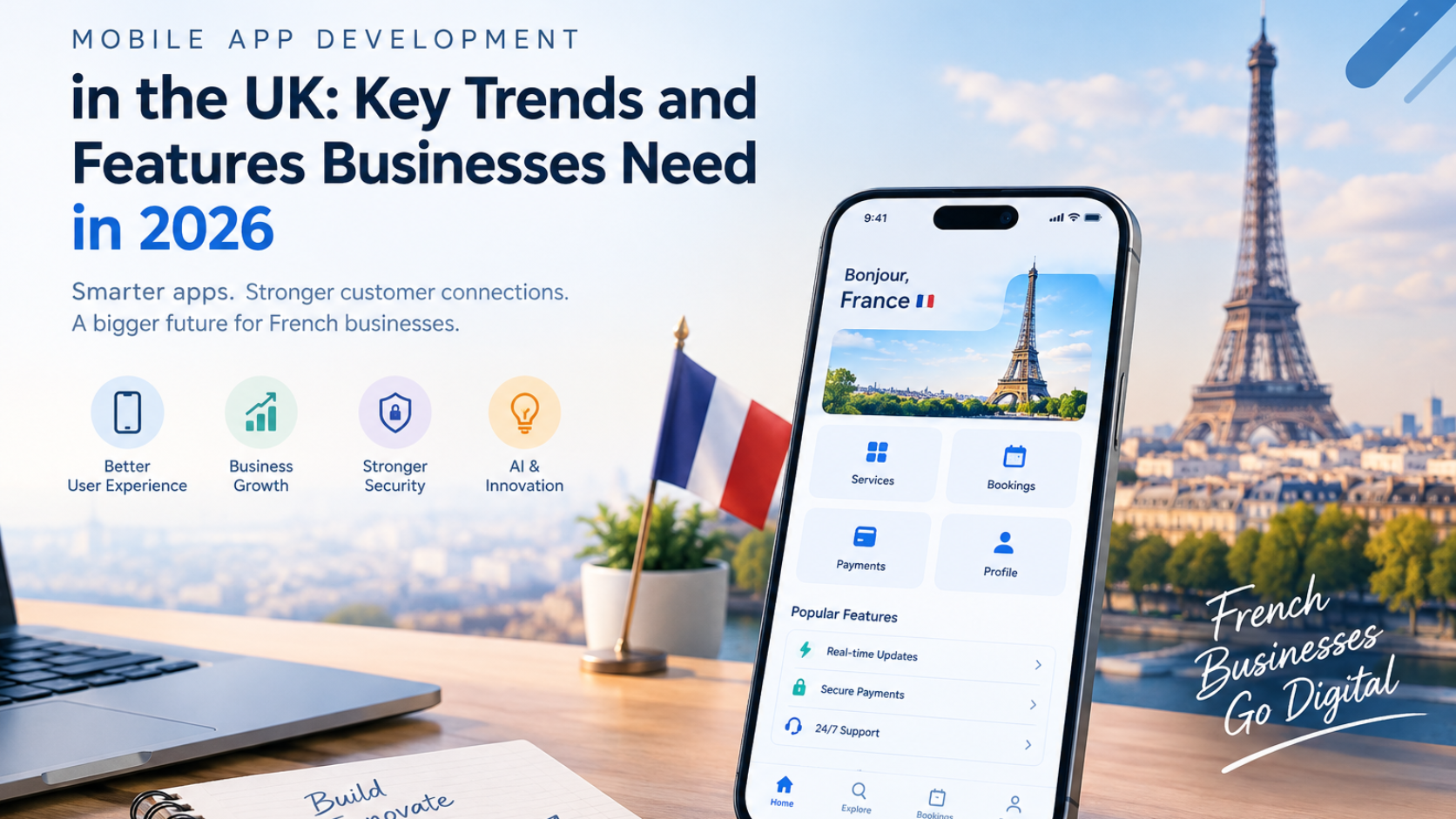
“Mobile applications have become an important part of how businesses connect with customers, deliver services and manage digital operations. For French businesses, a well-designed mobile application can provide a direct channel for customer engagement, ecommerce, bookings, payments, loyalty programmes, communication and personalised experiences. As customers increasingly expect convenient digital services, businesses need applications that are fast, secure, accessible and easy to use. Mobile app development in 2026 is also moving beyond basic applications. Businesses can now combine mobile experiences with artificial intelligence, cloud platforms, APIs, analytics and automation to create more intelligent digital products. The goal is not simply to build an app. It is to create a mobile experience that solves a real customer or business problem.”
Why Mobile App Development Matters for French Businesses in 2026
Mobile applications have become an important part of how businesses connect with customers, deliver services and manage digital operations. For French businesses, a well-designed mobile application can provide a direct channel for customer engagement, ecommerce, bookings, payments, loyalty programmes, communication and personalised experiences. As customers increasingly expect convenient digital services, businesses need applications that are fast, secure, accessible and easy to use. Mobile app development in 2026 is also moving beyond basic applications. Businesses can now combine mobile experiences with artificial intelligence, cloud platforms, APIs, analytics and automation to create more intelligent digital products. The goal is not simply to build an app. It is to create a mobile experience that solves a real customer or business problem.
What Is Mobile App Development?
Mobile app development is the process of planning, designing, developing, testing and maintaining applications for mobile devices such as smartphones and tablets. Depending on the business requirements, an application can be developed for iOS, Android or multiple platforms. A professional mobile app project can involve user experience design, frontend development, backend systems, APIs, databases, authentication, payment integration, notifications, analytics and ongoing maintenance. The technology selected should depend on the application's functionality, target audience, performance requirements, budget and long-term business objectives.
Why Should French Businesses Invest in a Mobile App?
A mobile application can create a more direct and convenient relationship between a business and its customers. Unlike a website, an application can provide device-specific capabilities such as push notifications, camera access, location services, biometric authentication and offline functionality. Businesses can use mobile apps for: • Customer engagement • Ecommerce • Online booking • Loyalty programmes • Digital payments • Customer support • Employee applications • Business management • Delivery tracking • Personalised experiences • Subscription services The right application strategy depends on the business model and the needs of its target customers.
Mobile App Development for Different French Industries
Mobile applications can support businesses across a wide range of industries in France. Retail and ecommerce businesses can use apps for product discovery, shopping, payments and loyalty. Hospitality businesses can support reservations, digital services and customer communication. Healthcare organisations can provide appropriate appointment, information and communication features. Logistics companies can use applications for shipment tracking, delivery management and operational workflows. Professional service businesses can use apps for bookings, customer communication and account management. Manufacturing and industrial organisations can develop internal applications for field teams, monitoring, reporting and operational processes. The application should always be designed around the specific requirements of the industry and its users.
Native vs Cross-Platform App Development
Businesses generally have two major approaches when developing mobile applications: native development and cross-platform development. Native applications are built specifically for a particular operating system such as iOS or Android. This approach can provide strong platform integration and performance. Cross-platform development allows businesses to build applications that can operate across multiple platforms using a shared development approach. The right choice depends on factors such as application complexity, performance requirements, platform-specific features, development resources and long-term maintenance. There is no single technology that is suitable for every mobile application.
AI-Powered Mobile Applications
Artificial intelligence is creating new possibilities for mobile applications. French businesses can explore AI-powered features such as intelligent search, virtual assistants, personalised recommendations, automated support, content generation, document processing and predictive insights. For example, an ecommerce application could use AI to improve product recommendations, while a customer service application could provide answers to frequently asked questions. However, AI should be implemented around a genuine business or customer requirement. The technology should improve the user experience rather than add unnecessary complexity to the application.
Mobile App UX and UI Design for French Users
User experience plays a major role in the success of a mobile application. An application should make important actions easy to understand and complete. Navigation, typography, buttons, forms, onboarding and visual hierarchy should be designed for mobile interaction. For applications targeting French customers, localisation is also important. Language, terminology, date formats, currency, payment preferences and communication style should be appropriate for the target audience. A localised experience can make the application feel more relevant and trustworthy.
Mobile Commerce and Ecommerce Apps in France
Mobile applications can provide ecommerce businesses with a direct shopping experience. Customers can browse products, search catalogues, save favourites, manage shopping carts, complete payments and track orders from their smartphones. Businesses can also use applications to provide loyalty rewards, personalised recommendations, promotional notifications and post-purchase communication. A successful ecommerce app should focus on reducing friction throughout the customer journey. From product discovery to checkout and delivery tracking, every step should be clear and easy to use.
Mobile App Security and Data Protection
Security should be considered from the beginning of mobile application development. Applications may process customer accounts, personal information, payment information, business data or other sensitive content. Important security considerations can include secure authentication, encrypted communication, protected APIs, access controls, secure storage, session management and regular security testing. Businesses operating in France and the European market should also understand the privacy and data protection requirements applicable to their specific application and business model. Security is not a final development step. It should be part of the complete application architecture.
Push Notifications and Customer Engagement
Push notifications can provide businesses with a direct communication channel on mobile devices. Depending on the application, notifications can be used for order updates, appointment reminders, new content, service updates, loyalty offers and important customer information. However, notifications should provide genuine value. Too many irrelevant notifications can negatively affect the user experience. Businesses should therefore consider customer preferences, timing, relevance and frequency when designing notification strategies.
APIs, Cloud Platforms and Backend Integration
A mobile application often requires a reliable backend system to manage data and business operations. APIs can connect the application with databases, payment systems, ecommerce platforms, CRM systems, booking platforms and other business tools. Cloud infrastructure can also support scalability, data management, monitoring and application performance. A well-planned backend architecture allows businesses to expand their application as new requirements emerge. The mobile interface is only one part of the complete digital ecosystem.
Mobile App Analytics and Personalisation
Analytics can help businesses understand how customers interact with their mobile application. Businesses can measure areas such as user journeys, feature engagement, conversions, retention and application performance. These insights can support continuous product improvement. Personalisation can also be used where appropriate to provide more relevant content, recommendations or experiences. Data-driven development allows businesses to make product decisions based on observed user behaviour rather than assumptions.
App Store Optimisation for French Businesses
Launching an application is only one part of a successful mobile strategy. Businesses also need to make their applications discoverable through relevant app stores. App Store Optimisation can involve application titles, descriptions, screenshots, icons, categories, reviews and other store information. For French audiences, store listings should use appropriate French-language content and communicate the application's key benefits clearly. The objective is to help potential users understand the application before they decide to install it.
How Much Does Mobile App Development Cost in France?
The cost of developing a mobile application in France depends on the complexity and requirements of the project. Factors that can influence development cost include: • Number of platforms • UI and UX complexity • Number of application screens • Backend development • API integrations • Payment systems • User authentication • AI features • Ecommerce functionality • Admin dashboards • Third-party integrations • Security requirements • Testing • Maintenance A simple business application and a complex ecommerce or enterprise application can require very different levels of development effort. Businesses should define their objectives and technical requirements before requesting development estimates.
Mobile App Development Process
A professional mobile application development process can include several stages. 1. Business and audience research 2. Requirement analysis 3. Feature planning 4. UX and UI design 5. Technology selection 6. Frontend development 7. Backend development 8. API integration 9. Testing 10. Security review 11. Performance optimisation 12. App Store and Google Play preparation 13. Launch 14. Analytics monitoring 15. Ongoing maintenance A structured process helps businesses reduce unnecessary development changes and maintain a clear direction throughout the project.
How to Choose a Mobile App Development Partner in France
Choosing a mobile app development partner requires more than comparing development costs. Businesses should evaluate the development team's technical experience, communication process, portfolio, understanding of business requirements and approach to long-term maintenance. It is also important to understand who will manage backend infrastructure, security updates, application releases and future improvements. A development partner should be able to explain technical decisions in terms of business outcomes and user requirements. Clear communication between the business and development team can help create a stronger final product.
Mobile App Trends French Businesses Should Watch in 2026
Mobile application development continues to evolve alongside changes in customer behaviour and technology. French businesses should pay attention to areas such as: • AI-powered experiences • Personalised applications • Cross-platform development • Mobile commerce • Digital payments • Cloud-native applications • Intelligent search • Conversational interfaces • Stronger application security • Accessibility • Business automation • Real-time data • Connected devices Businesses should not adopt every trend automatically. Technology decisions should be based on whether a feature creates measurable value for customers or the organisation.
How Seyfert Infotech Can Help French Businesses
Seyfert Infotech provides mobile app development, website development, digital marketing, business automation and custom software solutions for businesses looking to strengthen their digital presence. Our mobile app development approach can cover the complete development lifecycle, from planning and UX design to application development, backend integration, testing and ongoing improvements. Applications can be planned around business requirements such as ecommerce, customer engagement, booking, business operations, automation and digital services. For French and international businesses, the focus can be on creating mobile experiences that are scalable, secure, responsive and aligned with real business objectives.
Final Thoughts
Mobile app development for French businesses in 2026 is about creating useful digital products that solve real customer and business problems. A successful application combines intuitive UX, reliable technology, strong security, scalable infrastructure and meaningful functionality. Businesses can use mobile applications to improve customer engagement, ecommerce, communication, bookings, internal operations and digital services. Whether a business needs an iOS application, Android application, cross-platform solution or a complete mobile ecosystem, the development strategy should begin with clear objectives and user requirements. With the right technology, planning and ongoing optimisation, a mobile application can become an important part of a company's long-term digital strategy.
What is mobile app development?
Mobile app development is the process of designing, developing, testing and maintaining applications for smartphones and tablets. It can include frontend development, backend systems, APIs, databases, authentication and third-party integrations.
How much does mobile app development cost in France?
Mobile app development costs vary depending on the number of platforms, features, design complexity, backend requirements, integrations, security requirements and ongoing maintenance. A detailed project scope is normally required for an accurate estimate.
How long does it take to develop a mobile app?
Development time depends on the application's complexity, number of features, design requirements, backend systems, integrations, testing and approval process. A basic application generally requires less time than a complex ecommerce or enterprise application.