
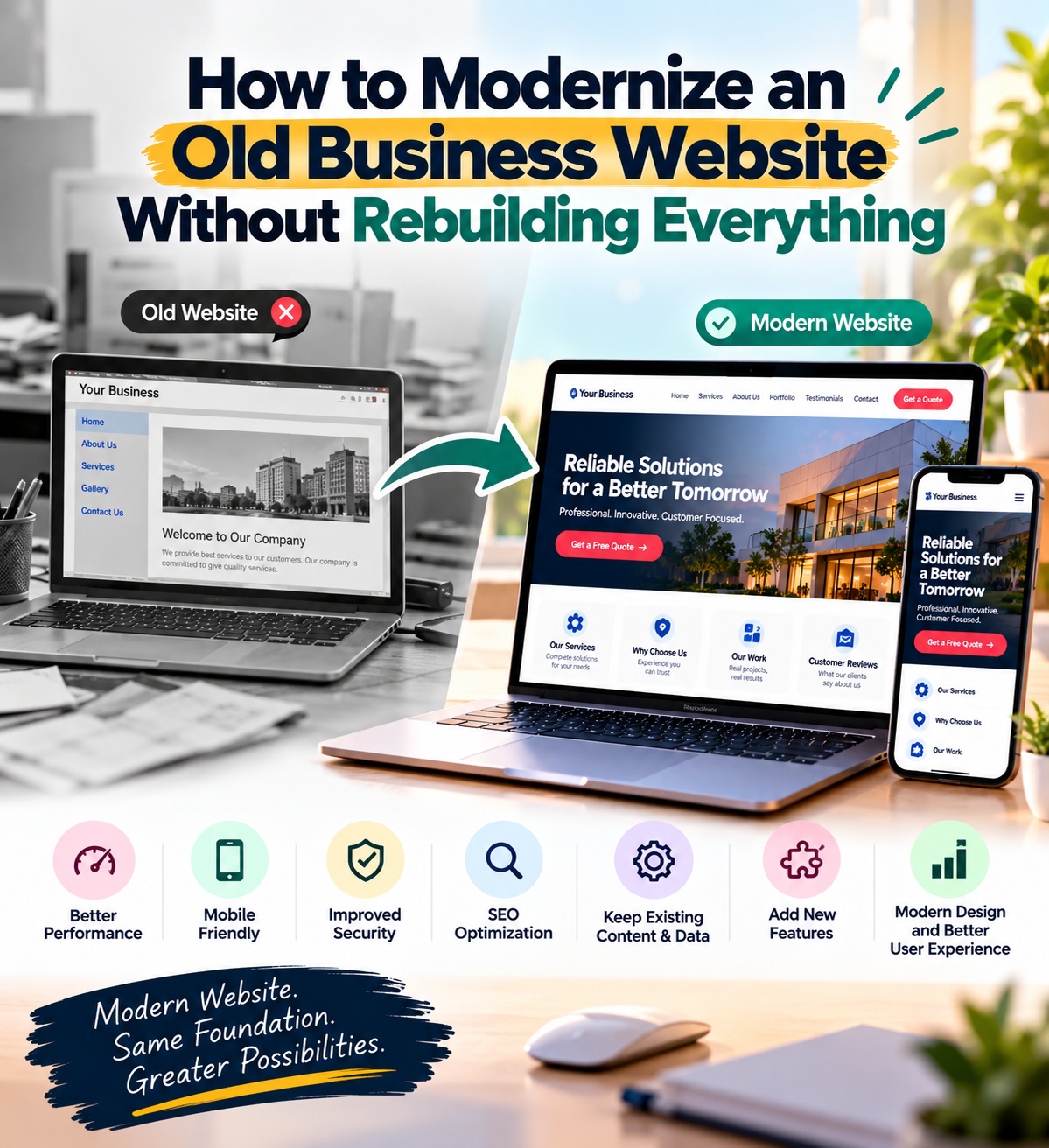
“Many businesses continue using websites that were developed several years ago. The website may still contain useful content, customer information, working features and search visibility, but the design may look outdated or the performance may no longer meet current expectations. In these situations, completely rebuilding the website is not always the best first step. A planned modernization process can improve the parts that need attention while preserving the elements that continue to provide value.”
Many businesses continue using websites that were developed several years ago. The website may still contain useful content, customer information, working features and search visibility, but the design may look outdated or the performance may no longer meet current expectations. In these situations, completely rebuilding the website is not always the best first step. A planned modernization process can improve the parts that need attention while preserving the elements that continue to provide value.
Start with a Website Audit
Before changing anything, businesses should understand what is already working and what needs improvement. A website audit can review design, mobile responsiveness, page speed, navigation, security, SEO structure, forms, integrations and technical issues. This helps the development team identify whether the problem is mainly visual, technical or related to content and usability. A proper audit can prevent unnecessary redevelopment and help prioritize the most important improvements.
Website modernization is not about changing everything. It is about improving what matters while preserving what already works.
Refresh the User Interface Without Replacing the Entire System
An outdated visual design can often be improved without rebuilding the complete backend. Colours, typography, spacing, buttons, banners, service sections and navigation can be redesigned while keeping useful existing functionality. This gives the website a more modern appearance without affecting systems that continue to work correctly. A UI refresh can also improve brand consistency and make the website easier for customers to understand.
Improve Mobile Responsiveness
Older websites may have been developed mainly for desktop screens. Today, customers expect websites to work smoothly on smartphones and tablets. Developers can improve responsive layouts, navigation menus, image sizing, form fields and button placement without replacing every part of the website. Better mobile usability can significantly improve the overall customer experience.
Optimize Website Speed
Slow performance is a common issue on older websites. Large images, outdated scripts, unnecessary plugins, unused code and poor caching can increase loading times. Modernization can include image optimization, code cleanup, caching improvements and removal of unnecessary resources. These changes can make the website feel significantly faster without requiring a complete rebuild.
Update Outdated Technologies Carefully
Older websites may depend on outdated frameworks, plugins, libraries or server configurations. Updating everything at the same time can create unexpected compatibility problems. A safer approach is to identify critical outdated components and upgrade them in stages. This allows developers to test each change and reduce the risk of breaking important functionality.
Improve Website Security
Website security requirements change over time. Older websites may have outdated login systems, weak form protection or unsupported software. Modernization can include HTTPS configuration, stronger authentication, updated software, secure user permissions, input validation and backup improvements. Security updates are especially important for websites that collect customer information or include admin panels.
Preserve Valuable SEO Pages and URLs
Businesses should be careful when modernizing websites that already receive search traffic. Popular pages, indexed URLs and useful content may have built visibility over several years. Unnecessary URL changes can affect existing search performance. When changes are required, proper redirects and SEO planning should be used to preserve as much existing value as possible.
Improve the Backend and Database Where Needed
Some website problems are caused by backend or database limitations rather than the visual design. Developers can review slow queries, outdated code, unnecessary database records and inefficient workflows. Improving these areas can increase stability and make future feature development easier. The goal should be to strengthen the existing system where practical instead of automatically replacing it.
Website Modernization at Seyfert Infotech
At Seyfert Infotech, website modernization can begin by understanding the existing system, identifying technical limitations and reviewing current business requirements. Depending on the project, improvements can include responsive redesign, performance optimization, security upgrades, SEO-friendly restructuring, UI/UX improvements, new integrations and custom functionality. The focus is on improving the parts that create the greatest value while preserving useful existing content, features and business data wherever practical. This helps businesses move toward a more modern digital experience without automatically rebuilding everything from the beginning.
Can an old website be modernized without rebuilding it completely?
Yes. Many websites can be improved through UI redesign, performance optimization, responsive development, security updates and new integrations while keeping useful existing functionality
What should be checked before modernizing a website?
Businesses should review design, mobile usability, performance, security, SEO, content, backend technology, database structure and existing integrations.
Will website modernization affect SEO?
It can if important URLs or content are changed incorrectly. Proper SEO planning and redirects can help protect existing search visibility.
When is a complete rebuild better than modernization?
A rebuild may be better when the technology is unsupported, the architecture is severely limited, major security problems exist or the business requirements have changed significantly.
Does Seyfert Infotech provide website modernization services?
Seyfert Infotech can modernize existing business websites through responsive redesign, performance improvements, security upgrades, integrations and custom development based on project requirements.