
“Manually checking emails, WhatsApp messages and phone enquiries can become difficult when a business receives multiple customer requests. A web application with an enquiry management system can: Collect customer details through online forms. Store enquiries in a central dashboard. Categorise enquiries based on service or requirement. Track follow-ups and enquiry status. Help employees avoid missing customer requests. This makes it easier to manage customer communication from one place.”
Automate Customer Enquiry Management
Manually checking emails, WhatsApp messages and phone enquiries can become difficult when a business receives multiple customer requests. A web application with an enquiry management system can: Collect customer details through online forms. Store enquiries in a central dashboard. Categorise enquiries based on service or requirement. Track follow-ups and enquiry status. Help employees avoid missing customer requests. This makes it easier to manage customer communication from one place.
Simplify Billing and Invoice Generation
Preparing invoices manually for every transaction can take time, especially for businesses handling frequent orders. A billing-enabled web application can: Generate invoices using saved customer details. Calculate totals, taxes and discounts automatically based on configured rules. Maintain digital invoice records. Track paid and pending payments. Reduce repeated data entry. This helps businesses manage billing more consistently and efficiently
Manage Inventory Automatically
Maintaining stock records manually can lead to outdated information, incorrect quantities and difficulty identifying products that need restocking. An inventory management web application can: Update stock quantities when sales or purchases are recorded. Display available stock in a dashboard. Highlight low-stock products. Maintain product and supplier details. Generate stock reports. For retail stores, supermarkets and wholesalers, this can make daily stock management easier.
Automate Appointment and Booking Management
Businesses that depend on appointments often spend time coordinating schedules and confirming bookings. A booking-enabled web application can: Allow customers to select available time slots. Store booking details automatically. Display upcoming appointments. Help staff manage cancellations and rescheduling. Send booking confirmations and reminders through supported integrations. This reduces manual coordination and gives customers a convenient booking experience.
Generate Reports Without Manual Calculations
Preparing daily, weekly or monthly reports manually can involve collecting information from multiple files and calculating figures repeatedly. A web application with reporting features can: Collect data from different business activities. Display sales, enquiries and operational summaries. Generate reports for selected date ranges. Present information through charts and dashboards. Export reports for further use. Business owners can access important information without preparing every report from scratch.
Connect Different Business Operations in One Platform
Many businesses use separate tools for customer management, billing, inventory and employee activities. Switching between these systems can create additional work. A customised web application can connect relevant business operations through a central platform. For example: Customer details can be linked with orders. Orders can be connected with inventory records. Billing information can be linked with customer transactions. Employees can access tasks based on their roles. Managers can monitor business activities through one dashboard. With suitable integrations, businesses can reduce duplicate data entry and improve coordination between departments.
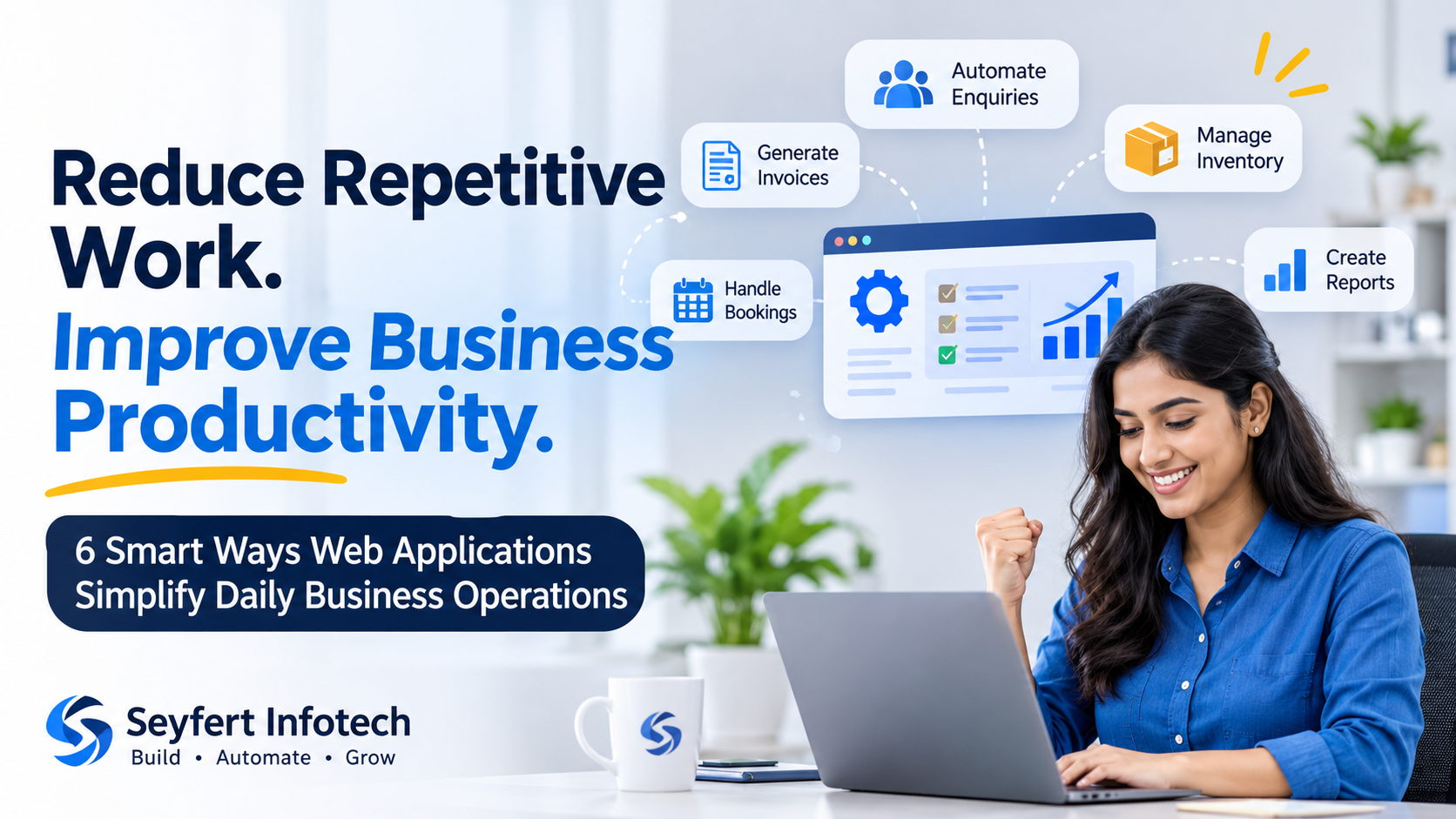
Work Smarter, Not Harder! Still managing customer enquiries, invoices, stock updates and reports manually? The right web application can simplify repetitive tasks, reduce duplicate data entry and give your team more time to focus on business growth. Seyfert Infotech helps businesses turn manual workflows into organised digital solutions.
How Seyfert Infotech Helps Businesses Work Smarter
At Seyfert Infotech, we develop websites and customised web applications based on business requirements. From enquiry management and inventory systems to billing platforms, booking solutions and administrative dashboards, the right digital solution can help reduce repetitive work and improve daily operations. Our focus is on developing practical solutions that make business processes easier to manage, more organised and more efficient. Want to reduce manual work in your business? Explore customised web application solutions with Seyfert Infotech.
What is a web application?
A web application is a software solution that runs through a web browser. Users can access its features through a computer, tablet or mobile device without necessarily installing traditional desktop software
How can web applications reduce repetitive business tasks?
Web applications can automate activities such as data entry, invoice generation, enquiry tracking, appointment scheduling and report preparation, reducing the need for repeated manual work.
Are web applications suitable for small businesses?
Yes. Small businesses can use web applications to manage customers, track orders, maintain inventory and organise daily operations. The features can be selected based on their requirements and budget.
Can a web application manage multiple business operations?
Yes. A customised platform can combine operations such as customer management, inventory, billing, bookings and reporting in one system, depending on the required integrations
How do I know whether my business needs a web application?
If your team frequently performs the same manual tasks, maintains multiple spreadsheets, enters the same information in different systems or struggles to track daily operations, a web application may help simplify the workflow