
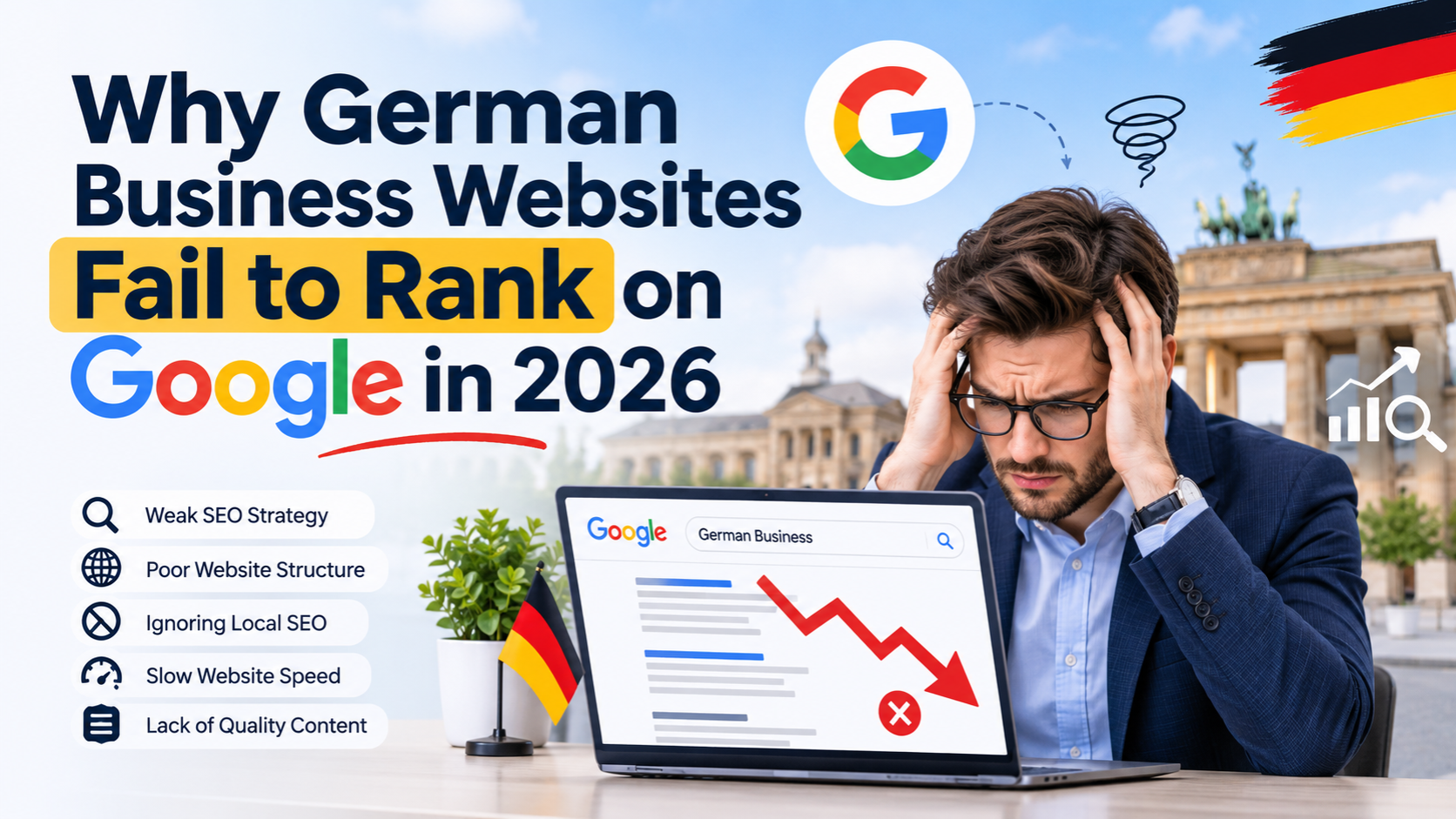
“Having a professional website is an important step for any business, but a visually attractive website does not automatically achieve strong Google rankings. Many German businesses invest in website development without addressing the search engine optimization factors that help potential customers discover their services. From incorrect keyword targeting to technical errors and unhelpful content, several issues can prevent a website from reaching its intended audience. In 2026, businesses operating in Germany need a strategy that combines technical SEO, German-language keyword research, relevant content, mobile performance, and a user-focused website experience. Understanding these common SEO problems is the first step toward improving organic visibility and attracting more relevant visitors.”
Having a professional website is an important step for any business, but a visually attractive website does not automatically achieve strong Google rankings. Many German businesses invest in website development without addressing the search engine optimization factors that help potential customers discover their services. From incorrect keyword targeting to technical errors and unhelpful content, several issues can prevent a website from reaching its intended audience. In 2026, businesses operating in Germany need a strategy that combines technical SEO, German-language keyword research, relevant content, mobile performance, and a user-focused website experience. Understanding these common SEO problems is the first step toward improving organic visibility and attracting more relevant visitors.
1. Targeting the Wrong Keywords
One common SEO mistake is choosing keywords based on assumptions rather than researching how potential customers search. German users may use different words and phrases depending on their location, industry, and search intent. Directly translating English keywords does not always produce natural or relevant German search terms. For example, a business offering website services should research German-language phrases, related commercial searches, and the specific questions its target customers ask.
How to improve:
Research German keywords using search data and competitor analysis. Separate informational searches from service-related searches. Identify relevant long-tail keywords with clear intent. Assign primary keywords to appropriate website pages. Review search performance and refine the strategy over time.
2. Publishing Thin or Generic Content
Pages containing only a few generic sentences about a service may struggle to demonstrate relevance or provide enough value to potential customers. Content copied from competitors or repeated across multiple service and location pages can make a website less useful. Simply inserting the phrase “SEO company Germany” several times will not create a strong SEO strategy. German businesses should publish original content that explains their services, processes, expertise, customer benefits, and solutions to real problems. Useful content can include detailed service pages, industry guides, case studies, practical FAQs, and educational articles based on genuine customer needs.
3. Ignoring Technical SEO Issues
Technical problems can prevent search engines from discovering, crawling, indexing, or correctly interpreting website content. Common issues include accidental noindex directives, incorrect canonical tags, broken internal links, redirect chains, duplicate pages, and poorly configured XML sitemaps. A website may look perfect to visitors while still containing technical problems that affect search visibility.
How to improve:
Review indexing reports in Google Search Console. Check robots.txt and page-level indexing directives. Fix broken links and unnecessary redirect chains. Verify canonical URLs and XML sitemap entries. Implement appropriate structured data where relevant. Check important pages after website launches or migrations.
4. Neglecting German-Language SEO
Businesses targeting German-speaking customers need content that matches the language and terminology of their audience. An English-only website may limit its ability to reach customers who search in German. However, adding automatic translations without reviewing their quality can also create problems. Effective German-language SEO includes natural wording, accurate terminology, locally relevant examples, suitable page titles, and content that reflects the search intent of German users. Businesses serving both German-speaking and international audiences should create a clear language strategy and maintain separate, useful language versions where appropriate.
5. Having a Slow or Poorly Optimized Website
Website performance affects user experience and can contribute to search performance. Slow pages, unstable layouts, and delayed interactions can frustrate visitors, especially on mobile devices. Common causes include oversized images, unnecessary JavaScript, inefficient loading strategies, and poorly configured hosting or caching. Businesses should measure real performance rather than relying only on how quickly a page loads on a developer's computer.
How to improve:
Compress and appropriately size images. Reduce unnecessary scripts and third-party resources. Improve caching and loading strategies. Test Core Web Vitals and mobile performance. Monitor key landing pages after changes.
6. Failing to Optimize for Mobile Users
A website that works well on a desktop computer may still be difficult to use on a phone. Small text, crowded navigation, buttons that are difficult to tap, and lengthy forms can create unnecessary friction for visitors. Mobile usability is particularly important when customers discover a business through search and want to contact it quickly. Use responsive layouts, readable typography, clear navigation, accessible forms, and prominent contact options. Test important pages across different screen sizes and devices.
7. Weak On-Page SEO and Internal Linking
Search engines use page content and links to understand the structure and relevance of a website. Missing or duplicated title tags, vague headings, weak meta descriptions, and unclear page structure can reduce the usefulness of search listings and make pages harder to interpret. Internal linking is equally important. If service pages are difficult to reach from related articles or navigation, visitors and search engines may have a harder time discovering them. Use descriptive page titles, logical headings, relevant internal links, and unique content for each important page. Meta descriptions can help communicate page value, although they are not a direct Google ranking factor.
8. Overlooking Local SEO in Germany
Businesses serving customers in specific German cities or regions may miss relevant opportunities when they ignore local search optimization. Accurate business information, a complete and eligible Google Business Profile, genuine customer reviews, and useful location-specific pages can help people discover local services. However, businesses should not create misleading listings or publish many near-identical pages for cities they do not genuinely serve. Focus on accurate information, authentic customer feedback, and useful content that explains the service offered in each relevant market.
9. Ignoring Backlink Quality and Brand Credibility
Links from relevant, reputable websites can help search engines discover content and understand its place within the wider web. Some businesses focus on acquiring large numbers of low-quality backlinks instead of developing valuable resources and genuine industry relationships. A more sustainable approach includes publishing useful research, contributing expert insights, building legitimate partnerships, and earning relevant mentions. Avoid paid link schemes intended to manipulate rankings. Trust is also supported by transparent company information, consistent contact details, accurate claims, and verifiable customer evidence.
10. Not Measuring SEO Performance
Without measurement, it is difficult to identify why a website is not improving or which activities are worth prioritizing. Businesses should not rely exclusively on a single keyword ranking. Rankings can vary by query, location, device, and search context. Use Google Search Console and suitable analytics tools to monitor organic clicks, impressions, indexing, landing-page performance, qualified enquiries, and conversions. Segment results by page and target market to discover whether the main issue is low search visibility, irrelevant traffic, or a website that fails to convert visitors into customers.
11. How to Improve Google Rankings: A Practical Checklist
German businesses can begin with these actions: Audit technical SEO and indexing. Research relevant German-language keywords. Improve important service and product pages. Publish original, useful content. Improve mobile usability and Core Web Vitals where needed. Strengthen internal linking and site structure. Review local SEO information when relevant. Build genuine industry authority and relevant backlinks. Track organic performance and qualified leads. Review progress regularly and prioritize evidence-based improvements. SEO results depend on competition, website history, content quality, technical condition, and available resources. No agency or technique can guarantee a particular Google ranking.
12. How Seyfert Infotech Can Help
Seyfert Infotech provides website development and digital solutions designed to support businesses in strengthening their online presence. A practical SEO improvement project can begin with a technical audit, keyword research, content evaluation, and analysis of the website's current search performance. Based on the findings, businesses can prioritize technical fixes, improve page structure, develop more useful content, enhance mobile usability, and create a measurable optimization plan. The right approach depends on the business's industry, target audience, website condition, and competition in Germany.
Conclusion
German business websites may struggle to rank on Google for many reasons, including poor keyword targeting, technical SEO errors, generic content, weak mobile experiences, and insufficient performance measurement. The solution is not simply to add more keywords. Businesses need a consistent SEO strategy that combines technical quality, useful German-language content, relevant internal links, trustworthy information, and ongoing analysis. By identifying the biggest problems first and making improvements based on evidence, businesses can build a stronger foundation for organic search visibility and long-term growth. Want to improve your website's SEO performance? Explore Seyfert Infotech's website development and digital solutions to identify opportunities for your business.
Why is my German business website not ranking on Google?
Possible reasons include indexing issues, mismatched keywords, weak content, technical errors, strong competition, and poor website usability. A website audit can help identify the specific causes.
Is German-language content important for SEO in Germany?
When your target customers search in German, high-quality German-language content can help your pages match their queries and expectations. The right language strategy depends on your audience and services.
How long does SEO take to improve Google rankings?
The timeline varies depending on competition, technical issues, content quality, website history, and implementation. Meaningful changes often require several months of consistent work.
Does website speed affect Google rankings?
Website performance and Core Web Vitals are among Google's page experience considerations, but they are not the only ranking factors. Relevant, helpful content and overall search relevance remain important.
How can a German business improve local SEO?
Maintain accurate business information, manage an eligible Google Business Profile, earn genuine reviews, and create useful location-specific content where appropriate.
Can a website redesign improve SEO?
A redesign can improve site structure, mobile usability, content presentation, and performance. Poorly managed migrations can also damage search visibility, so URL mapping, redirects, indexing, and post-launch monitoring are important.
How can I check my website's SEO performance?
Google Search Console provides information about search impressions, clicks, indexing, and queries. Analytics tools can help measure engagement and conversions. An SEO audit can uncover technical and content-related opportunities.