
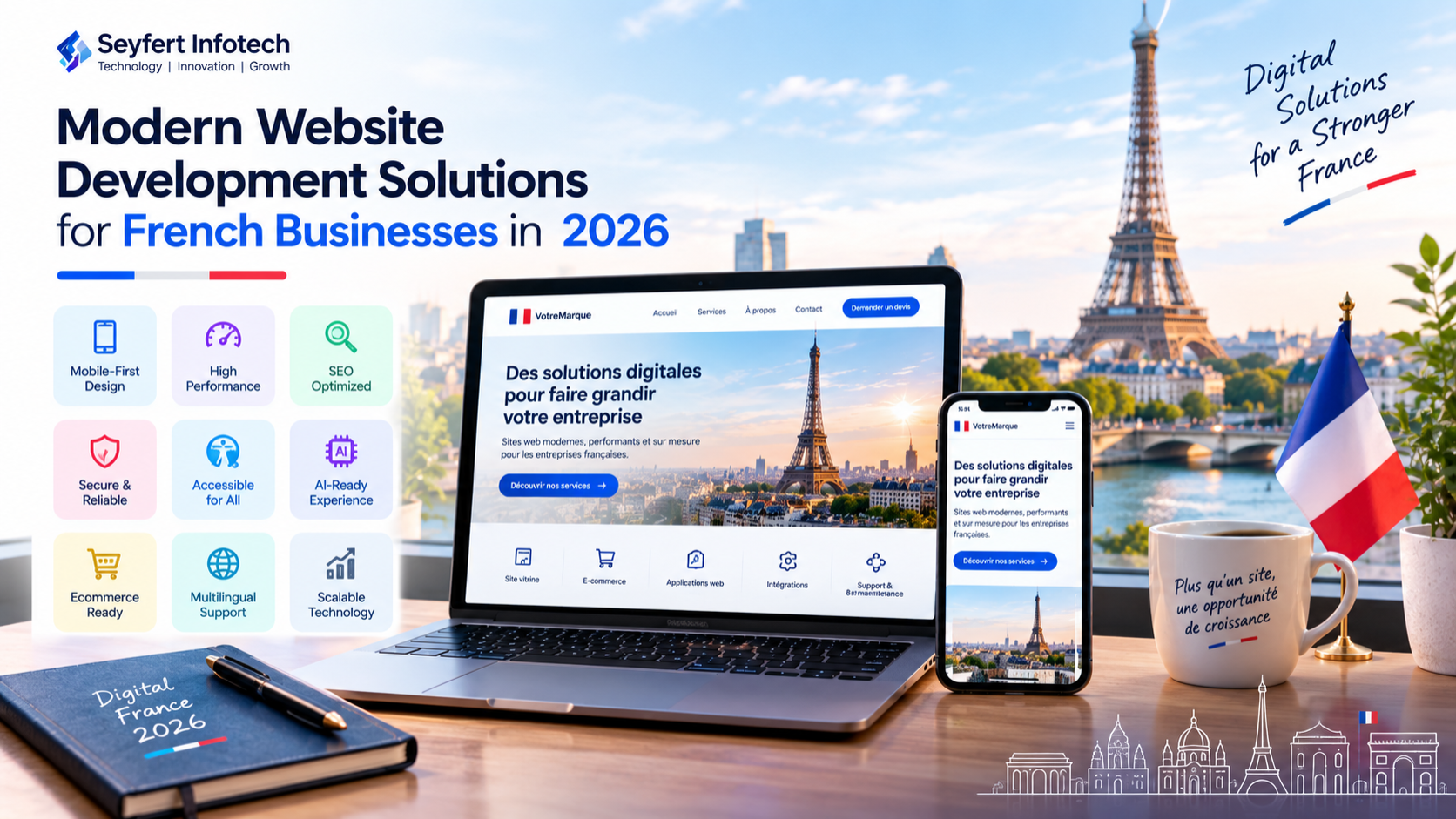
“A business website is no longer simply an online brochure. For French businesses, it can serve as a central platform for customer acquisition, brand communication, lead generation, ecommerce, customer support and digital business operations. As customers increasingly discover businesses through search engines, social platforms, mobile devices and AI-powered experiences, businesses need websites that are fast, useful, accessible and easy to understand. For French companies competing in local and international markets, a modern website should combine strong user experience with technical performance, search visibility, security, clear content and scalable technology. The objective is not simply to launch a website. It is to create a digital experience that can support the business as customer expectations and technology continue to evolve.”
Why Website Development Matters for French Businesses in 2026
A business website is no longer simply an online brochure. For French businesses, it can serve as a central platform for customer acquisition, brand communication, lead generation, ecommerce, customer support and digital business operations. As customers increasingly discover businesses through search engines, social platforms, mobile devices and AI-powered experiences, businesses need websites that are fast, useful, accessible and easy to understand. For French companies competing in local and international markets, a modern website should combine strong user experience with technical performance, search visibility, security, clear content and scalable technology. The objective is not simply to launch a website. It is to create a digital experience that can support the business as customer expectations and technology continue to evolve.
What Makes a Modern French Business Website Successful?
A successful business website brings together design, technology, content and business strategy. Visitors should quickly understand who the company is, what it offers, who its services are for and what action they can take next. At the same time, search engines and AI-powered discovery systems need clear and well-structured information to understand the organisation, services and expertise presented on the website. Important elements include: • Mobile-first design • Fast page performance • French-language user experience • Clear website navigation • SEO-friendly architecture • Structured content • AI-ready information • Strong security • Accessibility • Clear calls to action • Analytics • Scalable technology
1. Mobile-First Website Design
Mobile users expect websites to be easy to navigate, fast to load and comfortable to use on smaller screens. A mobile-first website should provide readable typography, clear navigation, appropriately sized buttons, optimised images and simple forms. Responsive design should work consistently across smartphones, tablets and desktop computers. For French businesses serving customers across different regions and age groups, a mobile-friendly experience can help create a more consistent digital journey. Mobile optimisation should therefore be considered from the beginning of the website development process rather than added as a final adjustment.
2. French-Language UX and Content
A website targeting French customers should provide more than a direct translation of English content. French-language website content should reflect the expectations, terminology and communication style of its intended audience. Navigation labels, service descriptions, calls to action, product information and customer support content should all be clear and natural. For businesses serving both French and international audiences, a multilingual website structure can help manage different languages while keeping content organised and easy to maintain. The goal should be to provide a genuine localised experience rather than simply replacing words from one language with another.
3. Search Engine Optimisation for French Websites
SEO should be considered during website planning and development rather than treated as a separate activity after launch. A search-friendly website can include logical page architecture, descriptive URLs, relevant page titles, meaningful headings, internal links, useful content and technically accessible pages. French businesses should also create content around the actual questions and needs of their customers. For example, service pages can explain what a service includes, who it is designed for, how the process works and what customers should consider before making a decision. This creates useful content for people while also giving search technologies clearer information about the website.
4. AI-Ready Content and Generative Search
Search behaviour is evolving as users increasingly interact with conversational and AI-powered search experiences. This makes clear and useful website content increasingly important. Businesses should provide specific information about their services, products, expertise, locations, processes and frequently asked questions. Instead of creating content purely to target search algorithms, French businesses should focus on providing information that genuinely helps customers understand their options. Well-structured content can make important information easier for both users and modern search systems to interpret.
5. Answer Engine Optimisation for French Businesses
Answer Engine Optimisation, commonly referred to as AEO, focuses on making useful information easier for answer-oriented search experiences to understand. French business websites can support this approach by providing direct answers to common questions, clear headings, concise explanations and structured service information. For example: What does website development include? How long does website development take? How much does a business website cost? What features should an ecommerce website have? How can a website improve online visibility? What makes a website accessible? Answering these questions clearly can improve the usefulness of the website while making important information easier to discover.
6. Geographic Relevance and Local SEO in France
Businesses targeting customers in France should communicate their geographic relevance clearly. Depending on the business model, this can include accurate business information, service areas, location pages, regional content and local business details. For businesses operating in cities such as Paris, Lyon, Marseille, Toulouse, Bordeaux or Lille, location-specific pages can be useful when they provide genuinely different and valuable information. However, simply repeating city names across multiple pages does not create useful local SEO. Geographic content should always provide real information that helps customers understand where and how the business operates.
7. Website Performance and Core Web Vitals
Website speed plays an important role in creating a smooth digital experience. Large images, unnecessary scripts, inefficient code and poorly optimised third-party resources can slow down a website. Developers should consider image optimisation, caching, efficient code, server performance and frontend optimisation during development. Core Web Vitals can also be used to evaluate important aspects of real-world page experience. Performance should be monitored continuously after launch rather than checked only during the initial development stage.
8. Accessibility for Modern Websites
Website accessibility helps make digital experiences usable by people with different abilities. Practical accessibility considerations can include keyboard navigation, readable typography, meaningful alternative text, appropriate contrast, accessible forms, clear focus states and understandable content. Accessibility can also improve the overall usability of a website for many users, including people using mobile devices or assistive technologies. French businesses should consider accessibility as part of the website design and development process rather than treating it as a separate technical task.
9. Website Security and Data Protection
Security should be part of the website architecture from the beginning. Business websites may process enquiry information, customer accounts, payment details, documents or other sensitive business information. Security considerations can include HTTPS, secure authentication, access controls, protected APIs, secure forms, software updates, backups and monitoring. The appropriate security approach depends on the type of website, business sector and information being processed. Businesses should also understand the privacy and data protection obligations that apply to their specific operations.
10. E-commerce Website Development in France
France has a mature and highly active e-commerce market. FEVAD reported €196.4 billion in French e-commerce revenue across products and services in 2025, with 3.2 billion online transactions. In the first half of 2026, French e-commerce sales increased by 6.6% year over year. :chatgpt-content-reference{index="1"} For French retailers and online businesses, an ecommerce website therefore needs to provide more than an attractive product catalogue. Important areas include product discovery, search, filtering, product information, mobile shopping, secure checkout, customer accounts, order information, delivery details and post-purchase communication. A strong ecommerce experience should make it easy for customers to move from discovering a product to completing a purchase.
11. AI-Powered Website Features
Artificial intelligence can be integrated into websites when it provides a practical benefit to users or businesses. Potential applications include intelligent website search, customer assistants, product recommendations, content personalisation, enquiry classification and workflow automation. For example, an ecommerce website could use intelligent search to help customers find relevant products, while a service business could use an AI assistant to answer common questions based on approved business information. AI should be introduced around a clear business or customer requirement rather than added simply because it is a current technology trend.
12. Multilingual Website Development
Businesses operating in France may need to communicate with both French-speaking and international audiences. A multilingual website can help organisations present their services in different languages while maintaining a consistent brand experience. A professional multilingual structure should consider translated page content, navigation, URLs, metadata, internal linking and language-specific user journeys. Translations should also be reviewed for natural language and local relevance rather than relying entirely on automated translation.
13. Conversion-Focused Website Design
A beautiful website is not automatically an effective business website. Every important page should have a clear purpose and an appropriate next action. Depending on the business, this could include: • Request a quote • Book a consultation • Contact the company • Make a purchase • Download information • Register for an account • Request a demonstration Clear calls to action, trust signals, testimonials, case studies and transparent service information can help visitors move through the customer journey more easily.
14. Scalable Website Architecture
A business website may start with a small number of pages but grow as the organisation expands. New services, products, locations, integrations, ecommerce features, customer portals and automation requirements may be introduced over time. A scalable architecture makes it easier to expand the website without rebuilding the entire platform. Technology should therefore be selected according to the current requirements while also considering realistic future needs. The right solution could involve a CMS, custom PHP development, modern JavaScript frameworks, APIs, ecommerce platforms or a combination of technologies.
15. Analytics and Continuous Improvement
Website development should not end when the website goes live. Analytics can help businesses understand how users discover the website, which pages receive engagement, where visitors leave and which actions contribute to business objectives. This information can be used to improve content, navigation, calls to action, landing pages and conversion journeys. A continuous cycle of measuring, analysing, testing and improving can help a website remain aligned with changing customer expectations.
16. Website Development for Different French Industries
Modern websites can support a wide range of French industries. Retail businesses can use websites for ecommerce, product discovery and customer engagement. Professional service companies can use websites to generate enquiries, explain expertise and support appointment booking. Manufacturing companies can use websites to present products, technical information and international capabilities. Hospitality businesses can provide bookings, location information and customer services. Healthcare organisations can provide appropriate information, appointment journeys and digital communication. Technology companies can use websites to communicate products, solutions, documentation and business value. The website structure and functionality should always be adapted to the specific industry and customer journey.
17. How Much Does Website Development Cost in France?
Website development costs in France can vary significantly depending on the scope and complexity of a project. Factors can include: • Number of pages • UX and UI design • CMS requirements • Ecommerce functionality • Custom development • API integrations • Multilingual content • Customer portals • AI functionality • Security requirements • Hosting and infrastructure • Ongoing maintenance A small business website and a large ecommerce platform require very different development approaches. Businesses should therefore define their objectives and requirements before comparing development costs.
18. The Website Development Process
A professional website development project typically follows a structured process: 1. Business and audience research 2. Requirement analysis 3. Website architecture planning 4. UX and UI design 5. Content planning 6. Frontend development 7. Backend and CMS development 8. API and third-party integrations 9. SEO implementation 10. Security and performance testing 11. Responsive testing 12. Deployment 13. Analytics setup 14. Ongoing maintenance A structured process helps businesses maintain consistency from the initial idea through to launch and future improvements.
19. How Seyfert Infotech Can Help French Businesses
Seyfert Infotech provides website development, ecommerce development, mobile app development, digital marketing, business automation and custom software solutions. For businesses targeting France and international markets, our approach can focus on responsive design, user experience, search visibility, performance, scalable technology and business-focused functionality. From corporate websites and ecommerce platforms to custom digital solutions, each project can be structured around the organisation's requirements, target audience and long-term digital objectives. The goal is to create a website that is not only visually professional but also useful, technically strong and ready to evolve with the business.
20. Final Thoughts
Website development for French businesses in 2026 is about creating a complete digital experience rather than simply designing attractive web pages. Businesses need websites that work well across devices, communicate clearly in French, load quickly, provide useful information, support search visibility and protect customer data. For ecommerce businesses, the opportunity is particularly significant as online commerce continues to develop in France. FEVAD's latest figures show continued growth in French online sales during 2026. :chatgpt-content-reference{index="2"} By combining UX, SEO, AEO, GEO, accessibility, security, performance, AI-ready content and scalable technology, French businesses can build a stronger foundation for long-term digital growth. The best website strategy is ultimately one that connects technology with real customer needs and measurable business objectives.
What is website development?
Website development is the process of planning, designing, building, testing and maintaining a website or web application. It can include frontend development, backend development, databases, APIs, integrations, security and ongoing maintenance.
How much does website development cost in France?
Website development costs vary depending on design, functionality, number of pages, CMS requirements, ecommerce features, integrations, multilingual content, custom development and ongoing maintenance. A detailed project scope is normally required for an accurate estimate.
How long does it take to develop a website in France?
Development time depends on the complexity of the website, number of pages, content, design requirements, integrations, approvals and functionality. A simple business website generally requires less development time than a custom ecommerce platform or web application.
What should a modern French business website include?
A modern French business website should generally include responsive design, clear navigation, French-language content, strong performance, security, accessibility, SEO-friendly architecture, useful information and clear calls to action.