
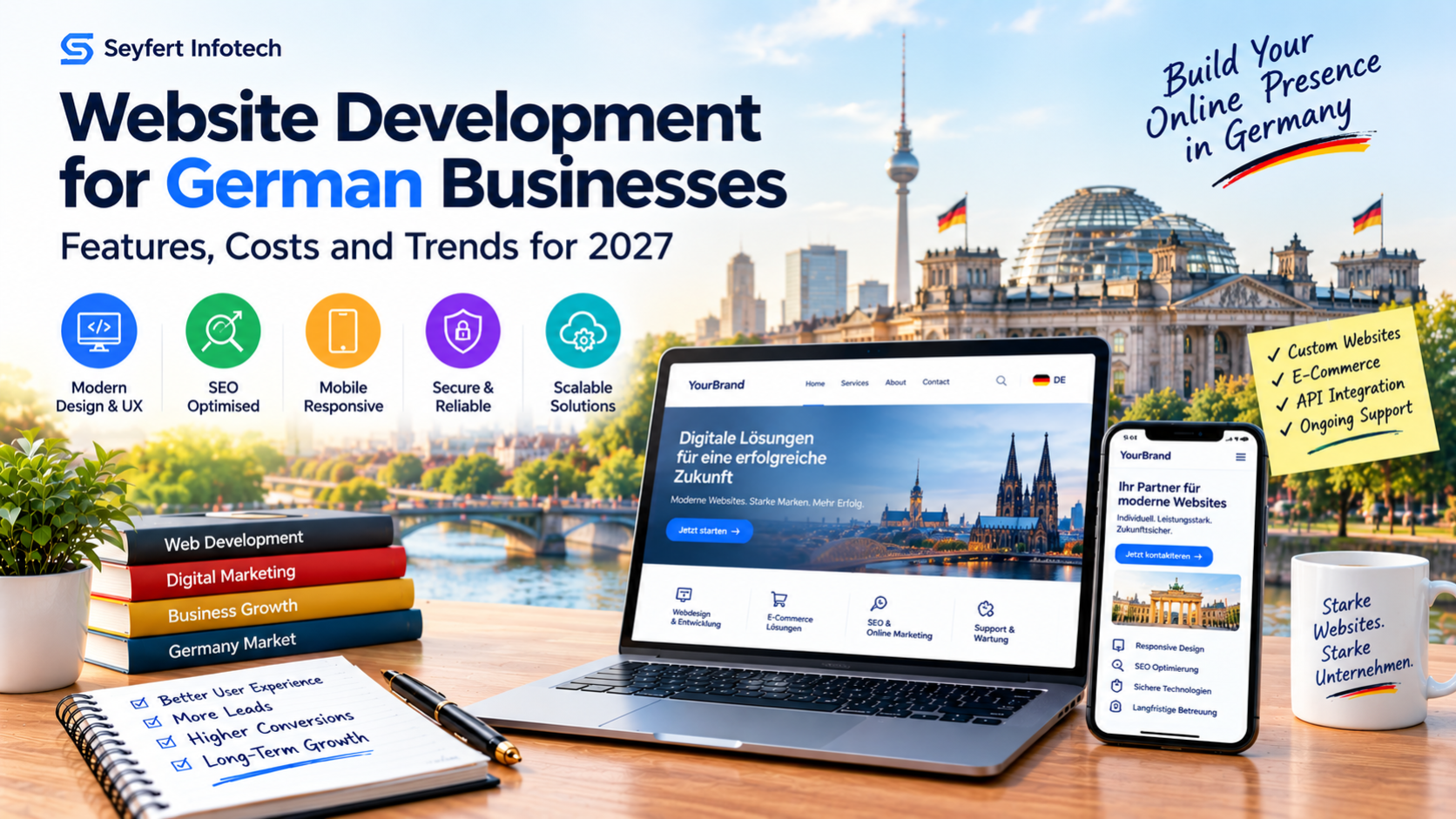
“Website development for German businesses is becoming increasingly important as companies look for effective ways to attract customers, strengthen their online presence, and compete in a digital marketplace. From small and medium-sized enterprises (SMEs) to manufacturers, professional service providers, retailers, and technology companies, a professional website helps businesses present their services, communicate with customers, and generate enquiries. A modern business website should do more than display company information. It should provide a smooth user experience, load quickly, work across devices, support search engine optimisation (SEO), and make it easy for potential customers to take action. For businesses operating in Germany, multilingual content, clear business information, privacy considerations, and accessible design may also be important depending on the audience and applicable requirements. In 2027, businesses should focus on creating websites that combine professional design, reliable technology, measurable marketing performance, and room for future growth. This guide explores the essential features, development costs, platform options, and website trends German businesses should consider before investing in a new website.”
Website development for German businesses is becoming increasingly important as companies look for effective ways to attract customers, strengthen their online presence, and compete in a digital marketplace. From small and medium-sized enterprises (SMEs) to manufacturers, professional service providers, retailers, and technology companies, a professional website helps businesses present their services, communicate with customers, and generate enquiries. A modern business website should do more than display company information. It should provide a smooth user experience, load quickly, work across devices, support search engine optimisation (SEO), and make it easy for potential customers to take action. For businesses operating in Germany, multilingual content, clear business information, privacy considerations, and accessible design may also be important depending on the audience and applicable requirements. In 2027, businesses should focus on creating websites that combine professional design, reliable technology, measurable marketing performance, and room for future growth. This guide explores the essential features, development costs, platform options, and website trends German businesses should consider before investing in a new website.
What Is Website Development?
Website development is the process of planning, designing, building, testing, and maintaining a website. It includes the visual interface customers interact with and the underlying technology that makes the website function correctly. Depending on the project, development may involve content management systems, databases, contact forms, customer portals, booking systems, API integrations, and custom business functionality. For German businesses, a website might serve as a corporate information hub, a lead-generation platform, a product catalogue, an online store, or a customer self-service portal. The right solution depends on the company's goals, audience, budget, and operational requirements. A well-planned development process helps ensure that the website is useful for customers while remaining manageable for the business.
Why German Businesses Need a Professional Website
A professional website gives German businesses a central online destination where potential customers can learn about their services, explore products, review company information, and make enquiries. Unlike a social media profile, a company website offers greater control over content, navigation, branding, and the customer journey. It can also support marketing campaigns, local search visibility, recruitment, and long-term customer relationships. For small and medium-sized businesses, a well-structured website can help explain complex services, showcase project experience, and establish credibility before a sales conversation begins. For manufacturers and B2B companies, it can present technical specifications, downloadable catalogues, industry expertise, and enquiry forms. For service providers, it can simplify appointment requests and customer communication. By combining useful content with clear calls to action, businesses can turn their websites into practical tools for business development.
Essential Features of a Modern Business Website
Responsive and Mobile-Friendly Design
A responsive website adapts its layout to smartphones, tablets, laptops, and desktop computers. Visitors should be able to read content, navigate menus, view images, complete forms, and contact the business without struggling with small text or awkward layouts. Mobile usability is particularly important when users arrive through search engines, social media, email campaigns, or online advertisements. A professional design should use consistent typography, accessible colour contrast, clear navigation, and appropriately sized interactive elements. Testing across different screen sizes and browsers helps identify layout problems before the website goes live.
Professional UI and UX Design
User interface (UI) design focuses on the visual elements of a website, while user experience (UX) design focuses on how easily visitors can achieve their goals. A successful business website combines both through logical page structures, consistent branding, clear headings, intuitive navigation, and useful content. German businesses serving professional audiences may benefit from a clean, organised design that prioritises clarity, accuracy, and trust. Service pages should explain what the company offers, who it serves, and how customers can get started. Rather than adding unnecessary animations or decorative elements, the design should support the visitor's journey and make important information easy to find.
Search Engine Optimisation
SEO should be considered during website planning and development, not treated as a last-minute addition. Search-friendly URLs, descriptive page titles, relevant meta descriptions, structured headings, internal links, image optimisation, XML sitemaps, and appropriate canonical tags help search engines understand website content. Businesses targeting customers in Germany should conduct keyword research based on their industry, services, location, and customer language. German-language landing pages may be useful when targeting German-speaking audiences, while English pages can support international customers where relevant. Local SEO can also help businesses present consistent contact information and improve their visibility for location-based searches. Technical SEO should include attention to page speed, mobile usability, crawlability, redirects, broken links, and Core Web Vitals. These practices provide a stronger foundation for search visibility, although rankings depend on many factors beyond website development alone.
Content Management System
A content management system (CMS) allows authorised staff to update website content without editing every page manually in code. Depending on the business requirements, a CMS can manage service pages, blogs, project portfolios, team profiles, announcements, images, and downloadable documents. WordPress is a common choice for content-driven business websites, while other CMS platforms may suit particular workflows or technical requirements. Businesses should evaluate ease of editing, security, extension quality, performance, multilingual support, and long-term maintenance before selecting a platform.
Contact Forms and Lead Generation
A business website should make it straightforward for potential customers to contact the company. Contact forms can collect relevant information such as name, business email, service interest, and enquiry details. Depending on the business model, the website may also include quotation requests, appointment bookings, downloadable resources, or consultation forms. Well-designed forms should request only the information needed for the enquiry and explain what happens after submission. Form validation, spam protection, clear confirmation messages, and reliable email delivery help ensure that enquiries reach the right team. Connecting forms to a CRM system can also help businesses track leads and follow up efficiently.
Website Speed and Performance
Fast-loading pages contribute to a smoother browsing experience and help visitors access information without unnecessary delays. Businesses should optimise image sizes, use modern image formats where appropriate, reduce unnecessary scripts, configure caching, and select suitable hosting. Developers should also monitor layout stability and responsiveness during loading. Performance should be tested on mobile devices and realistic network conditions, not only on a high-powered office computer. Google's Core Web Vitals provide useful metrics for evaluating loading performance, interactivity, and visual stability. Ongoing monitoring helps identify issues as content, plugins, and website functionality change.
Website Security and Data Protection
Security is essential when a website collects enquiries, stores user accounts, integrates with third-party services, or processes business information. Good practices include HTTPS, secure authentication, role-based access controls, software updates, reliable backups, spam protection, and careful management of third-party scripts and integrations. Businesses serving customers in Germany should assess applicable data protection and privacy requirements, including the GDPR and relevant German rules for cookies and electronic communications. Privacy notices, cookie controls, forms, analytics, and marketing tools should be configured according to the actual data processing taking place. Commercial websites also generally need an appropriately prepared and accessible legal notice, commonly called an Impressum, where required by German law.
Multilingual Website Support
Businesses serving German-speaking customers should consider whether the website needs German-language content, English-language pages, or additional languages. A multilingual website can help international manufacturers, exporters, technology companies, and service providers communicate with different audiences. Language versions should use accurate translations, consistent terminology, appropriate URLs, and clear language-switching options. Where relevant, hreflang annotations can help search engines understand alternative language or regional versions of pages. Machine translation should be reviewed carefully, especially for technical, legal, or industry-specific content.
Analytics and Marketing Integrations
Website analytics help businesses understand where visitors come from, which pages attract attention, and which actions lead to enquiries. With suitable configuration, businesses can measure form submissions, downloads, booking requests, and other meaningful conversions. A website can also connect with CRM platforms, email marketing systems, customer support tools, and advertising platforms. These integrations should serve clear business goals and be implemented with appropriate attention to privacy, permissions, and data minimisation.
How Much Does Website Development Cost in Germany?
Website development costs in Germany vary according to the project's scope, design requirements, content, functionality, integrations, and delivery model. A simple landing page costs considerably less than a large corporate website with multiple language versions, custom workflows, or a customer portal. As an illustrative planning guide, a basic landing page may cost around €1,000 to €3,000, while a small business website may cost approximately €2,500 to €6,000. A more comprehensive corporate website with custom design, a CMS, multiple service pages, and a stronger SEO foundation may require around €5,000 to €15,000 or more. Complex portals, bespoke web applications, and websites with advanced integrations can exceed €20,000. These figures are approximate planning ranges rather than fixed quotations or official market averages. Published German provider guides show substantial variation based on project scope and service model. For example, envyo's German website cost guide discusses pricing differences between landing pages, corporate websites, and custom projects.
Factors That Affect Website Development Costs
The level of design customisation is one of the main factors affecting project cost. A template-based website may be more economical to launch, while a custom-designed website requires additional planning, interface design, and implementation. The number of pages also matters, particularly when each page requires unique content, layout, or functionality. Additional features such as appointment booking, multilingual content, customer login areas, advanced search, CRM integration, or third-party APIs can increase development time. Content creation, copywriting, photography, translation, accessibility testing, and technical SEO may also need separate budgets. The more specialised the business requirements, the more important it becomes to define the project scope before requesting a final quotation.
Ongoing Website Maintenance Costs
The initial development cost is only part of the overall investment. Businesses should also budget for domain renewal, hosting, software updates, security monitoring, backups, technical support, and ongoing content changes. SEO services, analytics reviews, and conversion optimisation may require additional spending depending on business goals. A written maintenance agreement should explain which services are included, how frequently updates are performed, how backups are managed, and how technical issues are handled. Planning for ongoing maintenance helps keep the website reliable and reduces the risk of unexpected repair costs.
Choosing the Right Website Development Platform
The right platform depends on the company's content needs, technical requirements, budget, and internal resources. WordPress can be a strong choice for many corporate websites because it offers content management, design flexibility, and a broad ecosystem of extensions. Businesses should still consider hosting quality, plugin maintenance, security, and the complexity of the website before choosing it. Hosted website builders can suit smaller businesses that need a relatively simple online presence and prefer a managed environment. They can reduce technical administration but may limit custom functionality or portability in certain situations. Custom development may be more suitable when the business requires specialised workflows, complex integrations, unique user experiences, or functionality that existing platforms cannot support efficiently. For larger organisations, the decision may also involve existing enterprise systems, internal technical teams, security policies, and long-term integration plans. Businesses should compare the total cost of ownership, not just the initial build price, before committing to a platform.
Website Development Trends German Businesses Should Watch in 2027
AI-Assisted Website Experiences
AI-powered chat assistants, intelligent search, content recommendations, and customer support tools can help businesses provide more relevant experiences. Their usefulness depends on the quality of the information they access, the accuracy of their responses, and the availability of suitable human support when needed. Businesses should evaluate AI features based on practical needs rather than adding them simply because they are trending. Privacy, transparency, accuracy, security, and ongoing maintenance should be considered before implementation.
Accessibility and Inclusive Design
Accessible websites help more people navigate and understand digital content, including visitors who use assistive technologies or have different visual, motor, hearing, or cognitive needs. Practical measures include keyboard navigation, meaningful headings, appropriate colour contrast, accessible form labels, descriptive link text, and alternative text for informative images. Germany's Accessibility Strengthening Act, known as the BFSG, has applied since 28 June 2025 to certain products and services, including covered e-commerce services, subject to the law's scope and exemptions. Not every corporate website is automatically covered in the same way. Businesses should determine which accessibility requirements apply to their services and audience and treat accessibility as an important design consideration from the beginning.
Core Web Vitals and Performance
Website speed and responsiveness remain important parts of a good digital experience. Businesses should monitor loading speed, interaction responsiveness, and visual stability as pages become more complex. Optimised images, efficient code, suitable hosting, and careful script management can help keep websites responsive. Performance improvements should be measured rather than assumed. Regular testing can reveal issues caused by new plugins, embedded media, third-party tracking tools, or growing content libraries.
Personalisation and Customer-Focused Content
Businesses can make their websites more useful by presenting relevant information based on the visitor's needs, industry, or stage in the buying process. For example, a manufacturer may create dedicated pages for distributors, procurement teams, and technical buyers. A service provider may organise content by industry or problem solved. Personalisation should remain transparent and respect applicable privacy requirements. Clear, useful content is often more valuable than complex features that do not solve a real customer problem.
Headless and API-Driven Architecture
Headless architecture separates the website's front-end experience from its content or commerce backend. This approach can support flexible digital experiences across multiple channels, but it may require more development resources and specialised maintenance than a conventional CMS setup. For many small and medium-sized businesses, a well-configured traditional CMS may remain the more practical option. Headless architecture is worth evaluating when there is a clear need for greater front-end flexibility, multiple delivery channels, or complex integrations.
Multilingual and International Websites
German companies serving international markets may need websites that support multiple languages, regional content, and distinct customer journeys. Good multilingual implementation requires more than translating text; businesses should consider terminology, cultural context, search behaviour, navigation, and regional contact information. For international SEO, each language version should have a clear structure and properly managed metadata. Translation quality and consistency are particularly important for technical industries and regulated sectors.
German Website Legal and Privacy Considerations
Businesses operating websites in Germany should review the legal and privacy obligations relevant to their activities. Commercial websites generally need an accessible Impressum containing the provider identification information required by applicable law. The German Federal Portal explains the legal notice and provider identification requirements. Websites that process personal data should also provide appropriate privacy information and follow applicable GDPR requirements. Cookie and tracking technologies should be assessed under relevant German and European rules, with consent obtained where required. Contact forms, analytics tools, embedded third-party content, and marketing integrations should be reviewed as part of this process. Depending on the service offered, accessibility obligations under the BFSG may also apply. Businesses should confirm the requirements that relate to their particular website, products, services, and organisational circumstances rather than assuming that one checklist covers every situation. This section is general information and does not constitute legal advice.
The Website Development Process
A successful website project begins with discovery and planning. The business identifies its target audience, objectives, key messages, required pages, integrations, and budget. This stage helps the development team establish priorities and define what a successful launch should achieve. The next stage involves information architecture, wireframes, and visual design. Once the layout and content structure are approved, developers build the website, configure the CMS, implement forms and integrations, and prepare the required content. SEO foundations, responsive layouts, security controls, and accessibility considerations should be included throughout development. Before launch, the website should be tested across devices and browsers. Testing should cover navigation, form submissions, email delivery, broken links, redirects, page speed, security settings, and content accuracy. After launch, businesses should monitor performance, review analytics, update software, and improve pages based on real user behaviour.
Common Website Development Mistakes to Avoid
One common mistake is choosing a platform before understanding the business requirements. A website that looks attractive but cannot support the required workflows may need expensive changes later. Other problems include unclear messaging, weak mobile layouts, slow-loading pages, poor-quality content, and contact forms that are difficult to use. Businesses may also overlook technical SEO, privacy requirements, accessibility, or maintenance when preparing the initial budget. Launching without thorough testing can lead to broken forms, missing redirects, and technical problems that undermine customer confidence. A more effective approach is to plan for design, content, functionality, testing, compliance, and ongoing support as connected parts of the same project.
How Seyfert Infotech Can Help
Seyfert Infotech provides digital development services for businesses looking to strengthen their online presence and improve their digital operations. For German businesses planning a new website or redesign, the project may include responsive website development, CMS implementation, service and landing pages, contact forms, third-party integrations, technical SEO foundations, performance optimisation, and quality assurance. The appropriate solution depends on the company's industry, target audience, content requirements, and future plans. A small business may need a clear, conversion-focused corporate website, while a larger organisation may require multilingual pages, customer portals, or specialised integrations. By defining requirements early and selecting technology that fits the business, companies can create websites that are easier to manage and better aligned with their goals. Visit Seyfert Infotech to explore its digital development services.
Conclusion
Website development for German businesses in 2027 should focus on usability, performance, security, discoverability, and long-term maintainability. A professional website helps companies communicate their value, attract relevant visitors, and turn interest into meaningful enquiries. The right investment depends on the business's goals, technical requirements, and available resources rather than a one-size-fits-all price. By choosing a suitable platform, creating useful content, incorporating SEO and accessibility from the beginning, and planning for ongoing maintenance, German businesses can build a stronger digital foundation for future growth. A well-developed website is not simply an online brochure; it is an important part of how a business presents itself, supports customers, and competes in a changing digital environment.
How much does website development cost in Germany?
A basic landing page may cost around €1,000 to €3,000, while a professional corporate website may require several thousand euros or more. Complex portals and custom applications can cost substantially more. Actual pricing depends on scope, functionality, design, and provider.
How long does it take to develop a business website?
A simple website may take a few weeks, while a larger corporate website can take several months. Content readiness, design approvals, integrations, testing, and project complexity affect the timeline.
Which platform is best for German business websites?
WordPress, hosted website builders, and custom development can all be suitable in different situations. The best option depends on content needs, flexibility, technical resources, integrations, and total ownership costs.