
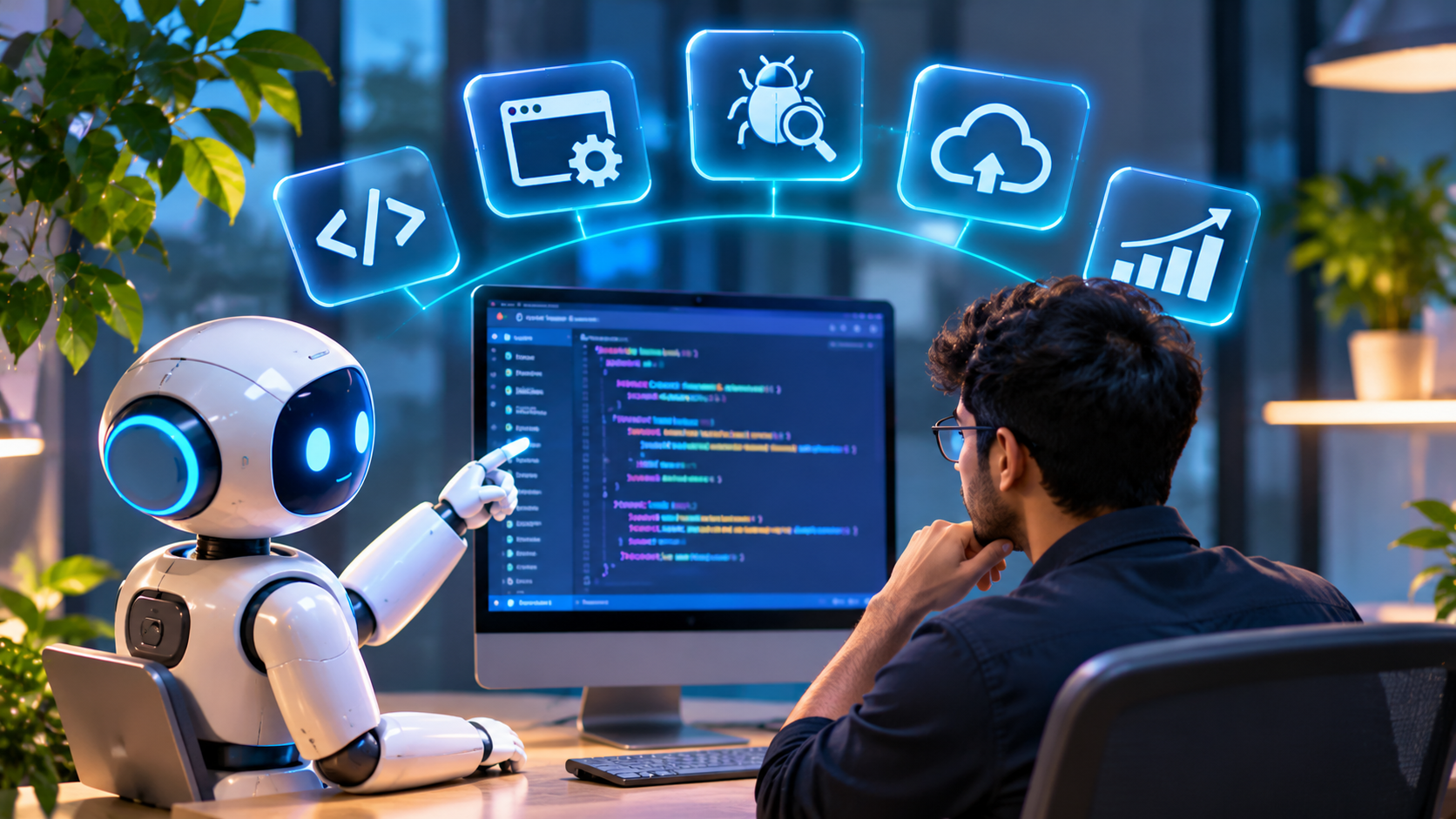
“Software development has evolved significantly over the years. From traditional programming methods to modern frameworks, cloud platforms, and automated development environments, technology continues to change how applications are designed, developed, and maintained. One of the biggest developments influencing the software industry is Artificial Intelligence (AI). Artificial Intelligence is introducing new ways for developers to write code, understand complex programming problems, detect software errors, automate repetitive tasks, and improve application performance. AI-powered tools are becoming part of everyday development workflows, helping software engineers work more efficiently. Previously, developers had to perform many tasks manually, including writing repetitive code, identifying bugs, creating test cases, and reviewing application logic. Today, AI-powered development tools can assist with these activities and provide suggestions based on the context of a project. However, AI is not simply replacing traditional software development. It is changing how developers approach programming and problem-solving. Human expertise, technical knowledge, creativity, and decision-making remain essential for building reliable software. In this article, let's explore how artificial intelligence is changing the future of software development and what it means for developers and businesses.”
Introduction: The Growing Role of Artificial Intelligence in Software Development
Software development has evolved significantly over the years. From traditional programming methods to modern frameworks, cloud platforms, and automated development environments, technology continues to change how applications are designed, developed, and maintained. One of the biggest developments influencing the software industry is Artificial Intelligence (AI). Artificial Intelligence is introducing new ways for developers to write code, understand complex programming problems, detect software errors, automate repetitive tasks, and improve application performance. AI-powered tools are becoming part of everyday development workflows, helping software engineers work more efficiently. Previously, developers had to perform many tasks manually, including writing repetitive code, identifying bugs, creating test cases, and reviewing application logic. Today, AI-powered development tools can assist with these activities and provide suggestions based on the context of a project. However, AI is not simply replacing traditional software development. It is changing how developers approach programming and problem-solving. Human expertise, technical knowledge, creativity, and decision-making remain essential for building reliable software. In this article, let's explore how artificial intelligence is changing the future of software development and what it means for developers and businesses.
1. What Is Artificial Intelligence in Software Development?
Artificial Intelligence in software development refers to the use of AI technologies to assist or automate different activities involved in building, testing, deploying, and maintaining software applications. AI systems can analyze information, recognize patterns, generate suggestions, and perform specific tasks based on their training and available context. In software engineering, AI can support activities such as: Generating code from natural-language instructions. Explaining complex programming logic. Identifying potential bugs and errors. Suggesting code improvements. Creating software test cases. Supporting documentation generation. Analyzing application logs. Assisting with database queries. Helping developers understand unfamiliar technologies. For example, a developer working on a Java Spring Boot application can use an AI coding assistant to generate a basic REST API structure, explain an error message, or suggest improvements to an existing method. The developer must still review the generated code, verify its correctness, and ensure that it meets the project's requirements.
2. How Is AI Changing the Software Development Process?
AI is influencing multiple stages of the software development life cycle, from initial planning to application maintenance. AI in Requirement Analysis Understanding project requirements is an important part of software development. AI tools can help developers and business analysts organize requirements, summarize stakeholder discussions, identify missing information, and prepare initial technical documentation. For example, when a business requests an online appointment booking system, AI can help organize requirements into modules such as user registration, appointment scheduling, payment processing, notifications, and administration. Human review is still necessary to confirm business rules, priorities, and technical constraints. AI in Software Design AI can assist developers in exploring application architecture, preparing initial design suggestions, and understanding different implementation approaches. It can help with: Suggesting possible application architectures. Creating initial database schemas. Explaining relationships between system components. Generating API structure examples. Supporting UI layout and component ideas. These suggestions provide a starting point, but developers must evaluate scalability, maintainability, security, and project-specific requirements. AI in Code Development AI-powered coding assistants can generate code snippets, complete partially written code, explain functions, and suggest solutions to programming problems. For example, a developer can describe a requirement such as creating a login API with authentication and validation. An AI tool may generate an initial implementation that the developer can review and adapt. This can reduce repetitive coding work and help developers explore unfamiliar programming concepts. AI in Software Testing Testing is essential for identifying errors before an application reaches users. AI-assisted testing tools can help generate test scenarios, suggest test cases, analyze test results, and identify patterns in recurring failures. For example, while developing an e-commerce application, AI can help suggest test scenarios for user registration, product searches, shopping carts, checkout processes, and payment validation. These tools support testing activities but do not eliminate the need for proper quality assurance. AI in Software Maintenance After deployment, applications require monitoring, bug fixing, updates, and performance improvements. AI can help developers analyze error logs, summarize application issues, identify unusual patterns, and suggest possible troubleshooting approaches. This can help development teams investigate problems more efficiently.
3. How AI Is Helping Developers Write Code Faster
One of the most visible applications of AI in software development is AI-assisted coding. AI coding assistants can understand programming context and suggest code based on comments, existing files, and natural-language instructions. Some common capabilities include: Code Completion: Suggesting the next lines of code while a developer is programming. Code Generation: Creating functions, components, classes, and basic application structures from instructions. Code Explanation: Explaining unfamiliar code and helping developers understand how a function works. Code Refactoring: Suggesting ways to improve code readability, organization, and maintainability. Documentation Assistance: Generating initial explanations and documentation for functions, classes, and APIs. For example, a React developer building a dashboard can use AI assistance to create an initial component structure, suggest reusable UI elements, and explain state-management logic. This allows developers to spend more time on application architecture, business logic, and solving complex problems.
4. Popular AI Tools Used in Modern Software Development
Several AI-powered tools are becoming part of modern software development workflows. GitHub Copilot GitHub Copilot is an AI coding assistant that helps developers generate code suggestions, complete code, and work with programming tasks inside supported development environments. It can assist with multiple programming languages and development workflows. ChatGPT ChatGPT can help developers understand programming concepts, generate code examples, debug errors, explain technical documentation, and explore different approaches to software development. It can also support learning new frameworks and technologies. Cursor Cursor is an AI-powered code editor designed to help developers understand and modify codebases, generate code, and work with project files using AI assistance. Amazon Q Developer Amazon Q Developer provides AI assistance for software development tasks, including code suggestions, understanding code, and working with AWS-related development workflows. Google Gemini Google Gemini can assist with programming questions, code generation, debugging explanations, and understanding technical concepts. The suitability of each tool depends on the programming language, development environment, project requirements, privacy considerations, and available features.
5. How AI Is Improving Software Testing and Debugging
Software testing and debugging can require significant time, especially in applications containing multiple modules and integrations. AI-assisted tools can help developers identify potential issues and improve testing workflows. Automated Test Case Generation AI can help create initial test cases based on application requirements, source code, and existing test scenarios. Bug Detection and Analysis AI-powered code analysis tools can identify suspicious code patterns, potential defects, and areas that may require further review. Error Log Analysis When an application experiences an unexpected error, AI can summarize log messages and suggest possible causes for investigation. Regression Testing Support AI-assisted testing tools can help teams identify relevant test cases when application code changes. For example, if a developer updates the payment module of an e-commerce application, testing tools can help identify related checkout and order-processing scenarios that should be verified. AI can improve testing efficiency, but actual execution, verification, and human quality assurance remain important. 6. The Role of AI in Frontend and Backend Development Artificial Intelligence is influencing both frontend and backend development. AI in Frontend Development Frontend developers build the visual interfaces that users interact with. AI can assist frontend development by: Generating HTML, CSS, and JavaScript examples. Creating React and Next.js component structures. Suggesting responsive design improvements. Explaining CSS and layout issues. Helping convert design requirements into initial UI components. Identifying accessibility improvements. For example, a developer creating a responsive business website can use AI assistance to generate an initial navigation component, responsive layout, and reusable sections. AI in Backend Development Backend development involves server-side logic, APIs, databases, authentication, and business operations. AI can support backend development through: Generating REST API examples. Suggesting database queries. Explaining authentication workflows. Creating initial validation logic. Analyzing server errors. Supporting API documentation. Suggesting code optimization approaches. For example, developers working with Java Spring Boot can use AI assistance to explore controller structures, service-layer logic, repository patterns, and API validation. However, backend code involving authentication, payment processing, personal information, and sensitive business operations requires careful security review.
7. How AI Is Changing Database Management and API Development
Databases and APIs are essential components of modern software applications. AI is helping developers work with these technologies by making complex technical tasks easier to explore and understand. AI in Database Management AI tools can assist developers with: Writing SQL queries. Explaining database errors. Suggesting database relationships. Reviewing query performance. Generating sample data. Understanding database schemas. For example, a developer can describe a requirement to retrieve customer orders from a database and ask an AI assistant to generate an initial SQL query. The query must still be tested for correctness, security, and performance. AI in API Development APIs allow different applications and services to communicate with each other. AI can help generate API documentation, suggest endpoint structures, explain request and response formats, and create initial integration code. This can make API development and integration workflows more efficient.
8. Benefits of Artificial Intelligence in Software Development
AI offers several potential advantages for developers, software companies, and businesses. Increased Developer Productivity AI can reduce repetitive coding and documentation activities, allowing developers to focus on more complex tasks. Faster Development Workflows Code suggestions, automated test generation, and debugging assistance can help teams complete certain development activities more efficiently. Improved Learning Opportunities Developers can use AI tools to understand programming languages, frameworks, technical errors, and unfamiliar concepts. Better Code Understanding AI can explain existing code and summarize complex functions, which can be useful when working with large or unfamiliar projects. Support for Software Testing AI-assisted tools can help prepare test cases, analyze results, and identify areas that require additional testing. Easier Technology Exploration Developers can explore different frameworks, libraries, and implementation approaches with AI assistance. These benefits depend on how effectively AI tools are integrated into development workflows and how carefully their output is reviewed.
9. Challenges and Risks of Using AI in Software Development
Although AI provides useful capabilities, it also introduces challenges that developers and organizations must understand. Incorrect Code Suggestions AI-generated code may contain programming errors, incorrect assumptions, or incomplete implementations. Developers must review and test every important suggestion before using it in production. Security Vulnerabilities AI-generated code can introduce insecure practices, such as improper input validation, weak authentication logic, or unsafe data handling. Security reviews and testing are essential. Data Privacy Concerns Developers must be careful when sharing source code, business information, credentials, or customer data with AI services. Organizations should follow their data protection policies and the privacy terms of the tools they use. Overdependence on AI Tools Relying entirely on AI-generated code can reduce opportunities to develop fundamental programming and problem-solving skills. Developers should understand the code they use rather than blindly accepting generated solutions. Intellectual Property and Licensing Organizations should review the licensing, ownership, and usage conditions associated with AI-generated code and third-party tools. Maintenance and Code Quality Generated code may not always follow the project's architecture, naming conventions, or coding standards. Human code reviews and established engineering practices remain important.
10. Will Artificial Intelligence Replace Software Developers?
One of the most common questions in the technology industry is whether AI will replace software developers. AI can automate certain repetitive programming activities and assist with tasks such as code generation, testing, documentation, and debugging. However, software development involves much more than writing code. Developers must understand business requirements, make architectural decisions, evaluate trade-offs, protect sensitive information, solve complex problems, and take responsibility for application quality. AI tools also require human guidance to understand project-specific requirements and verify their output. The role of software developers is therefore evolving. Developers who understand programming fundamentals and know how to use AI tools effectively can adapt to changing development workflows. Rather than focusing only on writing code, future software engineers will increasingly need skills in system design, problem-solving, security, architecture, and AI-assisted development.
11. Skills Developers Should Learn in the AI-Driven Software Development Era
As AI becomes more integrated into software engineering, developers should strengthen their technical foundations while learning to use modern AI tools. Important skills include: Programming Fundamentals: Learn languages such as Java, Python, JavaScript, or TypeScript and understand core programming concepts. Data Structures and Algorithms: Develop problem-solving skills and understand how to write efficient code. Frontend Development: Learn HTML, CSS, JavaScript, React, and modern frontend frameworks. Backend Development: Understand server-side programming, REST APIs, authentication, and database integration. Database Management: Learn SQL, database design, query optimization, and data management. Cloud and DevOps: Understand cloud infrastructure, Docker, Kubernetes, CI/CD, and deployment automation. AI-Assisted Development: Learn how to use AI coding assistants responsibly for code generation, debugging, documentation, and testing. Software Security: Understand secure coding practices, authentication, authorization, input validation, and data protection. Developers who combine strong fundamentals with modern tools will be better prepared to work on evolving software projects.
12. What Does the Future of AI-Powered Software Development Look Like?
The future of software development is likely to involve deeper integration between AI systems and traditional engineering workflows. Some emerging areas include: AI-Assisted Application Development Developers will increasingly use natural-language instructions to create initial application components, generate code, and explore implementation options. Intelligent Software Testing AI-assisted testing systems may help teams generate more relevant test scenarios, analyze failures, and prioritize testing activities. AI-Powered Development Environments Development environments will continue integrating AI capabilities for code understanding, project navigation, documentation, and debugging. Automated Code Review Assistance AI tools can help reviewers identify suspicious code patterns, potential quality issues, and areas that need additional attention. AI Integration in Business Applications More business applications are incorporating AI capabilities such as intelligent search, recommendation systems, document processing, chat interfaces, and workflow automation. Greater Focus on Human-AI Collaboration Developers will increasingly combine human engineering knowledge with AI assistance to build and maintain software systems. The exact pace of these changes will depend on technology improvements, business requirements, regulation, security, and industry adoption.
Conclusion: Building the Future of Software Development with AI
Artificial Intelligence is changing how software applications are planned, designed, developed, tested, and maintained. AI-powered coding assistants, automated testing tools, intelligent debugging systems, and development automation are creating new opportunities for software engineers and businesses. However, successful software development still depends on strong programming knowledge, proper system architecture, security practices, testing, and human decision-making. The future is not simply about allowing AI to write code. It is about combining artificial intelligence with engineering expertise to create reliable, scalable, secure, and useful software applications. For developers, learning modern technologies and understanding how to work effectively with AI tools will be important for long-term growth. For businesses, adopting AI-assisted development thoughtfully can help improve workflows and explore new digital solutions. Looking for modern software development solutions? Seyfert Infotech helps businesses explore software and web development solutions that support their digital requirements. Whether you are planning a business application, a web platform, or a custom software project, connect with our team to discuss your development requirements.