
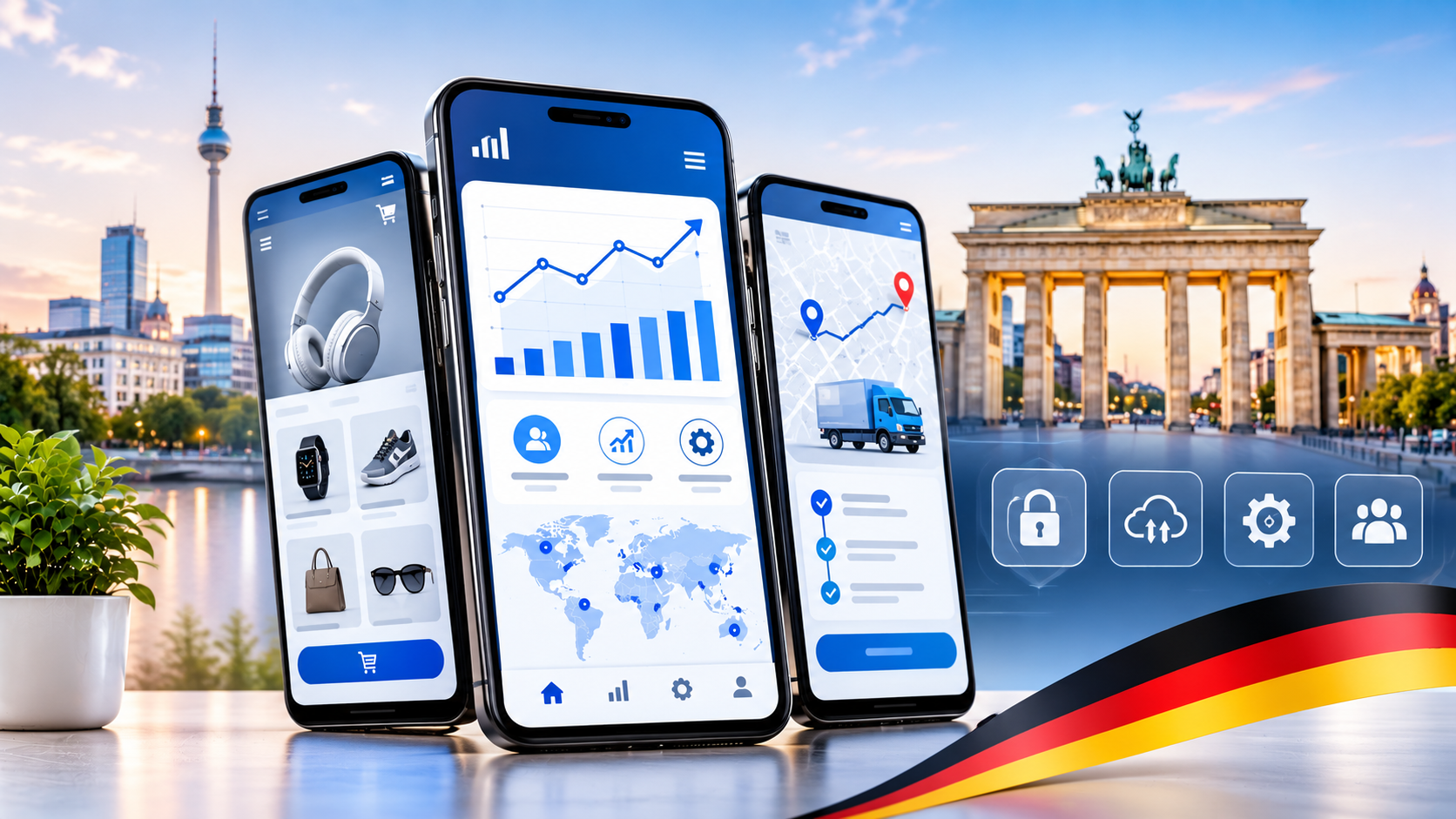
“German businesses are increasingly exploring mobile technology to improve customer engagement, streamline operations, and deliver convenient digital services. From e-commerce and logistics to healthcare, manufacturing, and professional services, mobile applications help organisations connect with customers and employees through intuitive digital experiences. Mobile app development for German businesses involves creating applications for iOS, Android, or both, tailored to specific business objectives and user requirements. These solutions can support online shopping, appointment booking, delivery tracking, employee workflows, customer management, and industry-specific services. As businesses prepare for 2027, important priorities include data privacy, application security, German-language localisation, artificial intelligence, accessibility, and integration with existing business systems.”
Mobile App Development for German Businesses: Features, Benefits and Trends for 2027
German businesses are increasingly exploring mobile technology to improve customer engagement, streamline operations, and deliver convenient digital services. From e-commerce and logistics to healthcare, manufacturing, and professional services, mobile applications help organisations connect with customers and employees through intuitive digital experiences. Mobile app development for German businesses involves creating applications for iOS, Android, or both, tailored to specific business objectives and user requirements. These solutions can support online shopping, appointment booking, delivery tracking, employee workflows, customer management, and industry-specific services. As businesses prepare for 2027, important priorities include data privacy, application security, German-language localisation, artificial intelligence, accessibility, and integration with existing business systems.
Why German Businesses Need Mobile Applications
1. Improve Customer Engagement
Mobile applications give customers convenient access to products, services, bookings, account information, and customer support. Features such as personalised notifications, loyalty programmes, and saved preferences can improve the overall user experience.
2. Streamline Business Operations
Business applications can simplify repetitive tasks, improve internal communication, and help employees access essential information while working remotely or on-site.
3. Expand Digital Services
Businesses can use mobile apps to offer digital bookings, online transactions, self-service portals, and personalised customer experiences across multiple channels.
4. Support International Expansion
Companies serving Germany and other European markets can build applications with multilingual interfaces, localised content, and flexible architecture to support future growth.
Types of Mobile Applications for German Businesses
E-commerce and Retail Apps
Offer product catalogues, shopping carts, order tracking, customer accounts, loyalty programmes, and personalised recommendations.
Logistics and Delivery Apps
Support shipment tracking, driver communication, delivery confirmation, route updates, and warehouse coordination.
Healthcare and Appointment Apps
Provide appointment scheduling, reminders, digital forms, and secure communication, with appropriate safeguards for sensitive information.
Manufacturing and Industrial Apps
Help employees monitor equipment, schedule maintenance, manage inventory, record inspections, and access operational dashboards.
Business Productivity Apps
Enable teams to manage tasks, approvals, documents, customer information, and internal workflows from mobile devices.
Travel and Hospitality Apps
Support reservations, digital itineraries, booking management, loyalty programmes, and customer notifications.
Essential Features of a Successful German Mobile App
German-Language Localisation
Applications targeting German users should consider professional German translations, local date and number formats, clear notifications, and culturally appropriate content. Multilingual support can be added when serving international audiences.
Data Privacy and Security
Businesses should evaluate GDPR obligations and applicable German data protection requirements. Appropriate safeguards may include secure authentication, encryption, access controls, data minimisation, and clear privacy information.
Secure Digital Transactions
Applications that support purchases or payments should use suitable payment providers and implement security measures appropriate to their functionality.
Intuitive UI/UX Design
Simple navigation, readable typography, consistent interfaces, and clear user journeys help people complete tasks efficiently.
Accessibility
Accessible interfaces should consider text readability, contrast, screen-reader compatibility, understandable controls, and clear error messages. Businesses should assess the accessibility requirements applicable to their particular service.
API and System Integration
Mobile applications can connect with CRM, ERP, inventory, booking, payment, and logistics systems through suitable APIs and integration methods.
Analytics and Performance Monitoring
Appropriately configured analytics can help businesses understand application usage, identify technical problems, and improve user journeys while respecting privacy requirements.
Native vs Cross-Platform App Development
Native Development
Native applications use platform-specific technologies, such as Swift or SwiftUI for iOS and Kotlin for Android. This approach offers strong control over platform features and can be suitable for specialised applications.
Cross-Platform Development
Frameworks such as Flutter and React Native allow developers to share substantial portions of the codebase across iOS and Android. This approach can support consistent functionality and efficient development for many business applications, although some features may still require native implementation.
Progressive Web Apps
Progressive web apps provide browser-based experiences with selected app-like capabilities. They can be appropriate for customer portals and services that do not require every native mobile feature. The best approach depends on the intended users, functionality, technical requirements, and long-term product strategy.
Mobile App Development Trends for Germany in 2027
1. AI-Powered Applications
AI can support intelligent search, virtual assistants, document processing, recommendations, and business insights. Each feature should have a clear purpose and appropriate safeguards for accuracy, privacy, and security.
2. Industrial IoT Integration
Mobile applications can connect employees with industrial equipment, connected devices, maintenance systems, and operational dashboards.
3. Cross-Platform Development
Cross-platform technologies can help businesses deliver applications across iOS and Android while sharing much of the underlying code.
4. Privacy-First Architecture
Privacy considerations should be integrated into requirements, design, development, analytics, and ongoing maintenance.
5. Cloud-Connected Applications
Cloud-connected systems can support synchronised information, centralised administration, and access to business services across multiple locations.
6. Accessible and Inclusive Design
Businesses should evaluate relevant accessibility standards and applicable legal requirements throughout design, development, and testing.
Conclusion
Mobile app development can help German businesses improve customer experiences, modernise operations, and deliver more convenient digital services. From e-commerce and logistics to industrial applications and employee platforms, successful solutions begin with a clear understanding of business and user needs. For 2027, businesses should prioritise intuitive design, reliable integrations, German-language localisation, privacy, security, accessibility, and long-term maintainability. Seyfert Infotech helps businesses explore mobile application solutions tailored to their goals, users, and technical requirements. A clear development roadmap can help turn a business idea into a useful, scalable digital product.
1. What is mobile app development for German businesses?
It is the process of creating mobile applications for German companies and their customers, employees, or business partners to support services, operations, and digital experiences.
2. Should a mobile app support the German language?
For applications targeting German-speaking users, German-language support is an important usability consideration. Additional languages may be useful for international audiences.
3. Is GDPR relevant to mobile app development in Germany?
Yes, when an application processes personal data within GDPR's scope. Businesses should assess applicable privacy, transparency, security, and data-retention requirements.