
“Educational organizations manage many interconnected activities every day. Admissions, student records, attendance, fees, examinations, staff management, communication, schedules, reports, and administrative tasks all need to work together smoothly. When these processes are handled through spreadsheets, paper records, or multiple disconnected applications, managing information can become time-consuming and difficult. A dynamic education management system can bring these activities together through a centralized digital platform. Instead of forcing an institution to change its workflow to match generic software, a custom-developed system can be designed around the organization's actual requirements. For schools, colleges, training institutes, coaching centers, universities, and other education businesses, this approach can create a more organized and scalable way to manage daily operations.”
Educational organizations manage many interconnected activities every day. Admissions, student records, attendance, fees, examinations, staff management, communication, schedules, reports, and administrative tasks all need to work together smoothly. When these processes are handled through spreadsheets, paper records, or multiple disconnected applications, managing information can become time-consuming and difficult. A dynamic education management system can bring these activities together through a centralized digital platform. Instead of forcing an institution to change its workflow to match generic software, a custom-developed system can be designed around the organization's actual requirements. For schools, colleges, training institutes, coaching centers, universities, and other education businesses, this approach can create a more organized and scalable way to manage daily operations.
What Is a Dynamic Education Management System?
A dynamic education management system is a software platform designed to manage and automate different operational activities within an educational organization. Unlike a basic static website or simple information management application, a dynamic system allows authorized users to add, update, search, manage, and analyze information through the application. For example, administrators may be able to manage student profiles, admission enquiries, fee records, attendance, examinations, staff information, notifications, and reports from a centralized dashboard. The important advantage is that the system can be developed according to the institution's specific business processes.
How Can It Improve Institutional Operations?
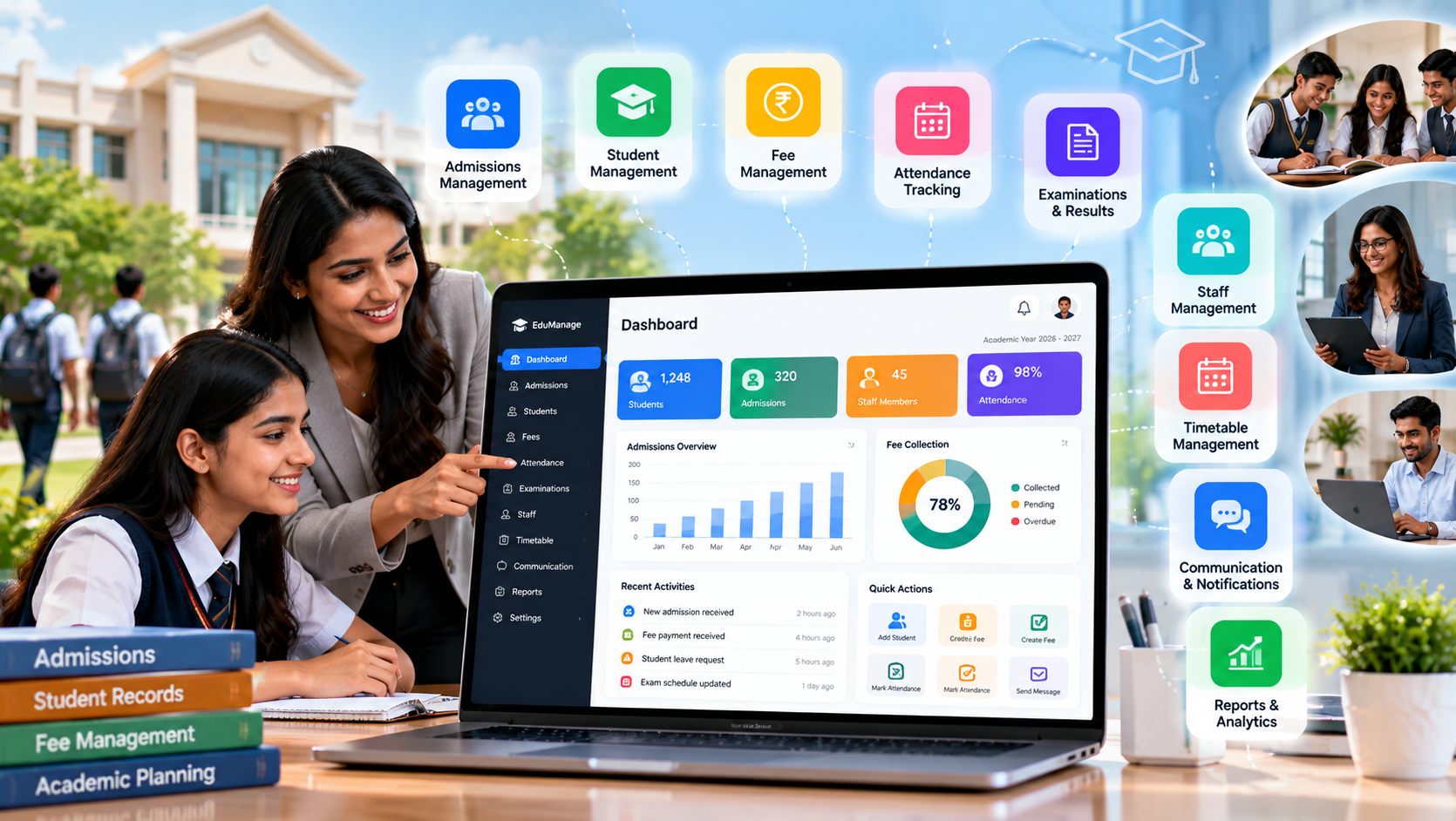
A well-designed education management system can improve operations by connecting different departments and workflows through one platform. 1. Centralized Student Management Educational institutions handle large amounts of student information, including personal details, academic information, enrollment records, attendance, fee information, examination results, and communication history. A dynamic system can store these details in a structured database and provide authorized users with access through a centralized interface. Instead of searching through multiple files or systems, staff can access the required student information from one location. This can improve data organization and make everyday administrative activities faster. 2. Streamlined Admission Management Admissions are an important operational process for education organizations. A dynamic platform can manage the complete admission workflow, starting from enquiry collection and application submission to verification, approval, enrollment, and student onboarding. The system can allow administrators to track: New enquiries Applicant information Application status Follow-up activities Documents Course or program selection Admission status Enrollment details This creates better visibility into the admission pipeline and reduces dependency on manual tracking. 3. Better Fee and Payment Management Managing fees manually can create challenges for administrative teams, particularly when an institution has a large number of students. A customized education management system can maintain fee structures, payment records, pending amounts, payment status, receipts, and transaction history. The system can also be integrated with payment gateways when required, allowing institutions to build a smoother digital payment workflow. Administrators can quickly identify pending payments and generate reports without manually combining information from different sources. 4. Efficient Attendance Management Attendance is another area where digital systems can reduce repetitive administrative work. Teachers or authorized staff can record attendance through the system, while administrators can view attendance information by student, class, department, course, or date. A dynamic system can also support attendance reports and notifications based on the institution's requirements. For organizations with different attendance policies, the software can be configured to follow their specific rules instead of relying on a one-size-fits-all workflow. 5. Simplified Examination and Result Management Educational institutions need to manage examination schedules, subjects, marks, grades, results, and academic records. A centralized system can allow authorized staff to manage examination-related information from a single platform. For example, administrators can create examination schedules, teachers can enter marks, and authorized users can generate result-related reports. The system can also be designed to support different grading structures depending on the educational organization's requirements. 6. Improved Staff Management Education organizations also need to manage information related to teachers, administrative employees, departments, roles, responsibilities, and schedules. A dynamic management system can provide role-based access so that different employees see the functions relevant to their responsibilities. For example, an administrator may have access to the complete system, while a teacher may only access assigned classes, attendance, examinations, and student information. This improves organization while helping protect sensitive information. 7. Better Communication With Students and Parents Communication is an important part of educational operations. A dynamic system can centralize notifications and communication related to admissions, attendance, examinations, fee reminders, events, schedules, announcements, and other important updates. Depending on the requirements, the platform can also be integrated with email, SMS, WhatsApp, or other communication services. This allows organizations to manage communication from their operational platform rather than maintaining separate manual processes. 8. Real-Time Dashboards and Reports One of the major advantages of dynamic software is the ability to convert stored data into useful information. An administrative dashboard can display important operational metrics such as: Total students New admissions Pending enquiries Fee collections Outstanding payments Attendance statistics Examination information Staff information Recent activities Management teams can use these dashboards to understand the current status of the organization without manually preparing reports from multiple sources. 9. Role-Based Access for Different Users Not every employee needs access to every part of an education management system. A custom platform can implement role-based access control according to the organization's hierarchy. For example: Super Administrator: Complete system access Admission Team: Enquiries, applications, follow-ups, and admissions Teachers: Students, attendance, examinations, and academic information Accounts Team: Fees, payments, receipts, and financial reports Management: Dashboards, analytics, and reports This approach can improve both usability and application security.
Why Should the System Be Customized Around the Organization?
Every educational organization may have different workflows. One institution may require detailed admission follow-ups, while another may focus more on course management and fee collection. A training institute may need batch management, while a college may require department, semester, subject, and examination workflows. Because of these differences, generic software may not always provide the exact functionality an organization needs. Custom software development allows the system to be designed around the existing business process. For example, if an institution follows a specific admission approval process, the software can implement that workflow directly rather than requiring employees to adapt their process to a generic application.
How Can a Dynamic System Reduce Manual Work?
Manual data entry and repetitive administrative activities can consume significant time. A dynamic platform can automate activities such as: Student registration Admission status updates Fee reminders Receipt generation Attendance calculations Notifications Report generation Follow-up tracking Data filtering Dashboard updates Document management When these processes are connected, information entered in one part of the system can automatically become available to other relevant modules. This reduces duplicate data entry and creates a more consistent flow of information.
How Can a Custom System Support Business Growth?
An education organization may start with a small number of students and employees but grow significantly over time. A properly planned software architecture can support this growth by allowing new modules and features to be added when required. For example, an organization may initially need: Student management Admissions Fees Attendance Later, it may require: Online payments Parent portals Mobile applications Advanced analytics Staff management Learning management features Multiple branches API integrations Automated notifications A scalable architecture allows these capabilities to be introduced without completely rebuilding the platform.
How Can Integrations Make the System More Powerful?
A modern education management system does not always have to operate independently. It can communicate with external services through APIs and integrations. Depending on business requirements, integrations can include: Payment gateways Email services SMS platforms WhatsApp services Authentication systems Cloud storage Accounting software Learning platforms Mobile applications These integrations can help create a connected digital ecosystem instead of isolated applications.
Why Is a Dynamic Web Application Better Than a Static Website for Operations?
A static website primarily provides information such as courses, facilities, contact details, announcements, and organization information. However, operational management requires something more interactive. A dynamic web application allows authorized users to log in and perform actions such as creating records, updating information, managing applications, generating reports, and monitoring activities. This makes the platform useful not only for presenting information but also for actually running business operations.
What Should Be Considered When Developing an Education Management System?
Before development begins, the organization should clearly identify its workflows and requirements. Important considerations include: User roles and permissions Student lifecycle Admission workflow Fee structure Attendance rules Examination process Staff responsibilities Reporting requirements Communication channels Data security Backup strategy Integration requirements Scalability Mobile responsiveness Understanding these requirements before development helps create software that solves real operational problems instead of simply adding unnecessary features.
Conclusion
A dynamic education management system can transform the way an educational organization manages its daily operations. By bringing admissions, students, fees, attendance, examinations, staff, communication, dashboards, and reports into one centralized platform, organizations can reduce manual work and improve operational visibility. The biggest advantage of custom development is flexibility. Instead of adapting the organization to generic software, the software can be developed around the organization's actual workflow. For education businesses looking to build a scalable digital platform, custom education management software can provide a foundation for improving current operations while supporting future growth and new business requirements.