
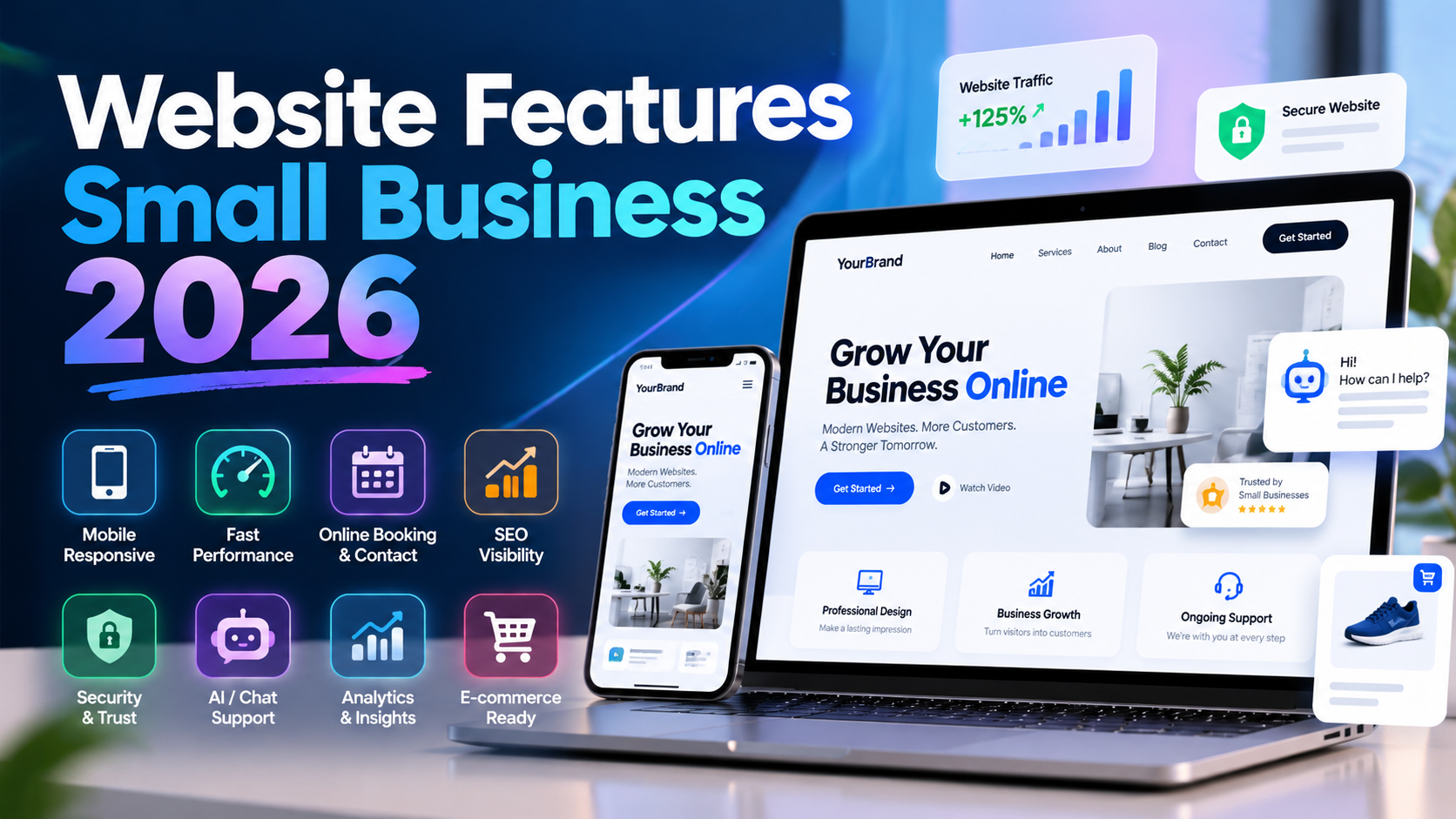
“A small business website is no longer just an online brochure. Customers use websites to understand services, compare businesses, check contact information, read reviews, find locations, and decide whether to make an enquiry or purchase.”
Why Small Businesses Need a Modern Website in 2026
A small business website is no longer just an online brochure. Customers use websites to understand services, compare businesses, check contact information, read reviews, find locations, and decide whether to make an enquiry or purchase.
In 2026, businesses need websites that are fast, mobile-friendly, secure, easy to navigate, and prepared for modern search experiences. Current website guidance for small businesses increasingly emphasizes mobile performance, clear calls-to-action, SEO foundations, analytics, security, and AI-friendly content.
Mobile-First Responsive Website Design
A mobile-first website is one of the most important features for a small business. Visitors should be able to browse services, read content, view images, submit forms, call the business, and use navigation comfortably from smartphones and tablets.
Responsive design should adapt layouts, typography, images, buttons, forms, and menus to different screen sizes. A website that looks good on desktop but becomes difficult to use on mobile can create a poor customer experience and reduce potential enquiries.
Fast Website Speed and Performance Optimization
Website speed directly affects the experience visitors have when opening a page. Large images, unnecessary scripts, inefficient code, excessive animations, and poor hosting configuration can make a small business website slower than it needs to be.
Modern website development should include image compression, efficient code, caching, optimized resources, and suitable hosting. Performance should also be monitored after launch because new content, plugins, integrations, and design changes can gradually affect loading speed.
Clear Navigation and Simple Website Structure
Visitors should be able to understand what a business offers without spending time searching through complicated menus. A clear navigation structure should make important pages such as Home, About, Services, Products, Blog, and Contact easy to access.
A well-organized structure also helps search engines understand relationships between pages. Logical categories, descriptive URLs, relevant internal links, and clear headings create a stronger foundation for both user experience and search optimization.
Strong Calls-to-Action for More Customer Enquiries
A business website should make it easy for visitors to take the next step. Depending on the business, this could mean calling the company, sending an enquiry, requesting a quotation, booking an appointment, starting a WhatsApp conversation, or purchasing a product.
Important calls-to-action should be visible without overwhelming the visitor. A clear CTA can appear in the header, service sections, landing pages, and contact areas while remaining relevant to the customer's stage in the decision-making process.
WhatsApp and Direct Communication Integration
Direct communication features can make it easier for potential customers to contact a small business. A WhatsApp button, click-to-call phone number, enquiry form, or chat option can provide visitors with multiple ways to start a conversation.
The communication method should match how the business actually handles enquiries. A WhatsApp button is useful only when someone is available to respond, while contact forms should be connected to a monitored email address or business system.
SEO-Friendly Website Structure for Search Visibility
Search engine optimization should be considered during website development rather than added only after the website is completed. Important pages should have descriptive titles, useful content, logical headings, clean URLs, internal links, optimized images, and technically accessible structures.
SEO-friendly development provides a foundation for future content marketing and local search optimization. Businesses can then build additional service pages, location pages, blogs, FAQs, and other useful resources around genuine customer search intent.
AEO and GEO Ready Content for AI Search
Search is increasingly incorporating AI-generated answers, making clear and well-structured website content more important. Businesses should create pages that directly answer common customer questions while providing detailed information about their products, services, expertise, and processes.
AEO focuses on answer-oriented content, while GEO is commonly used to describe optimization for generative AI discovery. These approaches should complement strong SEO rather than replace it, with useful content, clear information architecture, and accurate business information remaining the foundation.
Secure HTTPS Website and Protected Customer Forms
Security is essential for every business website, even when the website does not sell products online. HTTPS protects communication between the visitor's browser and the website, while secure forms and appropriate access controls help protect submitted information.
Businesses should also keep their CMS, frameworks, plugins, libraries, and integrations updated. Regular backups, strong administrator passwords, access restrictions, monitoring, and maintenance can reduce avoidable security and reliability problems.
Google Business Profile and Local SEO Integration
Local businesses should make it easy for customers to understand where they operate and how they can be contacted. A dedicated location or contact page can include the business address, service areas, phone number, opening information, map, and other useful local details.
The website should maintain consistent business information with relevant online profiles such as Google Business Profile. Accurate local information can help customers discover the business and understand whether its services are relevant to their location.
Dedicated Service and Product Pages
Small businesses often place all their services on one general page, but separate pages can provide customers with more useful information. Each important service page can explain the service, benefits, process, frequently asked questions, and appropriate next steps.
Dedicated pages can also create additional opportunities to target specific search intent. Instead of repeating keywords, businesses should make each page genuinely useful and clearly explain what makes the particular service or solution relevant to customers.
Customer Reviews and Trust-Building Elements
Customers often look for evidence that a business is reliable before making contact. Testimonials, genuine reviews, certifications, awards, project examples, client logos, case studies, and clear business information can help establish credibility.
Trust elements should be presented naturally throughout the website rather than placed only on one page. Real customer experiences and verifiable business information can provide stronger confidence than exaggerated marketing claims.
Analytics and Conversion Tracking Setup
Website traffic alone does not explain whether a website is helping the business. Analytics and search performance tools can help identify which pages receive visitors, where users come from, and which customer actions are taking place.
Conversion tracking can measure actions such as form submissions, phone clicks, WhatsApp interactions, bookings, downloads, and purchases. This information helps businesses understand which website pages and marketing activities are contributing to enquiries and sales.
Business Blog and Helpful Content Strategy
A business blog can help small companies answer customer questions and demonstrate knowledge within their industry. Useful topics can include how-to guides, service explanations, comparisons, frequently asked questions, pricing factors, maintenance advice, and industry trends.
Blog content should be created for real customers rather than simply publishing articles to increase page count. A well-planned content strategy can support SEO, AEO, GEO, internal linking, and long-term topical authority.
AI Features for Small Business Websites
Small businesses can consider AI features when they provide a genuine customer or operational benefit. Examples include AI chat assistants, intelligent search, automated enquiry handling, recommendation systems, document processing, and selected workflow automation.
AI functionality should be implemented according to the business's actual requirements. Accuracy, privacy, security, operating costs, and human oversight should be considered before connecting AI services to customer-facing or business-critical workflows.
Easy-to-Manage Content and Website Administration
A small business website should allow authorized users to update important information without depending on developers for every minor change. A suitable content management system can make it easier to update services, blogs, images, announcements, and other website content.
The administration panel should remain simple and focused on the business's actual requirements. Unnecessary complexity can make content management harder for staff and increase the amount of training required.
Website Maintenance and Continuous Improvement
A website should be reviewed regularly after launch because technology, customer expectations, search behaviour, security requirements, and business information can change. Maintenance can include software updates, backups, security checks, performance monitoring, bug fixes, and content updates.
Small businesses should also review their website at least periodically to identify outdated information, broken links, poor-performing pages, mobile usability problems, and opportunities to improve customer journeys. A website should evolve as the business grows rather than remain unchanged for years.
Your Small Business Website Should Do More Than Look Good — It Should Attract, Inform, Convert, and Grow With Your Business.
The most effective small business websites combine mobile-first design, fast performance, clear navigation, strong calls-to-action, SEO foundations, local visibility, security, analytics, useful content, and carefully selected AI features. These fundamentals create a website that works as an active business tool instead of a static online brochure.
Frequently Asked Questions About Small Business Websites
What are the most important features of a small business website in 2026?
Important features include mobile-responsive design, fast performance, clear navigation, strong calls-to-action, secure HTTPS, SEO-friendly structure, useful service pages, contact options, analytics, customer trust signals, and content prepared for modern search experiences.
Does a small business website need SEO?
Yes. SEO helps businesses make their website easier for search engines to discover and understand. Technical SEO, useful content, local optimization, internal linking, and well-structured service pages can support long-term organic visibility.
Should small businesses add WhatsApp to their website?
WhatsApp can be useful when customers commonly prefer direct messaging and the business has someone available to respond. It should be combined with other contact options such as click-to-call and enquiry forms when appropriate.
Does every small business need AI features?
No. AI should be added when it solves a genuine customer or operational problem. A fast, secure, mobile-friendly, SEO-ready website with useful content is more important than adding AI features without a clear purpose.
How often should a small business website be updated?
Technical maintenance should be performed regularly, while content should be updated whenever business information, services, products, contact details, or other important information changes. A broader website review at least once a year can help identify improvements.