
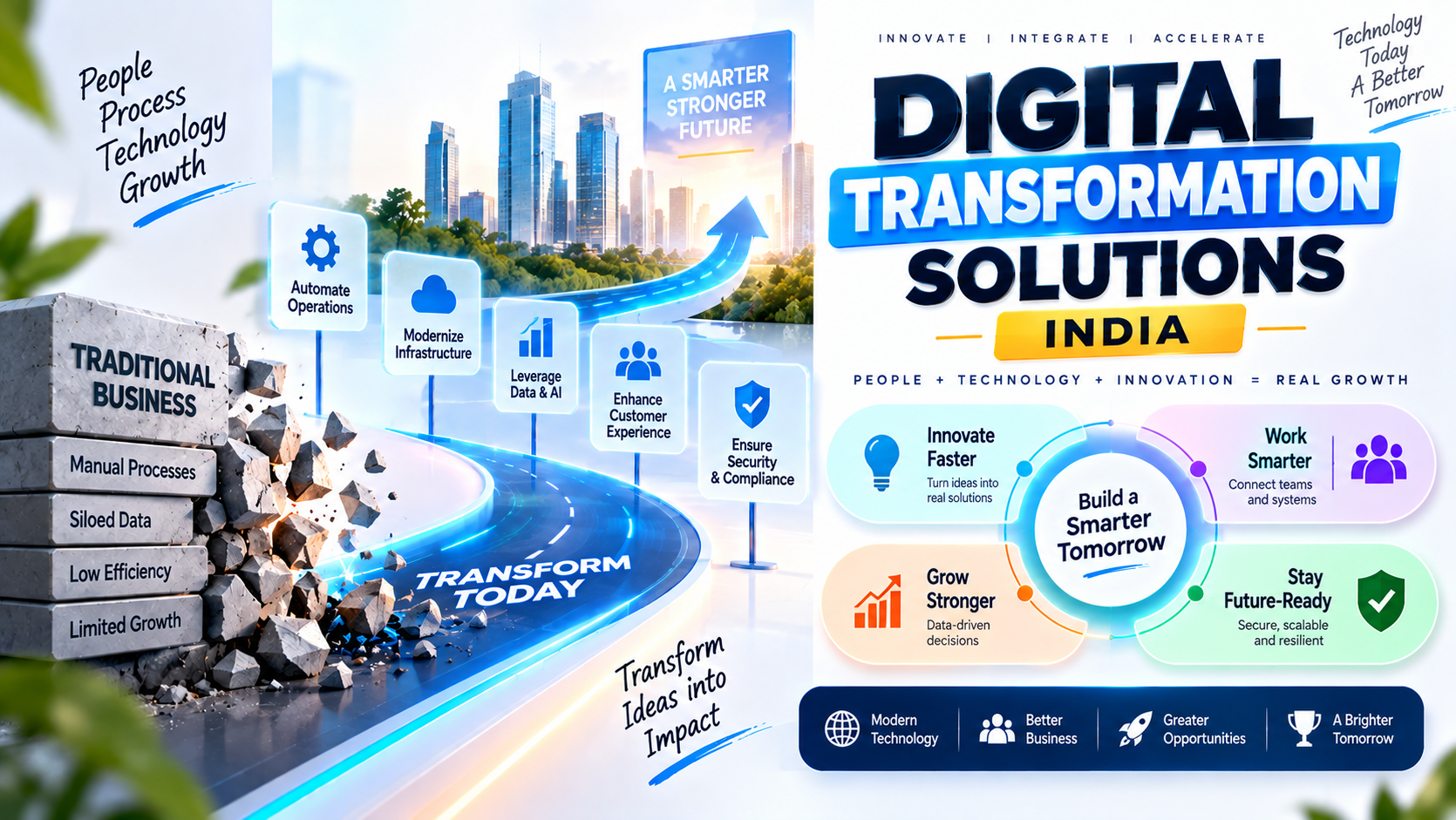
“Businesses increasingly depend on technology to manage customers, employees, operations, sales, communication, and business data. Organizations that rely heavily on disconnected spreadsheets, manual processes, or outdated applications may face difficulties as their operations expand. Digital transformation solutions in India help businesses evaluate these processes and introduce suitable technologies that improve connectivity, accessibility, automation, and operational visibility.”
Why Businesses Need Digital Transformation Solutions in India
Businesses increasingly depend on technology to manage customers, employees, operations, sales, communication, and business data. Organizations that rely heavily on disconnected spreadsheets, manual processes, or outdated applications may face difficulties as their operations expand. Digital transformation solutions in India help businesses evaluate these processes and introduce suitable technologies that improve connectivity, accessibility, automation, and operational visibility.
Digital transformation does not mean replacing every existing system at once. A practical strategy identifies areas where technology can solve genuine operational problems and prioritizes improvements according to business requirements. This approach allows organizations to modernize gradually while maintaining important workflows and reducing unnecessary disruption.
Custom Software Development for Digital Transformation
Building Software Around Business Requirements
Custom software development allows organizations to create applications based on their specific processes instead of depending entirely on generic software. Solutions can support sales, operations, inventory, customer management, reporting, approvals, and other business requirements. The development process should begin with an understanding of existing workflows, users, challenges, and expected outcomes before technologies and application architecture are selected.
Custom software can also be designed to integrate with compatible existing applications rather than replacing systems that continue to provide value. A scalable architecture provides greater flexibility when businesses need additional users, modules, locations, integrations, or functionality in the future.
CRM Solutions for Better Customer Management
Customer information is often distributed across spreadsheets, emails, messaging platforms, and different software applications. CRM solutions provide a centralized environment for managing leads, customer records, sales activities, follow-ups, and communication histories. A custom CRM can reflect the actual sales process of a business by defining stages, user roles, workflows, reminders, and reporting requirements.
CRM integration can also connect compatible websites, enquiry forms, communication systems, and other business applications through available APIs. Centralizing relevant customer information helps authorized teams maintain clearer visibility across the customer journey and coordinate sales and service activities more effectively.
ERP Solutions for Connected Business Operations
Enterprise Resource Planning solutions can connect important functions such as finance, purchasing, inventory, sales, production, human resources, and operational reporting. The required modules depend on the size, industry, and workflow of the organization. An integrated ERP environment can reduce fragmented information and provide authorized teams with more consistent access to operational data.
Custom ERP development allows businesses to configure workflows, approvals, dashboards, and reports according to actual organizational requirements. Implementation should include careful planning for data migration, employee adoption, security, integration, testing, and future scalability.
Business Process Automation Solutions
Many organizations spend significant time on repetitive activities such as data entry, assignments, notifications, approvals, status updates, and report preparation. Business process automation can reduce appropriate manual tasks by creating structured digital workflows. Automation rules can connect different stages of a process and trigger actions based on predefined business conditions.
Automation should be introduced where it creates practical value rather than applied to every business activity. Processes involving important judgment, exceptions, or sensitive decisions may still require human involvement. Mapping existing workflows before automation helps identify bottlenecks and determine where technology can provide meaningful improvements.
Cloud Solutions for Digital Business Transformation
Cloud-based applications can provide authorized employees with access to business systems across supported devices and locations. This can be useful for organizations with multiple branches, remote employees, distributed teams, or changing infrastructure requirements. Cloud technologies can support web applications, business software, databases, backups, integrations, and other digital services depending on organizational needs.
Moving business systems to cloud environments requires careful planning around availability, security, access controls, backups, performance, and data responsibilities. Organizations should select appropriate cloud architectures based on technical and business requirements rather than migrating systems simply because cloud technology is available.
AI Solutions for Business Automation and Productivity
Artificial intelligence can support selected business processes involving information retrieval, document analysis, customer assistance, classification, summaries, content support, and other suitable tasks. AI solutions should be introduced only after businesses identify a clear use case, the required data, expected level of accuracy, and how employees will interact with generated results.
Human review may remain important when AI outputs influence significant customer or operational decisions. Privacy, permissions, monitoring, and data security should also form part of AI implementation planning. A responsible approach allows organizations to use AI as a practical business tool rather than introducing automation without clear operational value.
Mobile App Development for Digital Transformation
Mobile applications can extend digital business systems to customers, employees, sales representatives, service teams, and other users. Depending on requirements, apps can support bookings, purchases, enquiries, field operations, customer accounts, approvals, and business dashboards. Native or cross-platform technologies can be selected according to functionality, target platforms, performance requirements, and development strategy.
Business mobile applications can also connect with CRM, ERP, e-commerce, and other backend systems through compatible APIs. This integration helps maintain more consistent information between mobile users and centralized business platforms while supporting convenient access to relevant services.
Web Application Development for Modern Businesses
Web applications can replace or improve manual workflows by providing centralized digital access through supported browsers. Businesses can develop customer portals, employee platforms, inventory applications, reporting systems, booking solutions, and other custom web-based tools. Responsive interfaces make these applications accessible across different screen sizes while centralized backend systems manage business information and application logic.
Modern web applications should consider usability, performance, security, accessibility, maintainability, and scalability throughout development. Clear navigation and role-based interfaces help users access relevant functionality without being overwhelmed by features that do not apply to their responsibilities.
System Integration and API Development Solutions
Digital transformation often involves connecting new technology with applications that a business already uses. API development and system integration can allow compatible CRM, ERP, websites, mobile apps, payment platforms, and communication systems to exchange permitted information. Connected systems can reduce duplicate data entry and create more consistent workflows between departments and digital channels.
Successful integrations require careful planning for authentication, data formats, synchronization, permissions, failures, and security. The capabilities of third-party platforms must also be considered because available APIs and permissions determine what information and actions can be integrated.
Data Analytics and Business Intelligence Solutions
Digital systems generate information about sales, customers, operations, inventory, marketing, and other business activities. Business intelligence solutions can organize relevant data into dashboards and reports that make operational information easier to understand. Management teams can use these dashboards to review appropriate metrics and identify patterns requiring further investigation.
Useful analytics depends on reliable underlying data. Organizations should therefore consider data quality, definitions, access permissions, integration, and reporting requirements before creating complex dashboards. A focused analytics strategy presents information that supports actual decisions rather than displaying large amounts of data without clear business purpose.
Cybersecurity in Digital Transformation Projects
As organizations connect more processes and information through digital platforms, security becomes an important part of transformation planning. Authentication, authorization, encryption, backups, software updates, secure development, and monitoring may all contribute to protecting business systems. Security requirements should be considered during architecture and development rather than treated as an optional feature after deployment.
Different organizations may require different controls based on their industry, data sensitivity, infrastructure, and applicable obligations. Employee access should also be managed carefully so users can work with the information and functionality necessary for their responsibilities without unnecessary privileges.
Digital Transformation Solutions for Different Industries
Digital transformation can support manufacturing, healthcare, education, retail, logistics, hospitality, real estate, finance, technology, and professional service organizations. Each industry has different operational challenges and technology requirements. A manufacturing company may prioritize ERP and inventory systems, while a service business may focus more heavily on CRM, automation, customer portals, and mobile applications.
Industry requirements should therefore be analyzed before selecting software or building digital platforms. Understanding real workflows helps organizations identify which technologies can provide practical improvements. A customized transformation roadmap can then prioritize projects according to operational importance, complexity, and available resources.
SEO AEO and GEO in Digital Transformation Strategy
Digital transformation can also include improving how customers discover and understand a business online. Search Engine Optimization strengthens traditional organic search foundations, while Answer Engine Optimization focuses on clear answers to relevant customer questions. Generative Engine Optimization considers how structured, useful, and credible information can be understood within emerging AI-assisted discovery experiences.
SEO, AEO, and GEO work best when supported by technically strong websites, accurate business information, useful content, clear service pages, and structured information. Businesses should focus on creating valuable digital experiences for customers instead of treating these approaches as methods for simply increasing keyword repetition.
How to Choose Digital Transformation Solutions in India
Organizations planning digital transformation should begin by identifying business problems rather than selecting technology first. Existing processes, software, integrations, customer journeys, employee requirements, security, and long-term objectives should be evaluated before implementation. A development partner can then recommend suitable combinations of custom software, CRM, ERP, mobile applications, cloud platforms, automation, AI, and integrations.
Businesses should also consider scalability, maintenance, training, data migration, technical support, and future integration requirements when creating their transformation roadmap. Breaking complex transformation projects into clearly defined phases can make implementation easier to manage while allowing organizations to evaluate progress at each stage.
Digital transformation combines custom software, CRM, ERP, cloud technology, AI, automation, mobile applications, analytics, and system integrations around real business requirements. A structured transformation strategy helps organizations modernize gradually while building scalable digital systems that can evolve with future operational needs.
Frequently Asked Questions About Digital Transformation Solutions
What are digital transformation solutions?
Digital transformation solutions use appropriate technologies to improve business processes, customer experiences, communication, data management, and operations. Solutions can include custom software, CRM, ERP, cloud platforms, mobile apps, automation, AI, analytics, and integrations.
Can small businesses use digital transformation solutions?
Yes. Digital transformation does not have to involve a large enterprise project. Small businesses can begin with focused improvements such as CRM software, workflow automation, cloud applications, customer portals, or integrated digital systems.
Can AI be included in digital transformation?
Yes. AI can support suitable use cases such as customer assistance, information retrieval, document processing, classification, analytics, and workflow automation. The implementation should consider accuracy, security, privacy, data quality, and appropriate human oversight.
Can existing business software be integrated with new solutions?
Yes, when compatible APIs or other supported integration methods are available. Integration can connect existing applications with new CRM, ERP, web, mobile, automation, or analytics platforms while reducing unnecessary replacement of useful systems.