
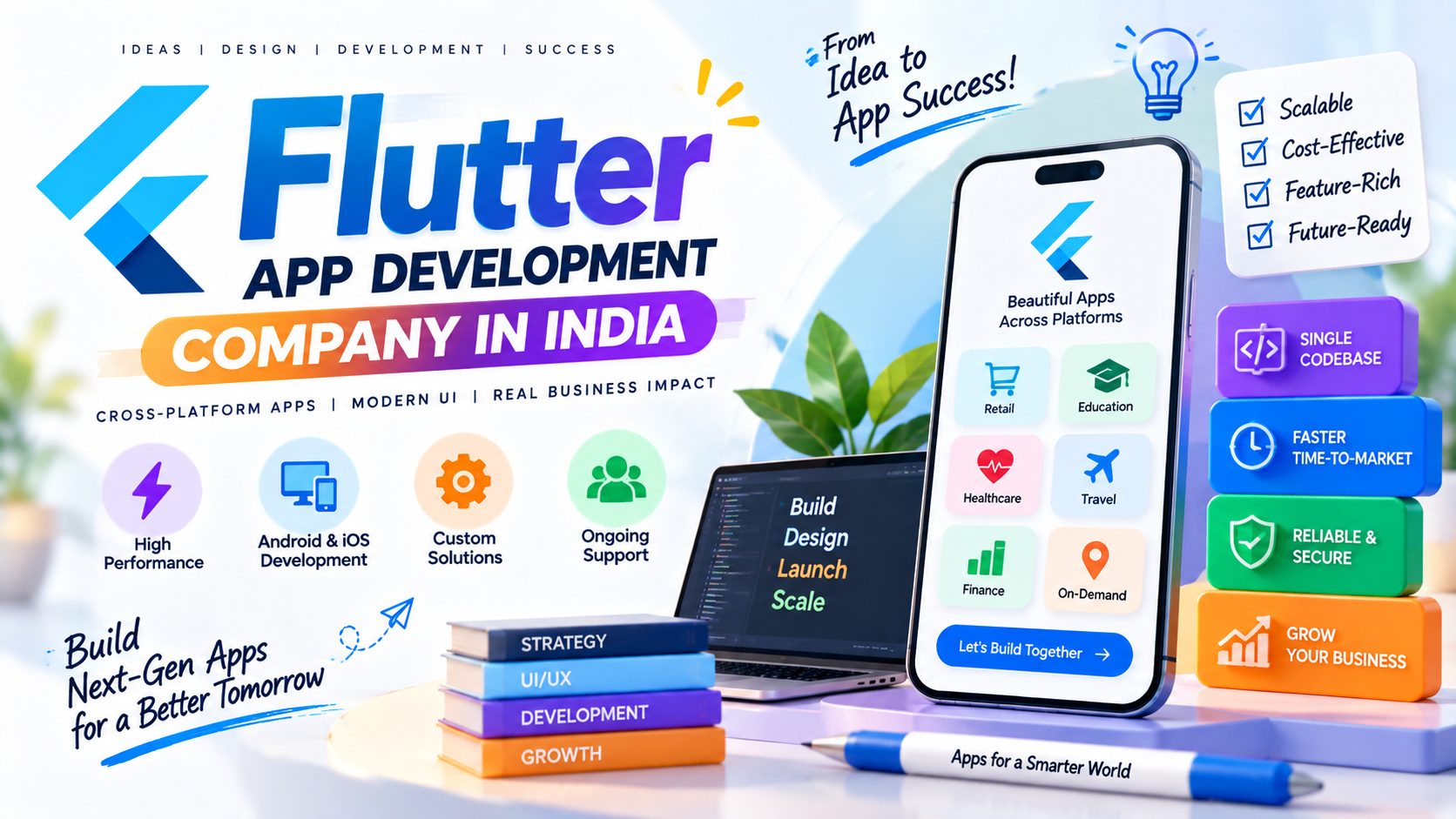
“Businesses increasingly need mobile applications that provide a consistent experience across different devices while remaining practical to develop and maintain. Flutter provides a cross-platform development framework that can be used to build applications for Android and iOS from a largely shared codebase. Flutter app development in India can support startups, small businesses, and enterprises that need custom mobile solutions without maintaining completely separate application projects for each supported mobile platform.”
Why Choose Flutter App Development in India
Businesses increasingly need mobile applications that provide a consistent experience across different devices while remaining practical to develop and maintain. Flutter provides a cross-platform development framework that can be used to build applications for Android and iOS from a largely shared codebase. Flutter app development in India can support startups, small businesses, and enterprises that need custom mobile solutions without maintaining completely separate application projects for each supported mobile platform.
Flutter provides developers with a flexible user interface system and tools for creating responsive mobile experiences. Applications can be designed according to brand requirements while connecting with APIs, databases, payment services, and other compatible business systems. The appropriate architecture and integrations depend on the application’s functionality, expected users, security requirements, and future expansion plans.
Custom Flutter App Development Services
Mobile Applications Designed Around Business Requirements
Every mobile application serves a different purpose, from customer engagement and online shopping to internal operations and service management. Custom Flutter app development begins by understanding the target users, required features, business workflow, and expected application journey. Developers can then plan the interface, application architecture, database requirements, APIs, authentication, notifications, and other functionality around those requirements.
Custom development also allows businesses to avoid unnecessary functionality that can make applications more difficult to use. Features can instead be prioritized according to genuine customer and operational requirements. A structured development approach creates a stronger foundation for adding future modules and integrations when the application grows.
Flutter Android App Development Solutions
Flutter can be used to create Android applications with custom interfaces and business-specific functionality. Applications can support customer accounts, product catalogues, bookings, enquiries, dashboards, notifications, location features, and other appropriate capabilities. Android development should consider different device sizes, operating system versions, performance requirements, and permissions during design and testing.
Businesses can also connect Flutter Android applications with existing web platforms and backend systems through suitable APIs. Careful testing across supported devices helps identify interface, performance, connectivity, and functionality issues before an application is released to users.
Flutter iOS App Development Services
Flutter also enables businesses to develop applications for supported iOS devices using the same cross-platform development ecosystem. The application interface can be adapted to provide an appropriate experience while following relevant platform requirements. Features such as authentication, notifications, API communication, media handling, and other business functionality can be integrated according to project requirements.
iOS applications still require platform-specific testing, configuration, signing, and release processes even when developed with a cross-platform framework. A professional Flutter development workflow therefore considers the requirements of both Android and iOS rather than assuming identical behavior across every device.
Flutter App UI UX Design and Development
A mobile application should make important actions easy for users to understand and complete. UI and UX planning helps define navigation, screen hierarchy, forms, buttons, content presentation, user journeys, and interactive components before development becomes too complex. Flutter provides a flexible widget-based approach that allows developers to create customized interfaces aligned with a company’s visual identity.
Good mobile design should also consider readability, accessibility, different screen sizes, loading states, error messages, and user feedback. Combining visual quality with practical usability creates an application that supports business goals without making everyday actions unnecessarily complicated.
Flutter E-Commerce App Development
Retailers and online businesses can use Flutter to build mobile commerce applications for customers using Android and iOS devices. Depending on requirements, applications can include product discovery, categories, search, customer accounts, carts, wishlists, checkout, and order information. Compatible payment gateways, inventory platforms, shipping services, and backend systems can also be integrated through supported methods.
E-commerce applications require particular attention to security, performance, product data, transaction workflows, and usability. The checkout journey should remain clear and minimize unnecessary steps for customers. Businesses should also plan how application data will remain synchronized with their website, inventory, CRM, or other existing systems.
Flutter Apps for CRM and Business Management
Flutter applications can provide mobile access to CRM, ERP, sales, inventory, service, and other internal business platforms. Employees can use appropriate mobile features to access customer information, update activities, manage tasks, or review operational data. Role-based access can ensure that employees only see information and functionality relevant to their responsibilities.
Mobile business applications are particularly useful for field sales representatives, service teams, managers, and employees working across multiple locations. Connecting the application with a centralized backend can help maintain more consistent information between mobile users and office-based teams.
API Integration for Flutter Mobile Applications
Modern mobile applications frequently rely on APIs to communicate with backend systems and third-party services. Flutter applications can integrate with compatible APIs for authentication, customer data, products, payments, bookings, notifications, maps, and other functionality. Reliable API architecture is important because many application features depend on accurate and secure communication between the mobile interface and backend services.
Developers should consider authentication, validation, error handling, permissions, connectivity, and data security when implementing integrations. Well-structured APIs can also make it easier to connect future applications or additional digital platforms with the same business backend.
AI Integration in Flutter App Development
Artificial intelligence can be integrated into Flutter applications when it provides a meaningful benefit to users or business workflows. Potential use cases include conversational assistance, intelligent search, content recommendations, document processing, classification, and other AI-supported functionality. The appropriate AI solution depends on application requirements, available data, privacy considerations, and the accuracy expected from the feature.
AI-generated information may require verification or human review depending on its purpose. Applications should communicate limitations appropriately and include suitable safeguards when AI affects important customer or business processes. Thoughtful AI integration can add useful functionality without making the mobile experience unnecessarily complicated.
Flutter App Performance and Security Optimization
Mobile application performance affects usability, particularly when users work with slower networks or lower-powered devices. Developers can review application startup, API requests, images, state management, animations, caching, and other areas that influence responsiveness. Performance testing should be conducted throughout development instead of waiting until the application is ready for release.
Security is equally important when applications manage user accounts, customer information, payments, or business data. Secure authentication, encrypted communication, permission management, validation, and careful handling of sensitive information should be considered during development. Security requirements can vary significantly according to the application’s industry and functionality.
Flutter App Testing and Quality Assurance
Testing helps identify functional, visual, performance, and compatibility issues before customers begin using an application. Flutter projects can include different levels of automated and manual testing depending on application complexity and business requirements. Important customer journeys such as registration, login, enquiries, purchases, payments, and data updates should receive particular attention.
Testing across relevant Android and iOS devices can reveal differences that may not appear during development on a single environment. A structured quality assurance process helps development teams identify problems earlier and improve application reliability before deployment.
Flutter App Maintenance and Future Upgrades
Mobile application development continues after the initial release because operating systems, APIs, dependencies, business requirements, and customer expectations change over time. Maintenance can include bug fixes, compatibility updates, performance improvements, security updates, and feature enhancements. Monitoring user feedback and technical issues can help businesses identify which improvements should receive priority.
A maintainable codebase makes future development easier when new features or integrations are required. Documentation, structured architecture, version control, and appropriate testing all contribute to long-term application maintainability. Businesses should therefore consider ongoing support when planning the initial Flutter development project.
Flutter App Development for Different Industries
Flutter applications can support businesses across e-commerce, education, healthcare, real estate, logistics, hospitality, retail, manufacturing, finance, and professional services. Each industry requires a different combination of customer journeys, security considerations, integrations, workflows, and mobile functionality.
Understanding the industry and target users before development helps determine which features genuinely provide value. A logistics application may prioritize tracking and field operations, while an e-commerce application may focus on products, payments, and order management. Industry-focused planning creates a more relevant application instead of relying on the same feature set for every business.
How to Choose a Flutter App Development Company in India
Businesses evaluating a Flutter development company should consider experience with mobile architecture, UI and UX, APIs, backend development, security, testing, deployment, and post-launch maintenance. The development team should first understand the business objective and target users before recommending application features or technical architecture.
Businesses should also discuss source code ownership, scalability, integrations, project milestones, testing, app store deployment, and ongoing support before development begins. Clear requirements and communication between business and technical teams can make the development process easier to manage from planning through launch.
Flutter enables businesses to develop cross-platform mobile applications while maintaining a largely shared development codebase across Android and iOS. Combining Flutter with scalable APIs, secure backend systems, thoughtful UI and UX, and appropriate AI capabilities can create flexible mobile solutions for modern business requirements.
Frequently Asked Questions About Flutter App Development
What is Flutter app development?
Flutter app development uses Google’s Flutter framework to build applications from a largely shared codebase across supported platforms. It is commonly used for cross-platform mobile development, including Android and iOS applications.
Can Flutter develop both Android and iOS applications?
Yes. Flutter supports Android and iOS development from a largely shared codebase, although platform-specific configuration, testing, permissions, signing, and deployment requirements may still be necessary.
Can Flutter apps integrate with existing business software?
Yes. Flutter applications can connect with compatible CRM, ERP, e-commerce, payment, booking, and other business systems through available APIs and supported integration methods.
Can AI features be added to a Flutter application?
Yes. Flutter applications can connect with suitable AI services for features such as chat assistance, intelligent search, recommendations, classification, and other business-specific use cases, subject to technical, privacy, and accuracy requirements.