
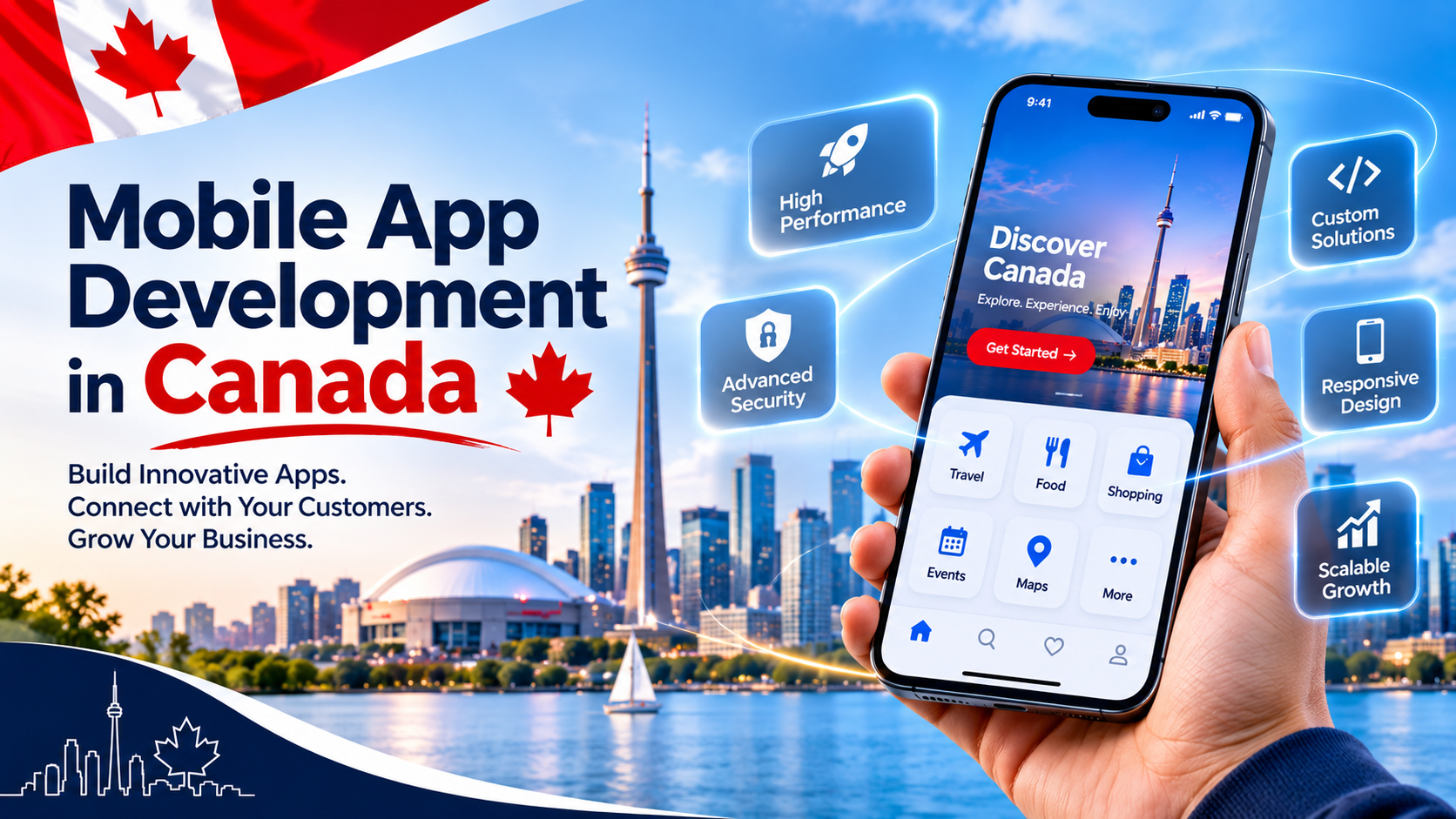
“Mobile applications have become an essential part of how businesses connect with customers, deliver services, and improve everyday operations. Across Canada, businesses are investing in mobile app development to create convenient digital experiences, strengthen customer relationships, and remain competitive in an increasingly digital marketplace. From Toronto and Vancouver to Montreal, Calgary, and Ottawa, mobile applications are transforming industries such as retail, healthcare, education, finance, transportation, and professional services. In 2026, mobile app development is evolving beyond traditional applications. Artificial intelligence, personalized user experiences, cloud integration, advanced security, and cross-platform technologies are helping businesses develop smarter and more scalable digital solutions. Whether a company is launching a new startup or modernizing an established business, investing in the right mobile app strategy can create new opportunities for growth across the Canadian market.”
Mobile applications have become an essential part of how businesses connect with customers, deliver services, and improve everyday operations. Across Canada, businesses are investing in mobile app development to create convenient digital experiences, strengthen customer relationships, and remain competitive in an increasingly digital marketplace. From Toronto and Vancouver to Montreal, Calgary, and Ottawa, mobile applications are transforming industries such as retail, healthcare, education, finance, transportation, and professional services. In 2026, mobile app development is evolving beyond traditional applications. Artificial intelligence, personalized user experiences, cloud integration, advanced security, and cross-platform technologies are helping businesses develop smarter and more scalable digital solutions. Whether a company is launching a new startup or modernizing an established business, investing in the right mobile app strategy can create new opportunities for growth across the Canadian market.
Why Mobile App Development Is Important for Canadian Businesses
Canadian consumers increasingly expect convenient, responsive, and accessible digital services. Mobile applications allow businesses to provide customers with direct access to products, services, bookings, support, and account information from their smartphones. Instead of relying entirely on physical locations or traditional communication channels, businesses can build stronger customer connections through personalized mobile experiences. For small and medium-sized businesses, mobile applications can improve operational efficiency, simplify repetitive tasks, and create additional revenue opportunities. Features such as push notifications, loyalty programs, digital payments, appointment scheduling, and real-time updates help businesses maintain engagement while delivering more convenient services. A well-planned mobile application can also support business expansion by making products and services accessible to customers across multiple Canadian provinces.
Latest Mobile App Development Trends in Canada for 2026
1. AI-Powered Mobile Applications
Artificial intelligence is changing how mobile applications understand user needs and deliver personalized experiences. Businesses can integrate AI-powered chatbots, intelligent search, recommendation engines, automated customer support, and predictive analytics into their applications. These capabilities can help users find relevant information faster while allowing businesses to understand customer preferences more effectively. For example, a Canadian retail application could recommend products based on browsing behaviour, while a service-based business could use an AI assistant to answer common questions and guide customers through bookings. Businesses should implement AI responsibly, with appropriate privacy safeguards, transparent functionality, and meaningful human support when needed.
2. Cross-Platform App Development
Cross-platform development enables businesses to create applications for both Android and iOS using shared code where appropriate. Technologies such as React Native and Flutter can help development teams reduce duplicated effort, streamline maintenance, and deliver consistent experiences across devices. This approach can be especially useful for startups and growing businesses that need to manage development budgets without compromising essential functionality. However, the right technology depends on application complexity, performance requirements, integrations, and the need for native device capabilities.
3. Personalized User Experiences
Modern users expect applications to feel relevant, intuitive, and easy to navigate. Personalized dashboards, location-aware services, saved preferences, tailored recommendations, and accessible interfaces can make mobile applications more useful to individual customers. Canadian businesses serving diverse audiences should also consider language preferences, regional needs, and accessibility from the beginning of the design process. Applications that are easy to understand and navigate can help improve engagement and build customer trust.
4. Mobile App Security and Data Privacy
Security is a critical consideration for Canadian mobile applications, particularly those that handle personal information, payments, health information, or financial transactions. Businesses should implement secure authentication, encrypted data transmission, appropriate access controls, secure API communication, and regular security testing. Application owners should also assess their privacy obligations under applicable Canadian federal and provincial laws, depending on the industry and location. Privacy-conscious development, clear consent practices, data minimization, and responsible data retention can help businesses protect users and maintain confidence in their digital services.
5. Cloud-Based Mobile Applications
Cloud integration allows mobile applications to connect with centralized databases, business systems, analytics platforms, and scalable backend services. This can support real-time synchronization, efficient data management, automated backups, and easier collaboration between users and teams. For Canadian businesses with multiple locations or customers across different provinces, cloud-based architecture can help deliver consistent digital services. Developers should evaluate hosting regions, data residency requirements, availability, performance, and disaster recovery needs before selecting a cloud infrastructure.
6. On-Demand Service Applications
On-demand applications continue to offer opportunities for businesses that connect customers with services, products, or professionals. Examples include food delivery, transportation, home services, appointment booking, and local marketplace platforms. Businesses can use features such as real-time notifications, location tracking, digital payments, booking management, and customer reviews to simplify service delivery. A successful on-demand application should be designed around a clear business model, dependable operations, user safety, and a smooth experience for both customers and service providers.
7. Mobile Commerce and Digital Payments
Mobile commerce enables businesses to bring product discovery, shopping, payments, and order tracking directly to customers' smartphones. Retailers and online businesses can benefit from features such as secure checkout, digital wallets, personalized offers, inventory updates, and loyalty rewards. Canadian businesses should ensure their payment integrations support the intended customer base and meet relevant security requirements. Simplifying the checkout process, providing transparent pricing, and making order information easy to access can help reduce friction in the buying journey.
Industries Benefiting from Mobile App Development in Canada
Healthcare
Healthcare applications can support appointment scheduling, reminders, patient communication, and access to selected health services. Solutions that handle sensitive health information require particularly careful attention to privacy, security, accessibility, and applicable healthcare regulations.
Education
Educational applications can provide digital learning materials, student portals, course schedules, assessment tools, and communication between learners and educators. Institutions can use mobile technology to make learning resources more accessible across locations and devices.
Retail and E-Commerce
Retail applications help businesses showcase products, manage customer accounts, offer personalized recommendations, and deliver convenient shopping experiences. Integrations with inventory and order management systems can improve operational visibility.
Finance and Fintech
Financial applications can support account access, transaction monitoring, budgeting, digital payments, and financial service management. Strong authentication, fraud prevention, secure architecture, and regulatory compliance are essential in this sector.
Travel and Hospitality
Travel and hospitality businesses can use mobile applications for reservations, itineraries, digital check-ins, booking updates, and customer support. Location-based information and personalized recommendations can help improve the customer journey.
Logistics and Transportation
Logistics applications can support delivery tracking, fleet coordination, route planning, proof of delivery, and communication between drivers and operations teams. Real-time information can help businesses improve visibility across their delivery processes.
How to Choose the Right Mobile App Development Company in Canada
Choosing a development partner is an important step in building a reliable mobile application. Businesses should evaluate a company's technical experience, portfolio, industry knowledge, communication process, and approach to long-term maintenance. A development partner should understand the business problem before recommending technologies or features. The development process should include requirement analysis, user research, UI/UX design, technical planning, development, quality assurance, security testing, deployment, and ongoing support. Businesses should also clarify project scope, milestones, ownership of source code, third-party service costs, maintenance responsibilities, and post-launch support before signing an agreement. Rather than selecting a provider based only on the lowest price, businesses should compare the overall value, technical quality, scalability, and ability to deliver a maintainable solution.
The Future of Mobile App Development in Canada
The future of mobile app development will be shaped by intelligent automation, stronger privacy practices, improved accessibility, connected digital services, and more efficient development tools. As customer expectations evolve, businesses will need to focus on applications that solve real problems rather than simply adding technology for its own sake. Companies that combine reliable engineering with useful features, intuitive design, and continuous improvement will be better positioned to create lasting value. For Canadian startups and established organizations alike, mobile app development can become an important part of a broader digital transformation strategy.
Conclusion
Mobile app development in Canada offers businesses opportunities to improve customer engagement, streamline operations, and expand their digital reach. From AI-powered features and cross-platform development to secure payments and industry-specific applications, the right solution depends on a clear understanding of customer needs and business objectives. By investing in thoughtful planning, user-centred design, secure architecture, and ongoing maintenance, businesses can build mobile applications that remain useful as their needs grow. In 2026, a successful mobile app is not just a digital product; it is a practical tool for delivering better services and supporting sustainable business growth.
What are the latest mobile app development trends in Canada for 2026?
Key trends include AI-powered features, cross-platform development, personalized experiences, cloud integration, mobile commerce, stronger security, and accessibility-focused design.
How much does it cost to develop a mobile app in Canada?
The cost depends on the application's complexity, features, design, integrations, and maintenance requirements. A detailed project scope is the best starting point for obtaining a reliable estimate.
Should a business choose native or cross-platform app development?
Native development can be suitable when an application requires platform-specific functionality or highly specialized performance. Cross-platform development can be effective when a business wants to support Android and iOS while sharing much of its codebase.