
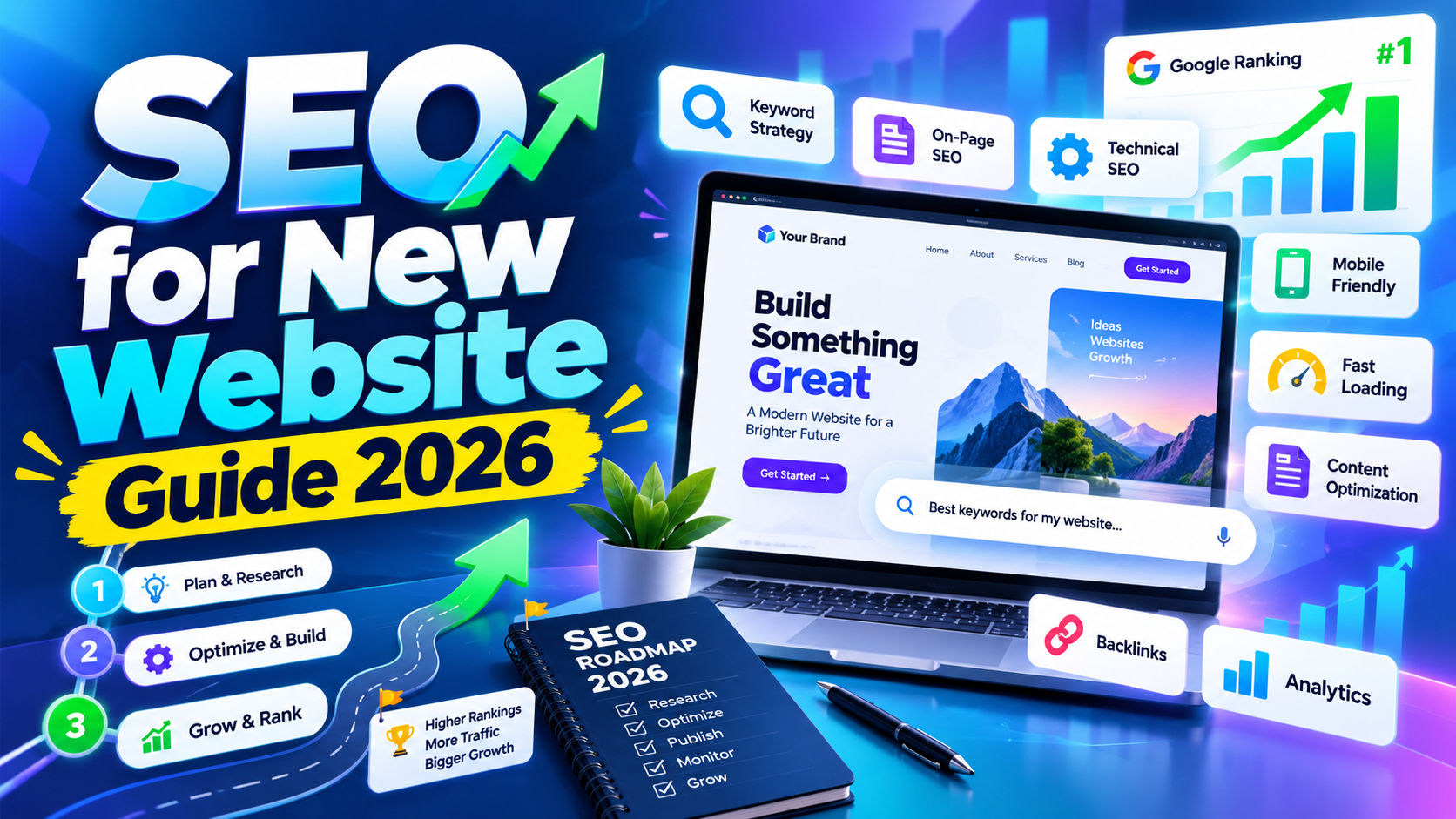
“Launching a new website does not automatically bring visitors from Google. Search engines need to discover, crawl, understand, and evaluate the pages before they can appear for relevant searches. SEO gives a new website the foundation needed to build organic visibility over time.”
Why SEO Is Important for a New Website in 2026
Launching a new website does not automatically bring visitors from Google. Search engines need to discover, crawl, understand, and evaluate the pages before they can appear for relevant searches. SEO gives a new website the foundation needed to build organic visibility over time.
For a new business website, SEO should begin before the website is launched rather than being treated as a separate activity afterward. Website structure, page topics, URLs, content, performance, mobile usability, and technical accessibility can all be planned with search visibility in mind.
Start SEO Planning Before Launching Your Website
SEO planning should begin while the website structure is being prepared. Businesses should identify their target customers, important services or products, locations served, common customer questions, and the search terms people may use to find their offerings.
Early SEO planning helps developers and content teams create the right page structure from the beginning. It can prevent problems such as missing service pages, confusing navigation, duplicate URLs, weak content organization, and unnecessary changes after launch.
Perform Keyword Research Based on Search Intent
Keyword research helps identify the words and phrases customers use when searching for products, services, information, or solutions. A new website should focus on relevant search terms that match its actual offerings rather than targeting keywords simply because they have high search volume.
Search intent should be considered alongside keywords. Someone searching for a definition may need an informational article, while someone searching for a service may be ready to compare providers or make an enquiry. Matching content with intent creates a more useful search experience.
Create a Clear SEO-Friendly Website Structure
A new website should have a logical structure that makes it easy for visitors and search engines to understand the relationship between pages. Important categories, services, products, locations, blogs, and supporting resources should be organized into a clear hierarchy.
Simple navigation, descriptive URLs, relevant internal links, breadcrumbs where appropriate, and well-organized content categories can help users find information more easily. A strong structure also provides a foundation for expanding the website as the business grows.
Create Dedicated Pages for Important Services
New websites often make the mistake of placing every service on a single page. Separate pages can provide more detailed information about important services while allowing each page to address a specific customer need and search intent.
A strong service page should explain what the service provides, who it is for, how the process works, important benefits, common questions, and the next step for customers. Content should be genuinely useful rather than created only to target search terms.
Write Helpful and Original Content From the Beginning
Content is an important part of building organic visibility for a new website. Businesses should publish information that demonstrates genuine knowledge of their products, services, industry, customers, and processes rather than relying on generic text available across many websites.
Original examples, case studies, practical explanations, customer questions, industry insights, comparisons, and detailed guides can make website content more useful. Content should be created primarily for people and should provide a clear reason for visitors to trust and use the website.
Optimize Page Titles and Meta Descriptions
Each important page should have a descriptive title that clearly communicates its subject. Titles should naturally include relevant terminology while remaining readable and useful to people viewing search results.
Build a Strong Internal Linking Strategy
Internal links connect related pages within a website and help visitors discover additional information. They also provide search engines with useful context about how different pages and topics are connected.
A new website can create internal links between service pages, blogs, FAQs, guides, category pages, and related resources. Descriptive anchor text and natural linking can help users understand what they will find on the destination page.
Make Your New Website Mobile Friendly
A large number of customers access websites through smartphones, making mobile usability essential for new websites. Visitors should be able to read content, navigate menus, view images, submit forms, and contact the business comfortably on smaller screens.
Responsive development should adapt layouts, typography, buttons, images, forms, and navigation to different devices. Businesses should test important pages across smartphones, tablets, laptops, and desktop screens before and after launch.
Improve Website Speed and Core Web Vitals
Website performance should be considered from the first stage of development. Large images, unnecessary scripts, excessive animations, inefficient code, and unsuitable hosting can slow down a new website and negatively affect the visitor experience.
Image compression, efficient code, caching, optimized resources, suitable hosting, and performance monitoring can help create a faster website. Performance should continue to be monitored as new pages, plugins, tracking tools, and features are added.
Set Up Technical SEO Before Website Launch
Technical SEO helps search engines discover and process website content. Before launch, businesses should review important technical elements including HTTPS, XML sitemaps, robots.txt, canonical URLs, redirects, indexability, URL structure, mobile responsiveness, and website architecture.
A technical SEO checklist can help identify problems before search engines begin processing the website. After launch, the website should also be monitored for crawl errors, indexing issues, broken links, unexpected redirects, and other technical problems.
Submit Your Website to Google Search Console
Google Search Console provides website owners with information about search performance, indexing, search queries, and technical issues. Setting it up early allows businesses to monitor how Google discovers and processes the new website.
Website owners can use Search Console to inspect URLs, review indexing information, monitor search performance, identify certain technical issues, and understand how pages are appearing in Google Search. It should be part of the ongoing SEO process rather than a one-time setup.
Create and Maintain an XML Sitemap
An XML sitemap provides search engines with information about important URLs on a website. It is particularly useful for helping search engines discover pages on a new website that may not yet have many external references.
The sitemap should contain the important canonical URLs that businesses want search engines to discover. It should also be kept updated as new pages are added or existing website structures change.
Optimize Images for SEO and Performance
Images can improve product pages, service pages, blogs, and educational content, but poorly optimized images can make a new website unnecessarily slow. Businesses should use appropriate image dimensions, modern formats where suitable, and compression to reduce unnecessary file sizes.
Relevant alternative text can also improve accessibility and help describe images when they cannot be displayed. Alt text should accurately describe meaningful images rather than being filled with repeated keywords.
Use Structured Data Where It Makes Sense
Structured data can provide search engines with additional information about supported content types. Depending on the website, relevant markup may describe organizations, products, articles, breadcrumbs, events, or other supported information.
Structured data should accurately represent the visible content on the page and follow search engine requirements. It should be treated as a supporting technical feature rather than a shortcut for achieving higher rankings.
Optimize Your Website for Local SEO
Local businesses should build location relevance into their SEO strategy from the beginning. Important business information such as name, address, phone number, service areas, and location details should be clearly presented on the website.
Businesses can also create useful location and service pages when they genuinely serve those areas. Maintaining accurate information across the website and relevant business profiles can help customers understand where the company operates.
Prepare Your New Website for AEO
Answer Engine Optimization focuses on making useful answers easy for users and search systems to understand. New websites can prepare by creating question-based content, FAQs, clear definitions, detailed service explanations, and direct answers to common customer questions.
AEO should complement traditional SEO rather than replace it. Strong website architecture, crawlability, helpful content, internal linking, and good page experience remain important foundations for search visibility.
Make Your Website Ready for GEO and AI Search
Generative Engine Optimization is commonly used to describe strategies for improving visibility within AI-generated search experiences. New websites can prepare by creating authoritative content, maintaining consistent business information, answering customer questions, and developing comprehensive resources around important topics.
There is no need to abandon traditional SEO for GEO. A technically accessible website with useful content and genuine expertise provides a stronger foundation for changing search experiences than trying to use artificial shortcuts designed specifically for AI systems.
Build Topic Authority With a Consistent Blog Strategy
A new website can gradually build topical authority by publishing useful content around its core products, services, industry questions, and customer problems. Blog topics should support the main website rather than being selected only because a keyword appears popular.
Related articles can be connected to service pages through internal links, creating a clear relationship between informational and commercial content. Over time, this approach can help create a deeper resource for customers researching the business's area of expertise.
Build Trust With Real Business Information
A new website should clearly communicate who operates the business and how customers can contact it. About pages, company information, service details, contact information, customer reviews, case studies, certifications, and genuine business experience can help visitors evaluate the organization.
Trust should be supported by accurate and verifiable information rather than exaggerated claims. Businesses should keep important details consistent and update them whenever services, locations, contact information, or other key information changes.
Build Quality Backlinks Over Time
A new website may initially have very few external links, so businesses can gradually build online authority by creating resources that other relevant websites genuinely want to reference. Industry guides, original research, useful tools, case studies, and expert resources can provide opportunities for natural references.
The focus should be on relevant and trustworthy links rather than collecting large numbers of low-quality backlinks. Sustainable authority building takes time and should be supported by strong content and genuine industry relationships.
Monitor SEO Performance After Launch
SEO work should continue after a new website goes live. Businesses should monitor search impressions, clicks, indexed pages, organic traffic, important search queries, landing-page performance, and conversions to understand how the website is developing.
Performance data can reveal which pages attract attention and which areas need improvement. SEO decisions should be based on meaningful trends rather than making major changes because of short-term fluctuations in traffic or rankings.
Common SEO Mistakes New Websites Should Avoid
New websites often struggle because SEO is added too late, pages contain thin content, keywords are used unnaturally, important services lack dedicated pages, technical problems are ignored, or the website is designed only for desktop users.
Another common mistake is publishing large quantities of generic content without adding genuine value. A smaller number of useful and well-structured pages can provide a stronger foundation than hundreds of weak pages created only to target search terms.
Create a Long-Term SEO Strategy for Your New Website
SEO for a new website should be treated as a long-term process rather than a launch-day task. Technical optimization, useful content, internal linking, local SEO, authority building, performance improvements, and regular monitoring should work together.
Businesses should also adapt their strategies as search behaviour changes. By combining traditional SEO with AEO, GEO, AI search readiness, and a strong user experience, a new website can build a foundation for sustainable organic visibility in 2026 and beyond.
Launch Your Website With SEO Built In — Not Added Later
A new website has the advantage of starting with a clean technical and content foundation. Planning SEO before launch, creating useful pages, optimizing performance, building authority, and monitoring results can give businesses a stronger path toward long-term organic growth.
Frequently Asked Questions About SEO for New Websites
How do I start SEO for a new website?
Start with search-intent and keyword research, create a logical website structure, develop useful service and informational pages, implement technical SEO, optimize mobile performance and page speed, set up Google Search Console, and begin monitoring search performance after launch.
How long does SEO take for a new website?
There is no fixed timeline for a new website to gain organic visibility. Results depend on competition, website quality, content depth, authority, search demand, technical health, and the consistency of SEO efforts.
Should SEO be done before launching a website?
Yes. Planning SEO before launch allows businesses to build search-friendly website architecture, page topics, URLs, content, internal links, and technical foundations from the beginning instead of correcting structural problems later.
Can a new website rank on Google without backlinks?
A new website can receive organic visibility without having a large backlink profile, particularly for relevant and less competitive searches. However, building genuine authority and earning relevant references can become increasingly important as competition grows.
Is AEO and GEO important for a new website in 2026?
AEO and GEO can help businesses prepare for answer-based and generative search experiences. However, they should complement strong SEO fundamentals such as crawlability, useful content, clear structure, internal linking, and good website performance.