
“Mobile applications have become an important part of how businesses communicate with customers, deliver services, and manage everyday operations. Across Australia, organisations in retail, healthcare, education, hospitality, logistics, finance, and professional services are exploring mobile technology to make their services more accessible and their business processes more efficient. As customer expectations continue to evolve, mobile app development for Australian businesses is increasingly focused on convenience, reliability, personalisation, and practical business outcomes. A well-designed mobile application can help customers book appointments, purchase products, manage accounts, receive notifications, and access services from their smartphones. For businesses, mobile apps can also support employee communication, field operations, inventory management, reporting, and customer relationship management. The right application depends on the organisation's objectives, target audience, and the problems it intends to solve. Looking towards 2027, Australian businesses should consider how mobile applications fit into their broader digital strategy. Modern app development involves more than creating an attractive interface. It requires thoughtful user experience design, secure architecture, reliable integrations, performance optimisation, and ongoing maintenance. By investing in the right features and technologies, businesses can develop mobile experiences that remain useful as their customers and operational requirements change.”
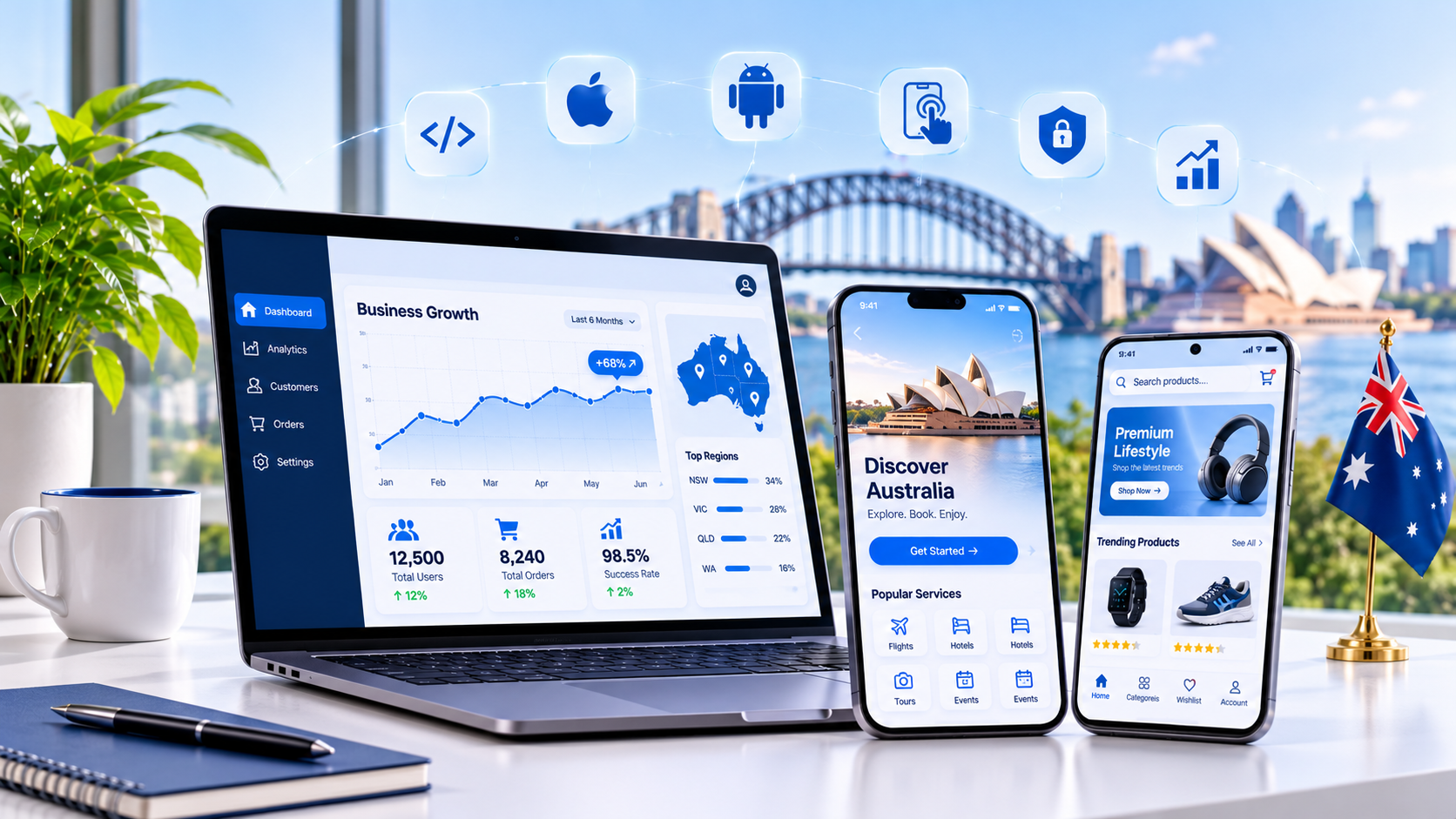
Mobile applications have become an important part of how businesses communicate with customers, deliver services, and manage everyday operations. Across Australia, organisations in retail, healthcare, education, hospitality, logistics, finance, and professional services are exploring mobile technology to make their services more accessible and their business processes more efficient. As customer expectations continue to evolve, mobile app development for Australian businesses is increasingly focused on convenience, reliability, personalisation, and practical business outcomes. A well-designed mobile application can help customers book appointments, purchase products, manage accounts, receive notifications, and access services from their smartphones. For businesses, mobile apps can also support employee communication, field operations, inventory management, reporting, and customer relationship management. The right application depends on the organisation's objectives, target audience, and the problems it intends to solve. Looking towards 2027, Australian businesses should consider how mobile applications fit into their broader digital strategy. Modern app development involves more than creating an attractive interface. It requires thoughtful user experience design, secure architecture, reliable integrations, performance optimisation, and ongoing maintenance. By investing in the right features and technologies, businesses can develop mobile experiences that remain useful as their customers and operational requirements change.
Why Mobile App Development Matters for Australian Businesses
Australian customers interact with businesses through multiple digital channels, including websites, mobile applications, online stores, and customer support platforms. A mobile application can provide a dedicated experience for customers who regularly use a service or need convenient access to specific features. For example, a retailer can use a mobile app to support product discovery, loyalty programmes, order tracking, and personalised offers. A healthcare provider may use an application to manage appointments, reminders, and selected patient services. A logistics company could introduce an app for delivery updates, driver workflows, and proof of delivery. Mobile applications can also help businesses organise internal activities. Employees may use dedicated apps to access schedules, submit reports, manage field tasks, or communicate with colleagues. When an application is connected to the appropriate business systems, it can reduce manual work and improve the consistency of operational information. The value of mobile app development comes from solving a real problem. Businesses should identify what customers or employees need to accomplish and determine whether a dedicated app offers meaningful advantages over an existing website or other digital solution.
Custom Mobile App Development for Australian Companies
Custom mobile app development allows businesses to build functionality around their unique services, workflows, and customer requirements. Instead of relying entirely on generic software, an organisation can create an application with specific features, integrations, and user journeys. A professional services company might need a client portal with document sharing and appointment scheduling. A retailer could require product catalogues, customer accounts, order notifications, and loyalty features. An enterprise may need an internal application connected to its inventory, CRM, or resource management systems. The development process should begin with requirements analysis, user research, and feature prioritisation. This helps businesses distinguish essential functionality from optional enhancements and establish a realistic product roadmap. Custom development also requires long-term planning. The application should be designed so that features can be improved, security updates can be applied, and integrations can be maintained as business requirements evolve. A well-planned architecture supports future development without making every change unnecessarily complicated.
iOS and Android App Development in Australia
Choosing the right mobile platforms is an important early decision. Australian audiences use both iOS and Android devices, so businesses should evaluate their target customers, expected usage, required features, and available resources before selecting a development approach.
iOS App Development
iOS app development focuses on applications for Apple's mobile ecosystem. Businesses may choose an iOS application when their target audience, service model, or required device capabilities make the platform a priority. A successful iOS app should follow platform conventions, provide clear navigation, support appropriate accessibility features, and handle permissions responsibly. Developers should also test on supported devices and operating system versions to ensure that important workflows operate reliably.
Android App Development
Android app development provides access to a broad range of smartphones and devices. Applications need to account for differences in screen sizes, hardware capabilities, operating system versions, and device configurations. Responsive layouts, efficient resource usage, clear permission handling, and thorough device testing help create a consistent experience. Businesses should also consider the devices commonly used by their intended customers and employees when planning testing requirements.
Native vs Cross-Platform Development
Native development uses platform-specific technologies, while cross-platform frameworks can allow teams to share a substantial portion of their application code across iOS and Android. Technologies such as Flutter and React Native can be suitable for many business applications. Native development may be more appropriate when an application requires specialised platform functionality, particular performance characteristics, or extensive device-level integration. The best approach depends on the application's complexity, required integrations, performance expectations, and long-term maintenance needs. Businesses should evaluate these requirements rather than assuming that one development method is always superior.
Essential Features of a Modern Business Mobile App
A successful mobile application combines useful functionality with an intuitive user experience. Account registration, secure authentication, profile management, search, notifications, and accessible navigation may be appropriate for many business applications, depending on their purpose. Customer-facing apps may require booking systems, online payments, product catalogues, order tracking, loyalty features, or customer support. Internal applications may instead focus on task assignments, staff schedules, reporting, document access, and operational dashboards. The application should also provide clear feedback when users complete an action, encounter an error, lose connectivity, or need to update information. Well-designed loading states, helpful error messages, and appropriate offline behaviour can make an app easier to use. Features should be selected according to genuine user needs. Adding too many functions at launch can make an application harder to navigate and maintain. A focused first release, followed by improvements informed by user feedback, often provides a more manageable development strategy.
AI-Powered Mobile Applications
Artificial intelligence is creating new possibilities for mobile applications, including intelligent search, personalised recommendations, conversational assistance, document processing, and automated content analysis. For Australian businesses, the most valuable AI features are those that address a clear user need. A retail application might help customers find suitable products, while a field-service app could assist staff with retrieving relevant documentation. An internal business app might summarise records or help employees locate information across approved knowledge sources. Some AI tasks can run directly on a device, while others require a cloud-based service. On-device processing may offer advantages for latency, offline availability, or data minimisation, depending on the capability. Cloud processing can provide access to more powerful services but introduces connectivity, operational, and data-handling considerations. AI features should be tested for accuracy, reliability, privacy, and usability. Businesses should also provide appropriate human oversight when automated outputs could affect important decisions. AI should improve the application experience rather than be added simply because it is a popular technology trend.
Mobile App Security and Privacy in Australia
Security is an essential part of mobile app development. Applications may process personal details, account credentials, location information, payment-related data, or confidential business records. These information types require appropriate protection throughout the application lifecycle. Recommended practices include secure authentication, encrypted communication, safe credential storage, restricted permissions, dependency updates, secure API design, and regular testing. Applications should request only the permissions needed for their functionality and explain their purpose clearly. Australian businesses should assess their obligations under applicable privacy legislation, including the Privacy Act 1988 where relevant. Requirements depend on the organisation, the data being processed, and the nature of the service. Businesses should also evaluate relevant app-store rules and sector-specific obligations. Privacy should influence architecture and feature decisions from the beginning. Data minimisation, appropriate retention policies, clear privacy notices, and secure deletion procedures can help organisations manage information responsibly.
User Experience and Mobile App Performance
A mobile application should make common tasks simple and predictable. Clear navigation, readable typography, accessible controls, consistent layouts, and helpful feedback allow users to complete actions with less frustration. Performance is equally important. Slow screens, repeated crashes, excessive battery consumption, and unreliable network requests can discourage continued use. Developers should optimise images and assets, reduce unnecessary processing, handle network failures, and monitor important performance indicators. Testing should cover different device sizes, operating system versions, network conditions, and accessibility needs. Usability testing with representative users can reveal problems that automated checks alone may not detect. A successful app is not defined only by its visual appearance. It must also remain dependable when users perform real tasks in everyday conditions.
Integrating Mobile Apps with Existing Business Systems
Businesses often rely on several digital platforms to manage customers, orders, employees, finance, and operations. A mobile application can provide a convenient interface to these systems when suitable integration methods are available. For example, a sales app could retrieve product information from an inventory platform, while a booking app might synchronise appointments with a supported scheduling system. A field-service application could submit completed job records to an administrative dashboard. APIs commonly enable these connections, but integration should be planned carefully. Developers need to consider authentication, data consistency, API availability, rate limits, error handling, and monitoring. A reliable integration should communicate failures clearly and avoid creating duplicate or inconsistent records. Connecting existing systems can be more effective than rebuilding functionality that already works well. The objective is to create a useful, maintainable digital experience with minimal unnecessary duplication.
The Mobile App Development Process
Successful mobile app development begins with discovery and planning. The business and development team define the target audience, key user problems, required functionality, platform priorities, integration requirements, and measurable outcomes. The next stage focuses on user experience and interface design. Wireframes and prototypes allow stakeholders to review navigation and key workflows before implementation begins. Early feedback helps identify missing features and usability problems. Development then covers the application interface, backend services, database operations, authentication, and required integrations. Testing should include functionality, responsiveness, security, performance, accessibility, and behaviour under poor network conditions. Before release, the team should validate the production environment, analytics, privacy information, store listing assets, and app-store submission requirements. Following launch, monitoring and maintenance help address defects, update dependencies, improve performance, and respond to user feedback. A structured development process helps businesses manage complexity and build an application around clearly defined objectives.
How to Choose a Mobile App Development Company for Australia
Choosing a mobile app development partner requires evaluating technical capabilities and the ability to understand business requirements. Businesses should review relevant project experience, platform expertise, design quality, testing practices, communication, and ongoing support arrangements. A reliable development process should include documented requirements, clear milestones, regular demonstrations, agreed acceptance criteria, and a plan for managing changes. Businesses should also clarify ownership of source code, design assets, developer accounts, documentation, and associated intellectual property. For international development partnerships, communication schedules, time-zone coordination, security responsibilities, and post-launch support should be agreed in advance. These arrangements help establish clear expectations throughout the project. The best development partner is one that connects technical decisions to business outcomes and can explain the trade-offs involved in different approaches.
How Seyfert Infotech Can Support Australian Businesses
Seyfert Infotech helps businesses explore digital solutions aligned with their operational goals and customer requirements. For Australian organisations considering a mobile application, the development process can begin with understanding the intended users, core features, existing systems, and long-term objectives. Depending on the project, a solution may include custom mobile app development, cross-platform applications, backend APIs, customer portals, business workflow integrations, administrative dashboards, and ongoing maintenance. The objective is to build a reliable application that makes important tasks easier, supports the business's digital strategy, and remains practical to maintain as requirements change. Careful planning and appropriate technology selection help align the final product with the intended business outcomes. Businesses planning a new mobile application can contact Seyfert Infotech to discuss their requirements and explore a suitable development approach.
Conclusion
Mobile app development for Australian businesses in 2027 is about creating reliable digital experiences that address real customer and operational needs. Custom functionality, intuitive design, secure architecture, suitable integrations, and ongoing optimisation can help businesses build applications that remain useful over time. From retail and healthcare to education, logistics, and professional services, the right mobile application can improve access to services, support customer relationships, and simplify everyday workflows. Success depends on selecting appropriate features, understanding users, and maintaining the application after release. Seyfert Infotech can help businesses explore mobile app development and digital solutions aligned with their objectives.
Build a smarter mobile experience for your customers and business.
What is mobile app development for Australian businesses?
Mobile app development involves designing, building, testing, and maintaining applications for smartphones and tablets. Businesses use mobile apps to deliver services, manage customer relationships, support employees, and simplify operational processes.
Should an Australian business develop an iOS app, an Android app, or both?
The choice depends on the target audience, required features, business objectives, and available resources. Businesses should research their users and assess whether native or cross-platform development is the most appropriate approach.
What is the difference between native and cross-platform app development?
Native development uses platform-specific technologies, while cross-platform frameworks allow developers to share much of the code between iOS and Android. The right approach depends on performance requirements, device integration, application complexity, and maintenance needs.