
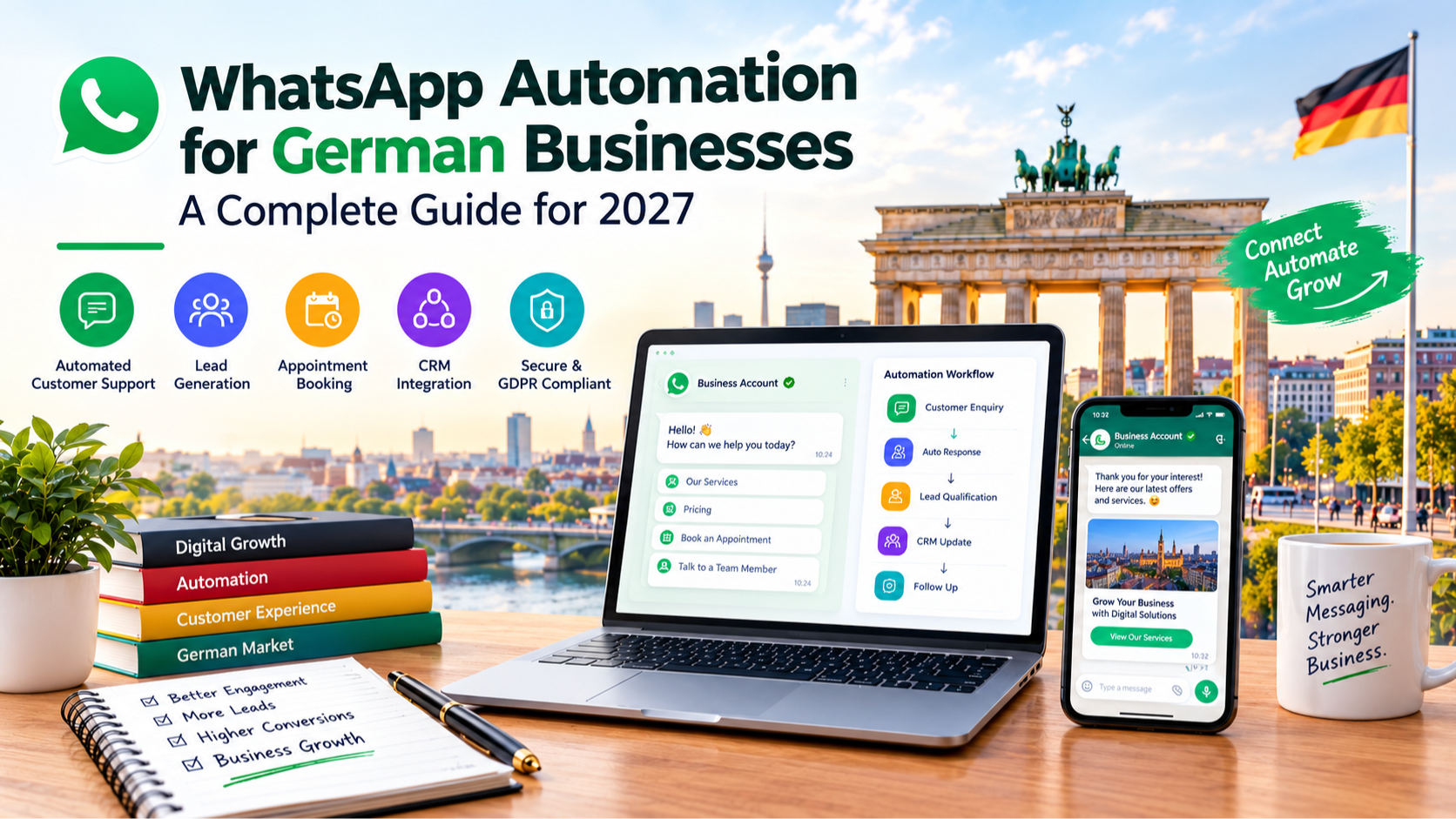
“WhatsApp has become an important communication channel for businesses that want to connect with customers quickly and conveniently. For companies in Germany, automated messaging can help streamline customer enquiries, improve response times, manage sales follow-ups, and reduce repetitive administrative work. As businesses prepare for 2027, WhatsApp automation offers opportunities to improve customer communication without requiring employees to handle every interaction manually. From small service providers and e-commerce stores to B2B companies and appointment-based businesses, automation can support a wide range of customer communication needs. With the WhatsApp Business Platform, businesses can integrate messaging into websites, customer relationship management (CRM) systems, booking applications, and other business tools. These integrations make it possible to build structured workflows for enquiries, notifications, support requests, and customer updates. However, successful automation requires more than sending automatic messages. Businesses must create useful customer experiences, protect personal information, follow applicable German and European privacy requirements, and respect WhatsApp's business messaging policies. This guide explains how WhatsApp automation works, its benefits for German businesses, practical implementation strategies, integration options, and the steps companies can take to build an effective messaging automation system in 2027.”
WhatsApp has become an important communication channel for businesses that want to connect with customers quickly and conveniently. For companies in Germany, automated messaging can help streamline customer enquiries, improve response times, manage sales follow-ups, and reduce repetitive administrative work. As businesses prepare for 2027, WhatsApp automation offers opportunities to improve customer communication without requiring employees to handle every interaction manually. From small service providers and e-commerce stores to B2B companies and appointment-based businesses, automation can support a wide range of customer communication needs. With the WhatsApp Business Platform, businesses can integrate messaging into websites, customer relationship management (CRM) systems, booking applications, and other business tools. These integrations make it possible to build structured workflows for enquiries, notifications, support requests, and customer updates. However, successful automation requires more than sending automatic messages. Businesses must create useful customer experiences, protect personal information, follow applicable German and European privacy requirements, and respect WhatsApp's business messaging policies. This guide explains how WhatsApp automation works, its benefits for German businesses, practical implementation strategies, integration options, and the steps companies can take to build an effective messaging automation system in 2027.
What Is WhatsApp Automation?
WhatsApp automation is the use of software and predefined workflows to manage business conversations and customer notifications through WhatsApp. Instead of manually responding to every message, businesses can configure automated systems to acknowledge enquiries, answer common questions, collect relevant information, send appointment reminders, and route conversations to the appropriate team. For example, when a customer submits an enquiry through a company's website, an integrated workflow could send an acknowledgement, record the enquiry in a CRM system, and notify the relevant sales representative.
Common WhatsApp automation features include: 1. Automated welcome messages and acknowledgements. 2. Frequently asked question responses. 3. Lead collection and qualification workflows. 4. Appointment booking confirmations and reminders. 5. Order and delivery notifications. 6. Customer support routing. 7. CRM and helpdesk integrations. 8. Human-agent handover. 9. Approved outbound messaging campaigns. 10. Reporting and conversation analytics. The exact capabilities depend on the solution used. Basic WhatsApp Business app features differ from the more advanced integration and automation options available through the WhatsApp Business Platform.
Why German Businesses Should Consider WhatsApp Automation in 2027
German businesses operate in a competitive environment where customer experience, operational efficiency, and responsible data handling are important considerations. Automation can help organizations manage communication more consistently while allowing employees to focus on complex customer needs.
Faster Customer Responses
Customers may contact businesses outside normal working hours or while employees are handling other tasks. Automated acknowledgements can confirm that a message has been received and explain when a customer can expect a response. For example, a German web development company could automatically acknowledge a project enquiry and ask the customer to share their project requirements. Automation does not eliminate the need for human support. Instead, it helps customers understand the next step while reducing unnecessary waiting.
Reduced Repetitive Work
Many customer conversations involve recurring questions about business hours, pricing, product availability, appointment schedules, or service details. A carefully designed automated workflow can handle common requests and direct more complicated questions to the appropriate employee. This reduces repetitive manual work and allows staff to spend more time on tasks that require judgment, expertise, and personal attention.
Improved Lead Management
Website enquiries and social media messages can easily become scattered across different communication channels. Integrating WhatsApp with a CRM system can help businesses organize incoming leads and track follow-up activities. For example, a B2B service provider can record the customer's requirements, categorize the enquiry, assign it to a salesperson, and schedule a follow-up task. A structured process reduces the risk of missed enquiries and makes sales activities easier to monitor.
More Convenient Customer Communication
Some customers prefer messaging for straightforward questions instead of making phone calls or waiting for an email response. Businesses can offer messaging as an additional communication option for suitable enquiries, booking updates, product information, and customer support. The objective should be to make communication easier rather than forcing every customer into a single channel.
Better Coordination Across Business Systems
When WhatsApp connects with a website, CRM, booking platform, or e-commerce system, information can move between tools more efficiently. For example, a booking system may trigger a confirmation message after an appointment is successfully created. An e-commerce system may send an eligible order update after the order status changes. These workflows reduce duplicate data entry and help businesses maintain consistent customer communication.
How WhatsApp Automation Works
A typical WhatsApp automation system combines a messaging platform, business rules, customer data, and integrations. The workflow generally follows these steps:
Step 1: A Customer Starts a Conversation
A customer contacts a business through a WhatsApp entry point, such as a website button, a QR code, or a business profile. The business should make it clear what type of assistance the customer can request and how their information may be used.
Step 2: The System Receives the Message
The WhatsApp Business Platform can deliver incoming messages to an integrated business application through the supported platform interfaces. The application identifies the type of request and determines which workflow should handle it.
Step 3: Automation Processes the Request
The system can match the message to predefined rules, menus, approved responses, or other configured logic. For example, a customer might choose between sales enquiries, technical support, appointment booking, or order assistance. More advanced solutions may use AI to classify requests or help prepare responses. Automated answers should be reviewed and controlled appropriately, particularly when incorrect information could affect customers.
Step 4: The System Sends an Appropriate Response
The application sends a response through the supported messaging interface, subject to applicable WhatsApp rules. Depending on the workflow, the response may acknowledge the enquiry, request additional information, provide an approved answer, or explain how to reach a human representative.
Step 5: Business Systems Are Updated
Where appropriate, the system records the interaction in a CRM, creates a support ticket, updates a booking workflow, or notifies an employee.
Step 6: A Human Takes Over When Needed
If the request is complicated, sensitive, or outside the automation system's capabilities, the conversation should be routed to a human team member. This combination of automation and human support helps businesses maintain efficient and customer-focused communication.
10 WhatsApp Automation Use Cases for German Businesses
1. Automated Website Enquiry Handling
Businesses can connect website enquiry forms with their WhatsApp communication workflows. When a customer requests information, the system may send an appropriate acknowledgement, record the enquiry, and notify the relevant team. For example, a German software company could categorize enquiries into website development, mobile applications, e-commerce, and custom software services. This helps the sales team organize enquiries and respond more consistently.
2. Lead Qualification and Sales Follow-Ups
Sales teams often need to understand a potential customer's requirements before preparing a proposal. WhatsApp automation can collect relevant information through a structured conversation, such as: 1. The service or product required. 2. The customer's project goals. 3. The expected timeline. 4. The preferred method of contact. 5. Any essential project requirements. The system can then record the details in a CRM and assign the lead to a suitable salesperson. Follow-up messages should be relevant, appropriately timed, and sent only when permitted by the applicable messaging rules and the customer's preferences.
3. Appointment Booking and Reminders
Appointment-based businesses can use WhatsApp automation to support scheduling and communication. Potential applications include consultations, service appointments, demonstrations, and booking confirmations.
4. E-commerce Order Notifications
Online retailers can connect their e-commerce platforms to WhatsApp messaging workflows. Depending on the platform integration and the customer's permissions, messages may provide order confirmations, dispatch notifications, delivery updates, or assistance with returns. For example, a German online store could trigger an order-status message when the e-commerce system confirms a particular status change. Businesses should distinguish transactional updates from promotional messages and apply the relevant messaging requirements to each category.
5. Automated Customer Support
Businesses receive many recurring support questions about services, product features, delivery policies, and account processes. A WhatsApp support workflow can provide approved answers to common questions and direct customers to relevant resources. If the system cannot resolve the issue, it should offer a clear route to a human agent rather than repeatedly returning irrelevant answers. A well-designed support workflow should also allow customers to request human assistance without unnecessary obstacles.
6. CRM Integration
CRM integration helps businesses connect customer conversations with their sales and service processes. Depending on the integration, a WhatsApp workflow may: 1. Create or update a contact record. 2. Record enquiry details. 3. Assign a lead to a salesperson. 4. Update a sales opportunity. 5. Create a support task. 6. Track the status of a follow-up. German B2B companies can use these capabilities to organize longer sales cycles and coordinate communication across departments. CRM access should be restricted appropriately, and personal information should be collected and retained only as necessary for the relevant purpose.
7. Customer Feedback Collection
Businesses can invite customers to provide feedback after a completed purchase, service appointment, or support interaction when the communication is appropriate and permitted. Feedback workflows may collect satisfaction ratings, short comments, or information about unresolved issues. Businesses should make it easy for customers to provide honest feedback and should not pressure them into leaving positive reviews. The information can help teams identify recurring problems and improve service quality.
8. Delivery and Logistics Updates
Logistics companies, distributors, and retailers often need to communicate delivery status and operational updates. Integrated workflows can send eligible notifications when a shipment is dispatched, a delivery time changes, or an action is required from the customer. For German logistics businesses, connecting messaging with order management or shipment tracking systems can help keep customers informed without requiring staff to send every update manually. Messages should reflect verified information from the connected system.
9. Internal Notifications and Team Workflows
WhatsApp may also be used as part of selected internal workflows, where appropriate and permitted by company policy. For example, a business application might notify an authorized team member when a high-priority enquiry arrives or when a customer support task requires attention. Businesses should assess whether WhatsApp is suitable for internal notifications and avoid sharing confidential, sensitive, or unnecessary personal information through messaging. For critical operational records, the designated business system should remain the reliable source of truth.
10. AI-Assisted Messaging
AI can help classify incoming enquiries, identify common customer intents, summarize conversations, or suggest responses to support agents. For example, an AI-assisted workflow could identify that a customer is asking about a delivery delay and route the request to the relevant support category. However, AI should not be treated as a substitute for verified business information or appropriate human judgment. Businesses should define which questions AI may handle, which situations require human review, and what information the system is allowed to access. Outputs should be monitored for accuracy, privacy, and suitability.
How Seyfert Infotech Can Help with WhatsApp Automation
Seyfert Infotech provides digital development and business technology services that can support companies looking to streamline customer communication and improve digital operations. Depending on project requirements, a WhatsApp automation solution may involve:
Custom WhatsApp Automation Workflows
Design structured workflows for enquiries, customer support, lead qualification, appointment notifications, and other appropriate messaging scenarios.
Website and WhatsApp Integration
Connect suitable website entry points with business messaging workflows to help customers initiate conversations and provide relevant enquiry details.
CRM Integration
Connect messaging workflows with customer management systems to organize leads, track follow-ups, and improve sales coordination.
E-commerce and Business System Integration
Integrate supported messaging workflows with order management, booking applications, or other business systems to deliver appropriate customer updates.
Custom Software Development
Develop supporting dashboards, workflow logic, reporting interfaces, and business integrations according to the company's operational requirements. The appropriate solution depends on the business's existing technology, message volume, privacy requirements, and goals. To explore digital solutions for your business, visit Seyfert Infotech.
Conclusion
WhatsApp automation can help German businesses manage customer communication more efficiently, organize leads, streamline appointments, support e-commerce operations, and connect messaging with existing business systems. In 2027, the most effective solutions will focus on practical workflows rather than automation for its own sake. Businesses should identify their main communication challenges, choose the appropriate WhatsApp solution, integrate reliable business data, and provide a clear path to human assistance. Privacy, customer permission, security, and compliance with WhatsApp's business messaging policies must remain central to the implementation. By starting with a clearly defined use case, measuring performance, and improving the workflow over time, German businesses can build a more consistent and convenient customer communication experience.
1. What is WhatsApp automation for businesses?
WhatsApp automation uses software and predefined workflows to manage business messages, answer common questions, organize leads, send eligible notifications, and connect customer conversations with business systems.
2. Is WhatsApp automation suitable for small businesses in Germany?
Yes. Small businesses can use automation for appropriate tasks such as enquiry acknowledgements, appointment reminders, and customer support. The solution should match their needs, budget, customer expectations, and applicable requirements.
3. What is the difference between WhatsApp Business and the WhatsApp Business Platform?
The WhatsApp Business app offers straightforward business messaging features. The WhatsApp Business Platform supports more advanced messaging integrations and automation through compatible applications and services.