
In the travel and tourism industry, attracting visitors to a website is only half the battle.
Local SEO in Pondicherry: A Practical Guide for Small Businesses
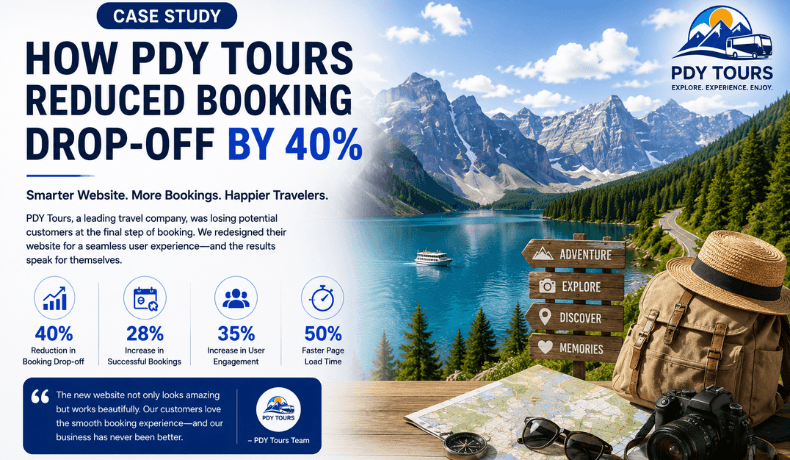
In the travel and tourism industry, attracting visitors to a website is only half the battle. The real challenge lies in converting those visitors into confirmed bookings. This case study explores how PDY Tours, a travel company specializing in tour packages and local travel experiences, improved its website experience and reduced booking drop-off by 40% through strategic website optimization, better user experience, and performance improvements.
When PDY Tours approached us, they were receiving a steady stream of visitors from search engines, social media, and digital marketing campaigns. Despite healthy traffic, the number of completed bookings was much lower than expected. Analytics revealed that many users abandoned the booking process before reaching the final confirmation page. The business was investing in marketing to attract potential customers, but a significant portion of those visitors were leaving without converting into paying customers.
To understand the problem, we conducted a complete website audit. We analyzed user behavior, page performance, mobile responsiveness, navigation flow, and booking funnel analytics. The findings showed several issues that were negatively affecting the customer experience. The booking process required too many steps, important information such as pricing and itinerary details was difficult to find, pages loaded slowly on mobile devices, and the call-to-action buttons were not prominent enough. Since many customers were browsing on smartphones, these usability issues created unnecessary friction during the booking journey.
The first step was simplifying the booking process. We reduced the number of steps required to complete a reservation and redesigned the booking form to collect only essential information during the initial stage. By eliminating unnecessary fields and presenting a cleaner interface, customers could complete their bookings more quickly and with less effort. This significantly reduced the number of users abandoning the process midway.
Next, we optimized the website's performance. Images were compressed without sacrificing quality, unnecessary scripts were removed, and page-loading speed was improved using modern web optimization techniques. Faster loading pages created a smoother browsing experience, particularly for mobile users, who represented a large percentage of the website's traffic. Research consistently shows that even a one-second improvement in loading speed can positively impact conversion rates, making performance optimization a crucial part of the project.
We also redesigned the tour package pages to make them more informative and visually engaging. Each package included clear pricing, detailed itineraries, destination highlights, customer testimonials, frequently asked questions, and high-quality images. Prominent "Book Now" and "Enquire Now" buttons were strategically placed throughout the pages, making it easier for visitors to take action without searching for the next step.
We also redesigned the tour package pages to make them more informative and visually engaging. Each package included clear pricing, detailed itineraries, destination highlights, customer testimonials, frequently asked questions, and high-quality images. Prominent "Book Now" and "Enquire Now" buttons were strategically placed throughout the pages, making it easier for visitors to take action without searching for the next step.
Search engine optimization (SEO) was implemented alongside the user experience improvements. Tour pages were optimized with relevant keywords, structured headings, meta descriptions, optimized images, and internal linking. These enhancements improved the website's visibility on search engines, attracting more qualified visitors who were actively searching for travel packages and local experiences.
Customer trust was strengthened by adding social proof throughout the website. Verified customer reviews, ratings, testimonials, secure payment indicators, and clear contact information reassured visitors that they were booking with a reliable travel company. Trust-building elements are particularly important in the tourism industry, where customers often make high-value purchasing decisions online.
Within a few months of implementing these improvements, PDY Tours experienced measurable results. The booking drop-off rate decreased by 40%, while completed bookings increased significantly. Mobile engagement improved, average session duration increased, and bounce rates declined as visitors found it easier to explore tour packages and complete their reservations. Organic traffic also grew steadily as the website began ranking for more location-specific travel keywords.
This case study demonstrates that increasing conversions does not always require additional advertising spend. In many cases, improving website usability, optimizing performance, simplifying customer journeys, and implementing strong SEO practices can produce substantial business growth. By focusing on the needs of users and removing obstacles from the booking process, PDY Tours transformed its website into a more effective sales and marketing platform.
For travel businesses, hotels, and tour operators, this success highlights the importance of continuously evaluating website performance and customer behavior. A fast, user-friendly, and SEO-optimized website not only attracts more visitors but also converts those visitors into loyal customers. Investing in user experience and conversion optimization is one of the most effective ways to maximize the return on digital marketing efforts and achieve sustainable business growth.